
Achroia grisella
(Fabricius, 1794)
Lesser Wax Moth
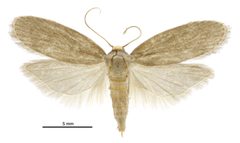
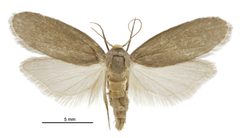
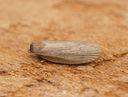
Achroia grisella, the lesser wax , is a pyralid moth and pest of colonies worldwide. It is smaller and less destructive than the greater wax moth (Galleria mellonella), primarily infesting weak or abandoned honey bee colonies where larvae feed on , pollen, honey, and cappings. The has a worldwide distribution in temperate and tropical regions where honey bees are kept, and its spread has been facilitated by human-mediated transport of equipment. are small grayish moths with distinctive yellow . The species is notable for its unusually simple directional ear, which enables acoustic localization for both avoidance and mate finding.
Pronunciation
How to pronounce Achroia grisella: /əˈkrɔɪə ɡrɪˈsɛlə/
These audio files are automatically generated. While they are not always 100% accurate, they are a good starting point.
Identification
Distinguished from the greater wax moth (Galleria mellonella) by smaller size: lesser wax moths are approximately half the size of greater wax moths. The yellow of A. grisella is a useful diagnostic feature. In larvae, A. grisella is smaller and creates less extensive damage than G. mellonella. Molecular identification via COI gene sequencing reliably separates the two , which form distinct monophyletic clades.
Images
Habitat
Primarily associated with colonies, particularly weak, queenless, or abandoned ones. Also found in stored equipment, unused combs, and honey bee nests. Occurs in both temperate and tropical climates where honey bees are maintained. Can persist in stored wax comb and hive debris outside active colonies.
Distribution
Worldwide distribution in temperate and tropical regions where honey bees (Apis mellifera) are kept. Present across North America, Europe, Asia, Africa, and introduced to many regions including Guam (first recorded 2019). Distribution closely tracks human activity; absent from areas with cold climates lacking colonies. GBIF records confirm presence in Belgium with established in Flemish and Walloon regions.
Seasonality
Multiple possible per year in warm climates, with development time varying by temperature. Activity year-round in tropical regions. are , with females entering hives one to three hours after dark to oviposit and leaving before daylight.
Diet
Larvae feed on , pollen, honey, cappings, and hive debris. Unlike the greater wax moth, does not typically consume pure beeswax efficiently; prefers materials contaminated with pollen and brood remains.
Host Associations
- Apis mellifera - pest ofWestern honey bee; primary . Infests weak or abandoned colonies.
Life Cycle
Complete with four stages: , larva, pupa, and . Females lay eggs in cracks and crevices of hive equipment or within colonies. Larvae tunnel through comb, creating silken galleries for protection. occurs in silken cocoons in protected locations. Development rate is temperature-dependent; in warm climates, multiple occur annually. Adult lifespan ranges from 3 to 30 days.
Behavior
activity pattern; avoid daylight. Females enter colonies at night to oviposit in cracks and crevices. Males produce ultrasonic advertisement signals to attract females; females exhibit directional hearing to locate calling males. Both sexes respond to bat echolocation calls by freezing or ceasing signaling. Males engage in agonistic contests over signaling stations, with contest winners characterized by earlier signaling initiation. When threatened by , males stop signaling and females freeze. Larvae construct silken tunnels while feeding, providing some protection from housecleaning bees.
Ecological Role
Pest of managed and colonies; contributes to colony decline in already stressed hives. In natural settings, plays role in decomposition of abandoned comb from feral honey bee nests. Serves as prey for various including Apanteles galleriae, Bracon brevicornis, and Trichogramma chilonis. Used as model organism in scientific research on , , and immune response.
Human Relevance
Economic pest of industry causing damage to stored comb and weak colonies. Beekeepers control through freezing of frames, airtight storage, and use of mothballs. Larvae raised commercially for fish , animal feed, and scientific research, particularly as alternative model for studying microbial . Subject of bio-inspiration research for acoustic sensing technology due to its simple directional ear structure. Spread facilitated by international trade in beekeeping equipment.
Similar Taxa
- Galleria mellonellaGreater wax moth; larger in size (approximately twice as large), more destructive to colonies, more efficient at consuming pure . Both are pyralid pests of colonies with similar but differ in severity of damage and colony condition preferences.
More Details
Acoustic Biology
Possesses one of the simplest known directional ears in insects, consisting of only four receptor attached directly to the tympanic . Capable of monoaural directionality—can localize sound sources using a single ear. This unusual hearing system has been repurposed from ancestral bat-avoidance function to serve mating communication, with males producing ultrasonic signals and females using directional hearing to locate them.
Sexual Selection Research
Well-studied model for research. Female choice based on male ultrasonic signal traits; male-male competition occurs over signaling stations. Studies demonstrate that risk modulates both male signaling and female mate choice, with attractive males taking greater risks and females abandoning preferences when attractive signals carry higher predation risk. Inter- and intra-sexual selection appear to act on uncorrelated traits.
Genetic Diversity
Global show moderate haplotype diversity (h = 0.834) with relatively low diversity (π = 0.00996). Population expansion not detected, suggesting stable historical population sizes. Thai populations show lower diversity (h = 0.467, π = 0.00150) compared to global .
Sources and further reading
- BugGuide
- GBIF taxonomy match
- iNaturalist taxon
- NCBI Taxonomy
- Catalogue of Life
- Why These Moths Are Unwanted | Bug Squad
- National Moth Week: Here's One Moth that Beekeepers Won't Celebrate | Bug Squad
- How One Entomologist Works to Combat Invasive Species and Protect Honey Bees on Guam
- Lesser Wax Moth Achroia grisella Fabricius (Insecta: Lepidoptera: Pyralidae)
- THE OVIPOSITION BEHAVIOUR OF ACHROIA GRISELLA (FABRICIUS) (LEPIDOPTERA: GALLERIIDAE)
- Finding each other: Achroia grisella’s oddly simple directional ear
- Achroia grisella’s ear as inspiration for acoustic sensing
- Azadirachtine maruz kalan Achroia grisella (Fabricius, 1794) (Lepidoptera: Pyralidae) larvalarında ölüm oranı, gelişim biyolojisi ve hücresel bağışıklık tepkileri
- PARASITISATION POTENTIAL OF EGG AND LARVAL PARASITOIDS AGAINST LESSER WAX MOTH Achroia grisella F. (LEPIDOPTERA: PYRALIDAE) UNDER STORED CONDITION
- Genetic Diversity and Demographic History of Wax Moths, Galleria mellonella Linnaeus, 1758 and Achroia grisella Fabricius, 1794 (Lepidoptera: Pyralidae)
- The influence of predation risk on mate signaling and mate choice in the lesser waxmoth Achroia grisella
- Observations on the Biology and Larval Instars Discrimination of Wax Moth Achroia grisella F. (Pyralidae: Lepidoptera)
- STUDY OF THE RELATIONSHIP BETWEEN ACHROIA GRISELLA (LEPIDOPTERA: PYRALIDAE) AND ITS PARASITOID APANTELES GALLERIAE (HYMENOPTERA: BRACONIDAE)
- Reproductive Behaviour of the Lesser Waxmoth, Achroia Grisella (Pyralidae: Galleriinae): Signalling, Pair Formation, Male Interactions, and Mate Guarding
- Partitioning the Components of Sexual Selection: Attractiveness and Agonistic Behaviour in Male Wax Moths, Achroia grisella (Lepidoptera: Pyralidae)