
Galleriinae
wax moths, snout moths
Tribe Guides
4The Galleriinae are a of snout moths (Pyralidae) with approximately 306 described distributed worldwide. This subfamily includes the commercially significant wax , whose larvae (waxworms) are mass-produced as pet food and fishing . Several species are economically important pests: wax moths (Achroia and Galleria) damage honeybee colonies, while others such as the rice moth (Corcyra cephalonica) infest stored food products. The subfamily exhibits notable morphological diversity, with five recognized tribes including the recently described Joelminetiini (2007).
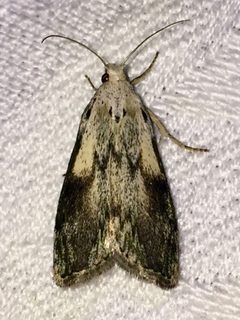
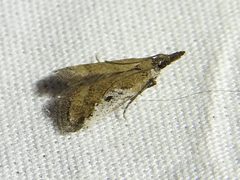
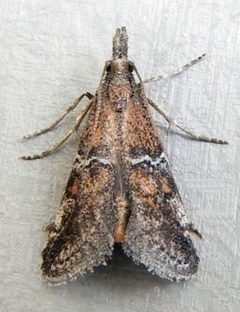
Pronunciation
How to pronounce Galleriinae: /ɡælərɪˈaɪnaɪ/
These audio files are automatically generated. While they are not always 100% accurate, they are a good starting point.
Identification
Larvae possess a sclerotised ring around the base of seta SD1 on the first abdominal segment. Pupae are distinguished from other Pyralidae by a prominent midline ridge along the and . males have a reduced or absent gnathos in the genitalia. Adults may lack ocelli and —unusual for Pyralidae—but retain the -characteristic large labial palps forming a 'snout'.
Images
Habitat
Diverse including colonies and , stored food product facilities, and natural environments. Some are in Hymenoptera nests, particularly (bees and relatives).
Distribution
Essentially worldwide; distribution in many cases facilitated by human-mediated introduction.
Host Associations
- Apis mellifera - pest in honeycombsprincipal for wax including Galleria mellonella and Achroia grisella
- Cassia fistula - larval plantreported for Galleria mellonella in India; previously unknown association
- stored food products - pestCorcyra cephalonica (rice ), Paralipsa, and related
- beeswax combs - larval food sourceAchroia grisella and related wax-feeding
Life Cycle
Complete with , larva, pupa, and stages. In Galleria mellonella: egg incubation 4–10 days (mean 7.2 days), eight larval instars lasting ~39 days, pupal period ~9 days, adult lifespan up to 8 days. Total approximately 39 days under laboratory conditions (28°C, 76% RH). occurs in silk cocoons spun within the substrate.
Behavior
Males produce high-frequency chirping sounds using their tegulae, with some generating structured 'mating songs' detectable only with specialized bioacoustic equipment. In Achroia grisella, males produce ultrasonic advertisement signals (70–100 kHz) via wing-fanning; females exhibit phonotaxis to these calls. Males engage in interference competition through acoustic jamming and physical displacement of rivals. Post-copulatory mate guarding occurs, with duration positively correlated with female . Some species are in nests, tolerated to varying degrees by colonies.
Ecological Role
and consumers of , honey, pollen, and stored organic materials. Some function as or in Hymenoptera nests. Significant pests of apiculture and stored product industries. Corcyra cephalonica are used commercially to rear Trichogramma for of lepidopteran crop pests in over 30 countries.
Human Relevance
Major economic importance in apiculture as pests of honeybee colonies (Galleria mellonella, Achroia grisella). Waxworms are commercially mass-reared as food for pets (reptiles, birds, small mammals) and as fishing . Stored product pests cause agricultural and food industry losses. Used in scientific research: Galleria mellonella serves as a model organism for studying insect and as an alternative for . Corcyra cephalonica supports industries through Trichogramma production.
Similar Taxa
- ChrysauginaeMay be closest living relatives; shares many plesiomorphic traits including convergent reduction or loss of the male gnathos. Distinguished by different larval and pupal .
- PhycitinaeMost -rich snout moth ; Galleriinae has fewer species but greater tribal diversity (5 vs. fewer tribes in Phycitinae). Phycitinae larvae lack the characteristic sclerotised ring on abdominal segment 1.
- PyralinaeCore snout moth ; typically retain well-developed and ocelli, unlike many Galleriinae.
Sources and further reading
- BugGuide
- Wikipedia
- iNaturalist taxon
- NCBI Taxonomy
- Catalogue of Life
- Pyraloidea: Pyralidae: Epipaschiinae, Galleriinae, Phycitinae, Pyralinae, undetermined subfamily
- Biological cycle of the greater wax moth Galleria mellonella (Linnaeus, 1758) (Lepidoptera: Pyralidae: Galleriinae) in Panama
- Reproductive Behaviour of the Lesser Waxmoth, Achroia Grisella (Pyralidae: Galleriinae): Signalling, Pair Formation, Male Interactions, and Mate Guarding
- Gonadotrophic effects of RH-5849, a non-steroidal ecdysone agonist on the rice moth Corcyra cephalonica St. (Lepidoptera: Galleriinae)
- Report of a New Larval Host Plant of Galleria mellonella (Linnaeus, 1758) from Kolkata, West Bengal, India (Lepidoptera: Pyralidae, Galleriinae)
- The exocrine glands of the male of Eldana saccharina walker (Lepidoptera, galleriinae): Intervention in precopulatory behavior