
Habrobracon hebetor
(Say, 1836)
Habrobracon hebetor is a minute braconid and gregarious ectoparasitoid of lepidopteran larvae. Females paralyze caterpillars with venom and lay up to 45 externally on the host body; larvae feed on host , leaving only the . One develops in 9–14 days under optimal conditions of 25–30°C and 70–80% relative humidity. The is widely used in programs against stored-product pests and field crop pests, with mass-reared releases achieving 70–90% biological efficacy. It exhibits high genetic diversity across geographic and can enter for cold storage.

Pronunciation
How to pronounce Habrobracon hebetor: /hæbroʊˈbrækɒn ˈhiːbɪtɔr/
These audio files are automatically generated. While they are not always 100% accurate, they are a good starting point.
Identification
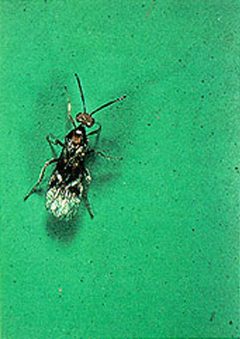
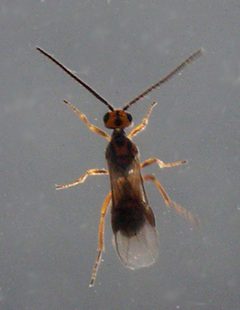
Minute in Braconidae. Distinguishable from similar braconid by its gregarious ectoparasitoid habit—females lay multiple externally on paralyzed caterpillars rather than internally. Ovipositor structure includes paired valvilli that divert eggs ventrally between first valvulae. color mutations have been documented and used in genetic studies. Sex determination is haplodiploid (males haploid, females ).
Images
Habitat
Apple orchards; stored grain and legume warehouses; open fields for biological protection of tomato, corn, soybeans, cotton, sunflower, and other crops. Present in all stations during growing season, with observed between them.
Distribution
India, Pakistan, South Africa, Egypt, Canada, Western Europe, Central Asia, southern Russia (Krasnodar Krai, Stavropol Krai), Crimea, Transcaucasia, the Caucasus, Ukraine, Moldova, Hawaii, and the conterminous United States. Distribution records include São Miguel and Brazil.
Seasonality
In the Sahelian region of Africa, releases coincide with onset of summer and of pearl millet miner (Helicochilus albipunctella). Active during growing season in agricultural settings; can be induced at 12°C with short (8L:16D) for cold storage.
Diet
Larvae feed exclusively on of paralyzed caterpillars. may feed on pollen; pollen diets (particularly almond, date, rapeseed, and honeybee pollen) significantly increase and growth parameters, though pollen does not significantly affect adult longevity.
Host Associations
- Cydia pomonella - codling moth, natural can reduce abundance by 22–35%
- Plodia interpunctella - Indian mealmoth, well-known commercial
- Ephestia kuehniella - Mediterranean flour moth
- Cadra calidella - dried fruit moth
- Galleria mellonella - wax , most effective for mass breeding (195 produced vs. 98 for )
- Helicoverpa armigera - cotton bollworm
- Ostrinia nubilalis - European corn borer
- Helicochilus albipunctella - pearl millet miner
- Corcyra cephalonica - rice
- Spodoptera frugiperda - fall armyworm
- Wolbachia - endosymbiontintracellular bacterium inducing and affecting mate preference
Life Cycle
Development of one takes 9–14 days. hatch on paralyzed caterpillar; larvae feed externally on ; occurs on or near . lifespan at least 15 days under optimal conditions (25–30°C, 70–80% RH). can be induced at 12°C with 8L:16D , enabling cold storage at 5°C for up to 150 days with 70–80% survival. Non-diapausing have poor cold (20–30% survival at 150 days) and reduced post-storage longevity (2–3 days vs. 10–14 days for diapausing wasps).
Behavior
Female locates caterpillar , paralyzes it with venom, then lays externally on host body. Gregarious —single host can receive up to 45 eggs. Exhibits in storage warehouse environments. affects mate preference, with infected females showing altered mating behavior that increases transmission of the bacterium. occurs: crosses between cured females and infected males produce only male offspring.
Ecological Role
Idiobiont ectoparasitoid regulating of lepidopteran agricultural pests. Used extensively in programs for vegetable, fodder, fruit, and field crops, as well as stored products. Natural populations suppress pest caterpillar abundances by 22–45% depending on ; mass-reared releases at 1–3 thousand individuals/ha achieve 70–90% biological efficacy. Compatible with programs; certain (imidacloprid, thiacloprid) show lower and can be used alongside this .
Human Relevance
Commercial agent used worldwide for management of stored-product pests and field crop pests without chemical . Mass-rearing programs established in developing countries (Niger, India, Kenya, Tanzania) using low-cost methods such as gunny sacks with grain, larvae, and founder pairs. Used in combination with for control of Plodia interpunctella in chocolate factories. Serves as genetic model organism for studying haplodiploid inheritance and color genetics. Cold storage of diapausing wasps enables year-round availability for augmentative release programs.
Similar Taxa
- Trichogramma spp.Both are used in , but Trichogramma are parasitoids (endoparasitoids of lepidopteran eggs) whereas Habrobracon hebetor is a larval ectoparasitoid. Trichogramma are also much smaller (~0.3 mm) and used in inundative rather than inoculative approaches.
- Pteromalus cerealellaeBoth are used in post-harvest of stored products, but Pteromalus cerealellae is in Pteromalidae and has different searching and reproductive performance characteristics.
- Pediobius foveolatusBoth are used in , but Pediobius foveolatus is an introduced of Mexican bean beetle that requires re-release because it does not overwinter, representing 'inoculative ' rather than the more permanent establishment potential of H. hebetor.
More Details
Wolbachia Manipulation
High rates of occur in natural . The bacterium induces and alters mate preference to increase its transmission, resulting in increased and female offspring production in infected females. This endosymbiont relationship has implications for mass-rearing programs and population management.
Genetic Diversity
RAPD analysis of Krasnodar and Stavropol revealed high with intrapopulation variability of 87.1% and interpopulation variability of 12.9%. Limited (Nm = 3.298) and relatively low genetic identity (GI = 0.906) between populations suggest these represent distinct geographic populations with implications for strain selection in programs.
Tritrophic Effects
quality varies with host diet: H. hebetor performs best on corn-fed hosts (developmental time 10.76 days, survival 0.74, 91.2 offspring/female) compared to wheat- or barley-fed hosts, indicating importance of host rearing conditions in mass production.
Sources and further reading
- BugGuide
- GBIF taxonomy match
- iNaturalist taxon
- NCBI Taxonomy
- Catalogue of Life
- Why Augmentative Biological Control Holds Promise for Advancing Agriculture in Developing Countries
- Dispersal of the parasitoid Habrobracon hebetor in storage warehouses
- Biological Features and Molecular Genetic Structure of Habrobracon hebetor Populations
- Performance of diapausing parasitoid wasps, Habrobracon hebetor, after cold storage
- Identification of Neuropeptides and Their Receptors in the Ectoparasitoid, Habrobracon hebetor
- Ovipositor of the braconid wasp Habrobracon hebetor: structural and functional aspects
- Effects of methoxyfenozide and pyridalyl on the larval ectoparasitoid Habrobracon hebetor
- Adults Feeding on Pollen Diet Influence Biology and Life Table Parameters of the Ectoparasitoid, Habrobracon hebetor
- Potencial do ectoparasitoide >i<Habrobracon hebetor>/i< Say, 1857 (Hymenoptera: Braconidae) para controle biológico de treze espécies de lepidópteros-praga
- Habrobracon hebetor and Pteromalus cerealellae as Tools in Post-Harvest Integrated Pest Management
- Tritrophic effects of different cereal flour on life table parameters and population projection of Habrobracon hebetor (Hymenoptera: Braconidae)
- Wolbachia induce cytoplasmic incompatibility and affect mate preference in Habrobracon hebetor to increase the chance of its transmission to the next generation
- Residual Toxicity of Some Pesticides on the Larval Ectoparasitoid, Habrobracon Hebetor Say (Hymenoptera: Braconidae)
- Control ofPlodia interpunctellainfesting a chocolate factory: Combining mating disruption and the parasitoidHabrobracon hebetor
- Using a Haplodiploid Insect to Teach Inheritance: Eye Color Genetics of the Parasitoid Habrobracon hebetor
- Figure 4 from: Pezzini C, Jahnke SM, Köhler A (2017) Morphological characterization of immature stages of Habrobracon hebetor (Hymenoptera, Braconidae) ectoparasitoid of Ephestia kuehniella (Lepidoptera, Pyralidae). Journal of Hymenoptera Research 60: 157-171. https://doi.org/10.3897/jhr.60.20104