
Cydia pomonella
(Linnaeus, 1758)
Codling Moth
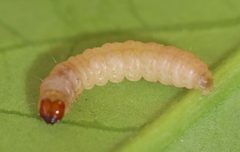
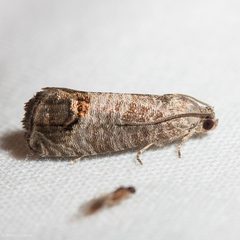
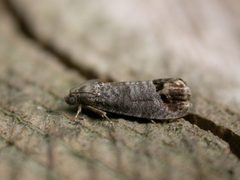
is a tortricid and major global pest of apple and pear orchards. The caterpillar, commonly known as the 'worm in the apple,' bores into fruit and prevents normal development, causing premature ripening and crop loss. are attracted to traps with limited plume reach, requiring multiple traps for reliable monitoring. The has been detected via environmental in yard waste shipments, highlighting its potential for human-mediated .
Pronunciation
How to pronounce Cydia pomonella: /ˈsɪdiə poʊməˈnɛlə/
These audio files are automatically generated. While they are not always 100% accurate, they are a good starting point.
Images
Habitat
Apple and pear orchards; ornamental crabapple trees in residential settings. Larvae develop within fruit. have been observed at blacklight traps in urban and suburban environments.
Distribution
Native to Eurasia; now . Present across Europe, North Africa, Middle East, Central Asia, South Asia, East Asia, Australasia (Australia, New Zealand), North America (Canada, USA), Central America (Mexico), and South America (Argentina, Bolivia, Brazil, Chile, Colombia, Peru, Uruguay).
Diet
Larvae feed internally on developing fruits of apple, pear, peach, apricot, almond, plum, quince, and walnut. Larvae cannot feed on leaves and are dependent on fruit as a food source.
Host Associations
- Malus - larval food plantapple
- Pyrus - larval food plantpear
- Prunus - larval food plantpeach, apricot, almond, plum
- Cydonia - larval food plantquince
- Juglans - larval food plantwalnut
Life Cycle
Complete . Larvae bore into fruit to feed and develop. occurs in soil or protected locations. emerge and mate; females deposit on or near fruit.
Behavior
Males orient to female (codlemone) with limited range; random movement plays significant role in trap capture. Courtship involves female wing fanning and movement toward males. are and attracted to lights.
Ecological Role
Major agricultural pest causing significant crop damage and economic loss in fruit orchards. Preyed upon by assassin bugs including Acholla .
Human Relevance
Primary pest of apple and pear production globally; management relies on monitoring, applications, and . Subject to border inspection and protocols. Environmental methods have been developed to detect presence in green yard waste shipments. Gene editing research (CRISPR/Cas9) targets odorant receptor genes for potential future control methods.
Similar Taxa
- Choristoneura fumiferanaBoth are tortricid moths, but spruce budworm feeds on conifers rather than fruit and has highly variable coloration
- Choristoneura conflictanaBoth in Tortricidae, but large aspen tortrix feeds on aspen, poplar, willow, and alder rather than fruit trees
More Details
Pheromone trap monitoring
Standard traps emit plumes reaching only about 5 meters. Line-trapping with five traps spaced 4 meters apart and averaged produces more reliable abundance estimates than single traps, reducing variability from 0-32 (single trap range) to 1-12 moths (line average range).
Gene function research
The CpomOR1 odorant receptor gene, expressed in male and female tip, is essential for production and viability—females with knocked-out CpomOR1 produce few eggs and none viable, suggesting role in preparation beyond detection.
Sources and further reading
- BugGuide
- GBIF taxonomy match
- iNaturalist taxon
- NCBI Taxonomy
- Catalogue of Life
- Odorant Receptor Gene in Codling Moth Also Affects Egg Production
- Line Trapping: A Promising Method for More Accurate Pest Monitoring
- Beetle in a Haystack: Environmental DNA Reveals Invasive Pest Incursions
- Bug Eric: Autumn Assassins: Acholla spp.
- New Management Methods Emerge for Walnut Husk Fly
- Bug Eric: My Personal National Moth Week, 2017
- Cydia pomonella . [Distribution map].
- Cydia pomonella . [Distribution map].
- The sublethal effects of methoxyfenozide on the field orientation and courtship behavior of Cydia pomonella (Linnaeus) (Lepidoptera : tortricidae)
- Identification of G Protein-Coupled Receptors (GPCRs) Associated with Lambda-Cyhalothrin Detoxification in Cydia pomonella
- Host-Specific Olfactory Plasticity in Cydia pomonella: Olfactory-Mediated Recognition of Walnut Volatiles Drives Oviposition Preference