
Plodia interpunctella
(Hübner, 1813)
Indian meal moth, Indianmeal moth, weevil moth, pantry moth, flour moth, grain moth
The is a pest of stored food products. are small slightly larger than ½ inch with distinctive wings banded white and rusty red. Larvae feed on grains, dried fruits, nuts, cereals, and pet foods, producing silk webbing and as conspicuous signs of . The completes its entirely within stored products or associated structures, with larvae capable of chewing through plastic packaging to access food.
Pronunciation
How to pronounce Plodia interpunctella: //ˌploʊdiə ˌɪntərpʌŋkˈtɛlə//
These audio files are automatically generated. While they are not always 100% accurate, they are a good starting point.
Identification
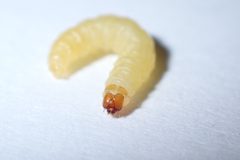
distinguished from similar stored product by wing pattern: basal third pale gray to white, outer two-thirds coppery brown to rusty red with darker banding. Slightly larger than ½ inch (approximately 13–16 mm wingspan). Larvae are cream-colored caterpillars with dark capsules, reaching up to 17 mm at maturity. Readily confused with almond moth (Cadra cautella) and raisin moth (Cadra figulilella), which share similar food sources and general appearance; precise identification requires examination of genitalia or wing venation. Mediterranean flour moth (Ephestia kuehniella) differs in having uniformly pale gray wings without contrasting bands.
Images
Habitat
Indoor environments associated with stored food products: pantries, cupboards, food warehouses, grain elevators, and retail food storage facilities. Also occurs outdoors in caches of nuts or seeds stored by squirrels or rodents. Thrives in warm, dry conditions typical of heated buildings.
Distribution
; occurs worldwide in association with human food storage. Present across North America, Europe, Asia, and other regions where stored products are maintained. Specific distribution records include the Azores (Faial, Flores, São Jorge, São Miguel, Terceira).
Seasonality
Year-round activity in heated indoor environments, with peaks often observed during late summer and autumn when wild populations may invade structures, and during winter holiday baking seasons when pantry activity increases. may enter homes during warm weather when doors and windows are open.
Diet
Larvae feed on diverse stored products rich in , fats, and proteins: grains, cereals, flour, dried fruits, nuts (cashews, sunflower seeds), seeds, spices, bread, pet foods, and processed grain products. Laboratory rearing uses ground rice, glycerin, brewer's yeast, and honey. do not feed.
Life Cycle
Complete with four stages. laid on food packaging surfaces or directly on food; females have been observed laying eggs on exterior of unopened plastic bags, with larvae entering through seams. Larvae feed internally on seeds or within food masses, spinning silken galleries from which they emerge to feed. Full-grown larvae become nomadic, leaving food sources to seek protected sites: cracks between shelves, jar lids, electrical sockets, baseboard seams, or walls and ceilings. Pupation occurs within silken cocoons. emerge from pupae to seek mates and new food sources. Development time varies with temperature and food quality; multiple per year in favorable conditions.
Behavior
Larvae produce extensive silk webbing that entangles and food particles, creating messy accumulations within infested containers. Larvae excavate seeds and generate conspicuous pellets of frass. Full-grown larvae chew holes through plastic, paper, and cardboard packaging to escape and locate sites. are strong fliers, active primarily during evening and night (scotophase), fluttering in zigzag patterns near food sources. Females exhibit calling during scotophase, releasing (primarily (Z,E)-9,12-tetradecadienyl acetate) to attract males. Calling behavior and production are regulated by PBAN (pheromone biosynthesis activating neuropeptide) and can be inhibited by octopamine receptor agonists. Males are attracted to female pheromone from distances of many feet.
Ecological Role
Pest of stored food products; significant economic impact through and consumption of human and animal food supplies. Serves as for including ichneumonids in the Mesostenus (e.g., M. gracilis), which are important agents. Recently discovered ability of larvae to degrade polyethylene suggests potential value in plastic waste bioremediation, though this remains experimental.
Human Relevance
Major household and commercial pest causing substantial economic losses in stored products. detected by presence of flying , silk webbing, , or larvae in food containers. Control relies on : removing infested products, vacuuming storage areas, sealing cracks and crevices, and proper food storage in airtight containers. traps containing synthetic female attract and capture males, serving as monitoring tools to detect incipient infestations. "Deep chill" treatment (one week freezing, one week thaw, one week freezing) can salvage suspect unopened packages by killing and larvae. Larval toxins may cause allergic reactions in sensitive individuals.
Similar Taxa
- Cadra cautella (almond moth)Shares similar food sources and general appearance; requires genitalia or wing venation examination for reliable separation.
- Cadra figulilella (raisin moth)Overlaps in and food preferences; morphological similarity creates identification challenges.
- Ephestia kuehniella (Mediterranean flour moth)Common pest of stored grains but distinguished by uniformly pale gray wings lacking the contrasting white and rusty red banding of .
Sources and further reading
- BugGuide
- GBIF taxonomy match
- iNaturalist taxon
- NCBI Taxonomy
- Catalogue of Life
- Pantry raiders: Indian meal moth, Plodia interpunctella — Bug of the Week
- Pantry surprises - Indian meal moth, Plodia interpunctella — Bug of the Week
- Small, whitish moths in the pantry? Could be Indian meal moth, Plodia interpunctella — Bug of the Week
- Pantry raid - Indian meal moth, Plodia interpunctella — Bug of the Week
- Bug Eric: Wasp Wednesday: Mesostenus
- Bug Eric: Beat The Winter Blues With An Indoor Bug Hunt
- Inhibitors of calling behavior of Plodia interpunctella
- Indianmeal Moth, Plodia interpunctella (Hübner) (Insecta: Lepidoptera: Pyralidae)
- Inhibitors of calling behavior of Plodia interpunctella
- Indian meal moth (Plodia Interpunctella Hübner, 1813) and human ecology
- Comportamento de oviposição de Plodia interpunctella / (Lepidoptera: Pyralidae) com difentes escolhas Oviposition behaviour of the Plodia interpunctella (Lepidoptera: Pyralidae) with different choices
- Electrophysiological and Behavioral Responses of Plodia interpunctella (Hubner) Females to Aldehyde Volatiles from Dried Fruits
- Biology and Host Range of Plodia interpunctella Hubner (Pyralididae: Lepidoptera)
- Behavioral Effect of a Sex Pheromone Extracted from Forewings of Male Plodia interpunctella 12
- Studies on the Ecological Life History of the Indian-Meal Moth, Plodia interpunctella HÜBNER
- Effects of Two Varieties of Bacillus thuringiensis Maize on the Biology of Plodia interpunctella