
Cadra cautella
(Walker, 1863)
Almond moth, Tropical warehouse moth
Cadra cautella, commonly known as the almond or tropical warehouse moth, is a small stored-product pest in the Pyralidae. It infests flour, bran, oats, and other grains, as well as dried fruits. The is frequently confused with the Indian mealmoth (Plodia interpunctella) and Mediterranean flour moth (Ephestia kuehniella). Males exhibit specialized in response to female plumes, maintaining upwind flight even at high pulse frequencies.
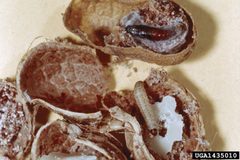
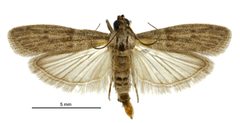
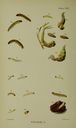
Pronunciation
How to pronounce Cadra cautella: /ˈkædrə kɔːˈtɛlə/
These audio files are automatically generated. While they are not always 100% accurate, they are a good starting point.
Identification
May be confused with Plodia interpunctella (Indian mealmoth) or Ephestia kuehniella (Mediterranean flour moth); specific diagnostic features distinguishing it from these common pantry pests are not provided in available sources.
Images
Habitat
Stored product environment, specifically associated with grain storage facilities and dried food commodities.
Distribution
distribution associated with stored products; records include Faial, Flores, São Miguel, Terceira (Azores), and Galápagos Islands.
Diet
Larvae feed on flour, bran, oats, other grains, and dried fruits. Can complete development on cocoa bean and cocoa powder, with slower development observed on cocoa powder compared to cocoa bean.
Life Cycle
Development slower on cocoa powder compared to cocoa bean; larvae complete development on both cocoa bean and cocoa powder substrates.
Behavior
Males exhibit oriented toward female plumes. In wind tunnel experiments, males increased flight duration and path length in pulsed plumes compared to continuous plumes, with flight tracks becoming more tortuous at higher pulse frequencies. Males maintained upwind flight regardless of plume structure, even at pulse frequencies up to 25 filaments per second.
Ecological Role
Notable stored product pest causing detrimental loss on stored cocoa and other dried commodities.
Human Relevance
Significant pest of stored food products including grains, flour, and dried fruits. risk higher for cocoa powder than cocoa bean based on development rate studies.
Similar Taxa
- Plodia interpunctellaAlso a common pantry pest; frequently confused with C. cautella in identification.
- Ephestia kuehniellaMediterranean flour moth, another common stored product pest that resembles C. cautella.
More Details
Reproductive physiology
The bursa copulatrix plays a role in oosorption, the process of resorption where developed are broken down and resorbed rather than being laid. Staining studies showed a direct correlation between stain intensity in the bursa copulatrix and the number of oocytes digested.
Pheromone response mechanism
Unlike some tortricid moths that are inhibited by homogeneous clouds, C. cautella males maintain upwind progress even at plume frequencies of 25 filaments per second, suggesting either enhanced sensory resolution or reduced dependence on signal flickering for orientation.
Sources and further reading
- BugGuide
- GBIF taxonomy match
- iNaturalist taxon
- NCBI Taxonomy
- Catalogue of Life
- Blacklighting at the Bohart: They Saw the Light | Bug Squad
- What Will You See at Bohart Museum Open House | Bug Squad
- Oh, What a (Moth) Night! | Bug Squad
- Mark Your Calendar for 'Moth Night' at Bohart Museum: July 30 | Bug Squad
- A Night at the Bohart Museum: Moth Night on Saturday, July 22 | Bug Squad
- If Cinderella Were a Moth... | Bug Squad
- ROLE OF BURSA COPULATRIX IN OOSORPTION IN CADRA CAUTELLA (LEPIDOPTERA: PYRALIDAE)
- Flight behaviour of Cadra cautella males in rapidly pulsed pheromone plumes
- Survival and development of Cadra cautella (Walker) (Lepidoptera: Pyralidae) on cocoa bean and cocoa powder
- Feeding Effects of three Verities of Date fruits on the Biology of Cadra cautella (Walker) (Lepidoptera: Pyralidae)