
Mesostenus
Gravenhorst, 1829
Species Guides
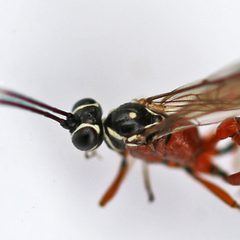
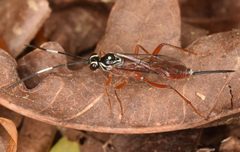
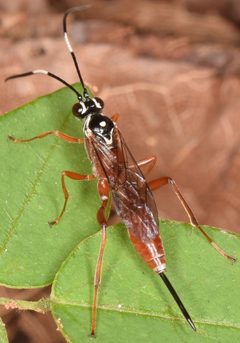
3Mesostenus is a of ichneumon wasps in the Ichneumonidae, currently comprising approximately 60-61 described worldwide. These small (6-13 mm) are characterized by bold black, white, and red coloration. Females possess a long, tail-like ovipositor used to lay in caterpillars, while males lack this structure. The genus has a nearly global distribution with ten species recorded in North America north of Mexico.
Pronunciation
How to pronounce Mesostenus: /mɛˈsɒstɛnəs/
These audio files are automatically generated. While they are not always 100% accurate, they are a good starting point.
Identification
Distinguished from similar ichneumonid by the combination of small size, bold black-white-red color pattern, and in females, the prominent elongated ovipositor. The genus belongs to Cryptinae, but -level identification requires examination of detailed morphological characters. Sexes easily separated by presence (female) or absence (male) of the external ovipositor.
Images
Appearance
Small measuring 6-13 mm in body length. Boldly marked with contrasting patterns of black, white, and red. Females possess a conspicuous long, tail-like ovipositor extending from the tip. Males lack an ovipositor, providing clear . long and multi-segmented, typical of ichneumonid wasps.
Habitat
Associated with flowering plants, particularly sunflowers (Helianthus spp.), where visit extrafloral . Some show specific plant associations; for example, Mesostenus sicarius is closely tied to prickly-pear cacti (Opuntia spp.). include open, sunny environments where caterpillars occur on vegetation.
Distribution
Nearly worldwide in distribution. Ten documented in North America north of Mexico, with at least four species present in Colorado. First records from Colombia (Mesostenus hypsipylaphagous) and Iraq (Mesostenus transfuga) indicate broad geographic range spanning multiple continents.
Seasonality
active during summer months in temperate regions, with observations in Colorado during August. Activity coincides with flowering of plants and availability of nectar sources.
Host Associations
- Acrobasis spp. - Stem-boring and shoot-boring caterpillars in Pyralidae
- Plodia interpunctella - Indianmeal Moth, a stored product pest
- Euzophera semifuneralis - American Plum Borer; caterpillars feed beneath bark
- Homoeosoma electella - Sunflower Moth caterpillar
- Hypsipyla grandella - Shoot borer of Meliaceae; of Mesostenus hypsipylaphagous
- Crambidae (family) - Caterpillars of grass moths
- Tortricidae (family) - Caterpillars of leafroller moths
Life Cycle
Developmental stages include , larva, pupa, and . Females use the long ovipositor to insert eggs into caterpillars. Larvae develop as internal , eventually killing the host. Specific details on developmental duration and stages vary by and remain undocumented for most species in the .
Behavior
frequently visit extrafloral on sunflowers and other plants to feed on secreted sugars. While foraging for nectar, they actively avoid aggressive ants that defend these food sources. Persistent in returning to nectar sources despite disturbance. Females use their elongated ovipositors to probe into plant stems, bark crevices, or other concealed locations to locate and parasitize caterpillars.
Ecological Role
Primary role as of lepidopteran caterpillars, particularly in Pyralidae, Crambidae, and Tortricidae. Serves as a agent for several agricultural and forestry pests, including stored product pests and shoot borers. influenced by availability of flowering plants providing food resources.
Human Relevance
Valued as agents for pest management in agriculture and forestry. Mesostenus gracilis and related help suppress of the Indianmeal Moth and other stored product pests. Potential for use in programs targeting shoot borers in Meliaceae. Misidentification of the female ovipositor as a stinger causes unnecessary human alarm, though the are harmless and cannot sting.
Similar Taxa
- Other Cryptinae generaSimilar body plan and coloration; distinguished by specific combinations of color pattern, ovipositor length, and morphological details of and wing venation
- Other small IchneumonidaeSize overlap and general appearance; Mesostenus distinguished by the distinctive bold black-white-red pattern and association with specific
Misconceptions
The female ovipositor is frequently mistaken for a stinger, leading to fear and misidentification as a dangerous . The structure is solely for -laying and cannot deliver venom. These wasps are harmless to humans and beneficial for pest control.
More Details
Taxonomic History
established by Gravenhorst in 1829. Revised by Cushman in 1929 for North American fauna. count varies between sources (50-61 described species), reflecting ongoing taxonomic work and new species descriptions.
Research Opportunities
associations remain unknown for most in the . Rearing of caterpillars, particularly in Pyralidae, Crambidae, and Tortricidae, may yield valuable new host records and contribute to understanding of species .
Sources and further reading
- BugGuide
- Wikipedia
- iNaturalist taxon
- NCBI Taxonomy
- Catalogue of Life
- Bug Eric: Wasp Wednesday: Mesostenus
- A new species of Mesostenus Gravenhorst (Hymenoptera: Ichneumonidae: Cryptinae) from Colombia
- New report of Mesostenus transfuga Gravenhorst, 1829 (Ichneumoni-dae - Hymenoptera) from Karbala Province in Iraq