
Euzophera semifuneralis
(Walker, 1863)
American plum borer, American Plum Borer Moth
Euzophera semifuneralis, the American plum borer, is a North American in the Pyralidae. It is a significant pest of stone and pome fruit trees, as well as other broadleaf trees. The completes 1–3 per year depending on latitude, with larvae mining galleries in the cambium layer of trees and as mature larvae in silken cocoons beneath the bark.
Pronunciation
How to pronounce Euzophera semifuneralis: /juːˈzɒfərə ˌsɛmɪfjʊˈnɪərəlɪs/
These audio files are automatically generated. While they are not always 100% accurate, they are a good starting point.
Identification
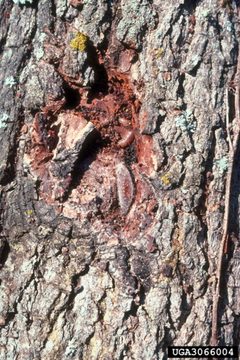
Distinguished from related Pyralidae by association with cambium-mining larvae in fruit trees and broadleaf . may be confused with other small pyralid moths; identification to often requires examination of genitalia or larval host association. Larvae produce abundant in irregular cambium galleries, a trait shared with some other borers but combined with specific host range and geographic distribution.
Images
Appearance
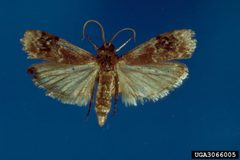
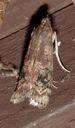
Small with wingspan 17–28 mm. have narrow, elongated forewings typical of Pyralidae. Coloration includes grayish-brown tones with darker markings.
Habitat
Found in cultivated orchards, ornamental plantings, and natural stands of trees. Larvae inhabit the cambium layer of stems and branches, particularly in areas with bark cracks, mechanical wounds, frost damage, cankers, or graft unions. Young trees are vulnerable at the lower stem and root collar. Burrknots on apple rootstocks provide entry points.
Distribution
Native to North America: United States (throughout), southern Canada, and parts of Mexico. One established non-native in Türkiye. Not present in the European Union.
Seasonality
emerge April–May. One per year in parts of Canada; two to three generations per year in southern United States and Mexico. Overlapping generations in southern range result in larvae present throughout the growing season.
Diet
cambium feeder. Larvae mine galleries in bark and cambium layer of trees, feeding horizontally and girdling branches or trunks.
Host Associations
- Prunus domestica - primary plum
- Prunus avium - primary sweet cherry
- Prunus persica - peach
- Prunus armeniaca - apricot
- Prunus dulcis - almond
- Malus domestica - apple
- Pyrus communis - pear
- Juglans nigra - black walnut
- Morus alba - white mulberry
- Morus nigra - black mulberry
- Olea europaea - olive
- Punica granatum - pomegranate
Life Cycle
Four stages: , larva, pupa, . Egg development: 8–14 days. Larval stage: 4–6 weeks. Pupal stage: 10–18 days in summer, 20–30 days in spring. Females deposit 12–74 eggs singly on twigs and young stems or in small groups in bark cracks, wounds, grafts, frost damage, or cankers. Larvae mine irregular horizontal galleries in cambium, producing abundant . Overwinters as mature larva in white silken cocoon constructed under bark. occurs within cocoon.
Behavior
Larvae bore into bark and mine irregular galleries in cambium, feeding horizontally and girdling main branches or entire trunk. Produces large amounts of that may accumulate at gallery openings. are generally unable to fly long distances. has been identified and is commercially available for detection and monitoring.
Ecological Role
Pest of cultivated and ornamental broadleaf trees. the plant pathogenic fungus Ceratocystis fimbriata. Serves as for including Mesostenus gracilis (Ichneumonidae).
Human Relevance
Significant economic pest of stone fruits (plum, cherry, peach, apricot, almond) and pome fruits (apple, pear). Also affects walnut, mulberry, olive, and pomegranate. Damage from larval feeding and girdling reduces tree vigor and productivity. Ceratocystis fimbriata, a fungal causing canker . used for monitoring and management in programs.
Similar Taxa
- Euzophera bigellaRelated congeneric ; may overlap in distribution and use but differs in specific host associations and geographic range details
- Acrobasis spp.Other Phycitinae with larval boring habits; distinguished by specificity and gallery architecture
- Synanthedon spp.Clearwing moths (Sesiidae) with similar borer but have -mimic appearance with clear wings and different activity
More Details
Parasitoid relationships
Larvae are parasitized by ichneumon Mesostenus gracilis, which uses its long ovipositor to insert through bark into cambium-dwelling caterpillars. This also attacks other Pyralidae including Plodia interpunctella (Indianmeal moth) and Acrobasis spp.
Invasion history
Only one non-native known, established in Türkiye. Not considered established in the European Union despite potential introduction risk through plant trade.
Detection methods
(Z)-9-tetradecenyl acetate and related compounds identified and commercially synthesized for monitoring traps.