
Euzophera
Zeller, 1867
snout moths
Species Guides
5- Euzophera aglaeella
- Euzophera magnolialis(magnolia root borer)
- Euzophera ostricolorella(Root Collar Borer Moth)
- Euzophera semifuneralis(American plum borer)
- Euzophera vinnulella
Euzophera is a of snout moths (Pyralidae) established by Philipp Christoph Zeller in 1867. The genus comprises approximately 70 described distributed across multiple continents, with larvae that typically bore into plant tissues. Several species are economically significant agricultural pests, including stem borers of solanaceous crops and fruit borers of pomegranate. The genus exhibits considerable diversity in plant associations, ranging from monophagous to oligophagous within particular plant .
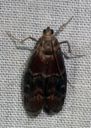
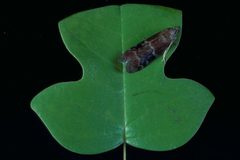
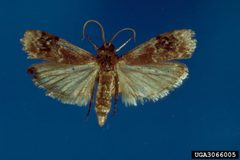
Pronunciation
How to pronounce Euzophera: /ɛuˈzɒfɛrə/
These audio files are automatically generated. While they are not always 100% accurate, they are a good starting point.
Images
Habitat
vary by and are closely tied to plant availability. Agricultural species inhabit orchards, vegetable fields, and cultivated areas; E. perticella occurs in brinjal/eggplant fields, E. punicaella in pomegranate orchards, and E. ostricolorella in yellow-poplar stands. Non-pest species occupy natural and semi-natural environments corresponding to their host plants.
Distribution
Widespread across the Palearctic, Nearctic, Oriental, and Afrotropical regions. Documented from Europe (including Scandinavia: Denmark, Norway, Sweden), North America (United States, including Vermont), Central Asia, South Asia, and Africa. Specific ranges vary considerably by ; some are restricted endemics while others are broadly distributed.
Seasonality
Multivoltine observed in studied . E. osseatella exhibits four overlapping annually: winter generation (mid-October to early May), spring generation (early April to late July), summer generation (early June to mid-September), and autumn generation (mid-August to mid-November). E. perticella activity occurs from February through October, with peak damage in June-July.
Host Associations
- Solanum melongena (brinjal/eggplant) - primary E. perticella; larvae bore into stems causing wilt and stunted growth
- Solanum tuberosum (potato) - secondary E. perticella; occasional
- Lycopersicon esculentum (tomato) - secondary E. perticella; occasional
- Capsicum spp. (chilli) - secondary E. perticella; occasional
- Punica granatum (pomegranate) - primary E. punicaella; larvae develop inside fruits
- Liriodendron tulipifera (yellow-poplar/tuliptree) - primary E. ostricolorella; root collar and stem borer
- Artemisia absinthium (absinthe wormwood) - primary E. cinerosella; monophagous in native European range
- Artemisia vulgaris (mugwort) - E. cinerosella; supports development in laboratory
- Various North American Artemisia species - potential E. cinerosella; laboratory development confirmed, precluding biocontrol use in Canada
- Solanum spp. (nightshades) - primary E. osseatella; preferred in U.A.R./Egypt
- Prunus americana (American plum) - E. semifuneralis; larvae feed beneath bark
- Helianthus spp. (sunflowers) - indirect associationE. semifuneralis; caterpillars visited by at extrafloral
Life Cycle
Developmental documented for several . E. osseatella: stage 3–13 days, larval stage 24–159 days, pre-pupal stage 2–15 days, pupal stage 7–24 days, longevity 1–15 days; total 41–190 days with temperature-dependent duration. E. perticella: oviposition period 4–11 days, incubation 3–9 days, larval period 29–47 days, pupal period 7–14 days; adult longevity 4–8 days (males), 5–13 days (females). E. osseatella females lay 54–352 eggs (mean 158.3) under laboratory conditions (26.3°C, 69% RH), with pre-oviposition period 0–3 days and oviposition period 1–11 days. Larval feeding typically internal: stem borers, root collar borers, or fruit borers.
Behavior
Larvae exhibit internal feeding , tunneling within plant tissues. E. perticella larvae bore into eggplant stems, causing characteristic wilting, drooping, and yellowing of shoots; damage is more severe in ratoon and grafted crops. E. punicaella larvae develop entirely within pomegranate fruits, rendering chemical control ineffective. E. ostricolorella larvae bore at the root collar and lower stem of yellow-poplar. of some are attracted to extrafloral , where they are subject to aggressive defense.
Ecological Role
Herbivores; several function as significant agricultural pests reducing crop yield and quality. E. perticella causes 13.5–89.7% stem damage in brinjal crops seasonally. E. punicaella reduces pomegranate export quality and yield. Some species serve as for including ichneumonids (Mesostenus gracilis, Pristomerus euzopherae) and braconids (Bracon hebetor), contributing to local . E. cinerosella was evaluated and rejected as a biocontrol agent for Artemisia absinthium in Canada due to unacceptably broad host range including native Artemisia species.
Human Relevance
Several are economically important crop pests requiring . E. perticella is a major pest of brinjal in India, particularly in Tamil Nadu and West Bengal. E. punicaella is a key pest of pomegranate in Central Asia, especially Uzbekistan. E. semifuneralis (American plum borer) and E. ostricolorella (tuliptree borer, root collar borer) are North American forest and orchard pests. Management strategies include using Trichogramma species and Bracon hebetor, cultural practices, and limited application. The concealed larval habit makes chemical control challenging and favors biological and cultural approaches.
Similar Taxa
- AcrobasisBoth are pyralid moths with stem-boring or shoot-boring larvae; share (Mesostenus) as natural enemies
- Plodia interpunctella (Indianmeal moth)Stored product pest in same ; shares (Mesostenus) with Euzophera semifuneralis
- Homoeosoma electella (sunflower moth)Pyralid with caterpillars that are for Mesostenus also associated with Euzophera
More Details
Taxonomic authority
The was established by Philipp Christoph Zeller in 1867. The authority is sometimes cited as 'Zeller, 1867' in taxonomic databases.
Subgeneric classification
The includes three subgenera: Euzophera (sensu stricto), Cymbalorissa Gozmány, 1958, and several with unknown subgeneric placement. Subgenus Cymbalorissa contains E. fuliginosella (Heinemann, 1865).
Economic pest species
Notable pest include: E. perticella (brinjal stem borer), E. punicaella (pomegranate fruit borer), E. semifuneralis (American plum borer), E. ostricolorella (tuliptree borer, root collar borer), and E. osseatella (eggplant pest in North Africa/Middle East).
Biological control context
E. cinerosella was investigated as a potential biocontrol agent for absinthe wormwood (Artemisia absinthium) in Canada but rejected due to laboratory-demonstrated ability to develop on multiple North American Artemisia , posing unacceptable risk to native flora.
Sources and further reading
- BugGuide
- Wikipedia
- GBIF taxonomy match
- iNaturalist taxon
- NCBI Taxonomy
- Catalogue of Life
- Bug Eric: Wasp Wednesday: Mesostenus
- Biology of Euzophera ostricolorella on Yellow-Poplar in Tennessee
- Annual Generations and Life History of Euzophera osseatella Treit. (Lepid., Pyralidae)
- Euzophera Punicaella Mooze (Lepidoptera) bioecology and development of host entomophagic equilibrium in biocenosis
- Life History and Control of a Root Collar Borer (Euzophera ostricolorella Hulst) in Yellow-Poplar
- BIOLOGY OF DEVELOPMENT AND PHYSIOLOGY OF THE APSHERON POPULATION OF POMEGRANATE EUZOPHERA PUNICAELLA MOORE (LEPIDOPTERA, PYRALIDIDAE)
- Biology and Control of the Brinjal Stem Borer - Euzophera perlicella Rag. (Lepidoptera, Pyralididae)
- ENVIRONMENTALLY SOUND MANAGEMENT OF BRINJAL STEM BORER (EUZOPHERA PERTICELLA RAGONOT) FOR SAFE FOOD PRODUCTION
- Euzophera cinerosella (Zeller) (Lep.: Pyralidae) not suitable for release to control Artemisia absinthium L. (Compositae) in Canada
- Biology of stem borer, Euzophera perticella (Lepidoptera: Pyralidae) and association of endoparasitoid Pristomerus euzopherae (Hymenoptera:Ichneumonidae) in grafted and ratoon brinjal crop
- Relationship between certain Morphological Characteristics of Egg‐Plants and their Susceptibility to Infestation by Euzophera osseatella Treit. (Lepidoptera, Pyralidae)