
Pristomerus
Curtis, 1836
Species Guides
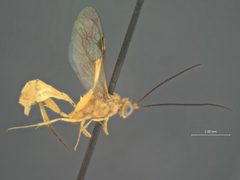
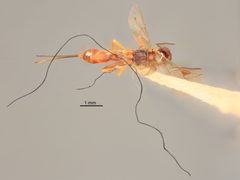
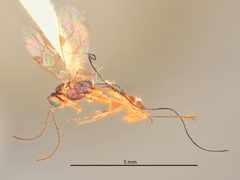
2Pristomerus is a of in the Ichneumonidae, Cremastinae, distributed worldwide with greatest diversity in tropical regions. Members are solitary koinobiont endoparasitoids that attack concealed larvae of small Lepidoptera. Several have been employed in programs. The genus exhibits high regional , with 49 species recognized from the Afrotropical region, 22 from Australia (19 newly described in 2016), and 15 from Madagascar (12 ).
Pronunciation
How to pronounce Pristomerus: //prɪˈstɒmərəs//
These audio files are automatically generated. While they are not always 100% accurate, they are a good starting point.
Identification
Australian with a tooth on the side of the hind can be identified using the dichotomous key provided by Broad et al. (2016), which distinguishes 22 species based on morphological characters. Afrotropical species are distinguished by colour patterns with ecological and geographical correlates, with an illustrated key to females available. Malagasy species show high with only 3 of 15 species occurring outside Madagascar.
Images
Habitat
Tropical , particularly in Northern Queensland and the Northern Territories of Australia where Australian are most diverse. Occurs in agricultural settings including brinjal (eggplant) crops where P. euzopherae has been recorded.
Distribution
Worldwide distribution with majority of in tropics. Documented from: Afrotropical Region (49 species); Australia (22 species, with 5 previously reported ); Madagascar (15 species, 12 endemic); Iran (multiple species including P. mirzakhaniae); India (P. euzopherae in Uttar Pradesh); Scandinavia (records from Denmark, Norway, Sweden).
Seasonality
In Uttar Pradesh, India, P. euzopherae observed from second fortnight of April, peaking in July (12.48% parasitization) with June showing intermediate levels (7.73%).
Host Associations
- Euzophera perticella - endoparasitoidlarvae of this pyralid stem borer in brinjal crops
- small Lepidoptera - endoparasitoidconcealed larvae attacked worldwide
Behavior
Solitary koinobiont endoparasitoid. Females attack concealed larvae. New host records reported for P. pallidus in Afrotropical region.
Ecological Role
agent of lepidopteran pests; P. euzopherae contributes to natural suppression of brinjal stem borer in agricultural .
Human Relevance
Used in biocontrol programs against lepidopteran pests. P. euzopherae provides natural of brinjal stem borer (Euzophera perticella) in eggplant in India.
Similar Taxa
- Trathalahistorically confused with Pristomerus; erroneous reports of T. concolor in South Africa were actually misidentifications
More Details
Taxonomic activity
The has undergone extensive recent revision: 31 new Afrotropical described in 2015, 19 new Australian species in 2016, and 12 new Malagasy species in 2013. Colour patterns in Afrotropical species show correlations with and geography.
Phylogeographic uncertainty
Origin of Australian Pristomerus fauna remains unresolved: may represent Southern relict elements with South American affinities, or result from more recent Paleotropical immigration. Dated required for resolution.
Sources and further reading
- BugGuide
- GBIF taxonomy match
- iNaturalist taxon
- NCBI Taxonomy
- Catalogue of Life
- pristomerus_inaequidens_dasch_holotype_female_ucrc_ent_283776_lateral.jpg | Entomology Research Museum
- Primary Type List | Entomology Research Museum
- Ichneumonid wasps from Madagascar. VI. The genus Pristomerus (Hymenoptera: Ichneumonidae: Cremastinae)
- Revising Australian Pristomerus (Hymenoptera, Ichneumonidae, Cremastinae): species with a tooth on the hind femur
- Revision of the Afrotropical species of Pristomerus (Ichneumonidae: Cremastinae), with descriptions of 31 new species
- A new species of Pristomerus Curtis, 1836 (Hymenoptera, Ichneumonidae, Cremastinae) and key to the known species in Iran
- Biology of stem borer, Euzophera perticella (Lepidoptera: Pyralidae) and association of endoparasitoid Pristomerus euzopherae (Hymenoptera:Ichneumonidae) in grafted and ratoon brinjal crop