Hypsipyla grandella
Zeller, 1848
Mahogany Shoot Borer
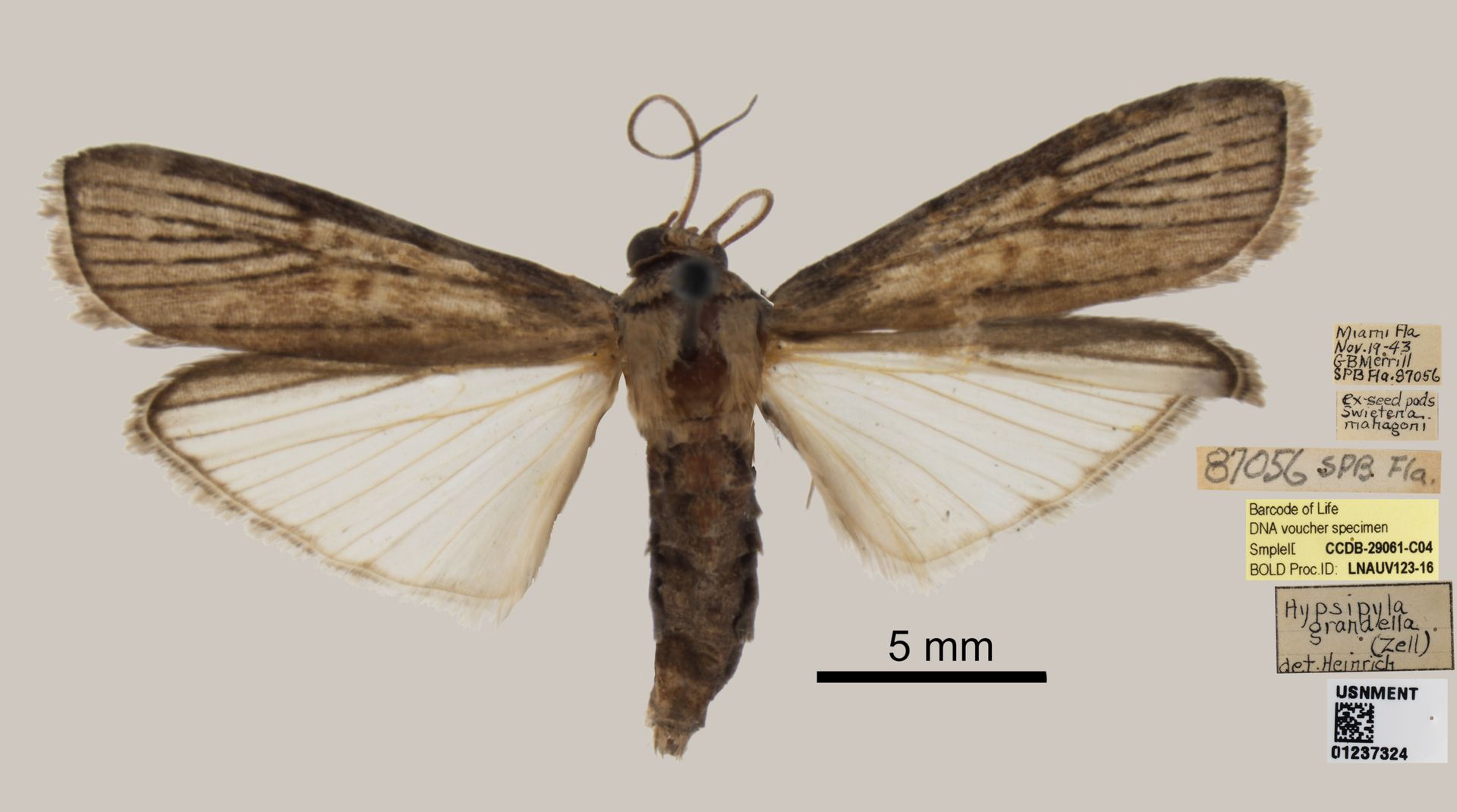
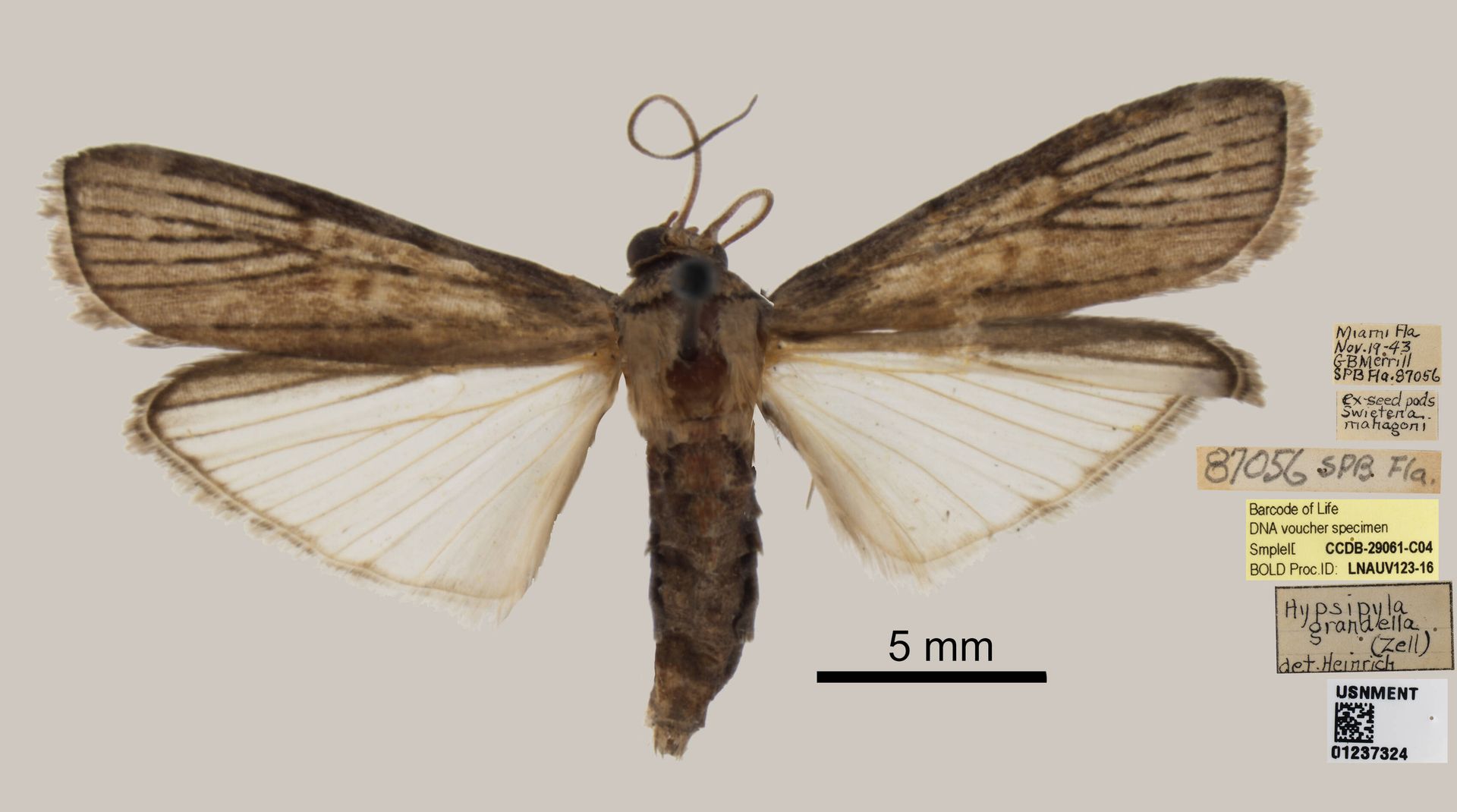
Hypsipyla grandella is a pyralid whose larvae are serious pests of mahogany (Swietenia spp.) and Spanish-cedar (Cedrela spp.). The larvae bore into terminal shoots and seeds, causing significant damage to plantation forestry in the Neotropics. have silvery hyaline hindwings that distinguish them from the congeneric Hypsipyla ferrealis, which has gray hindwings. The has been introduced to Mauritius outside its native range.
Pronunciation
How to pronounce Hypsipyla grandella: /hɪpˈsɪpɪlə ɡrænˈdɛlə/
These audio files are automatically generated. While they are not always 100% accurate, they are a good starting point.
Identification
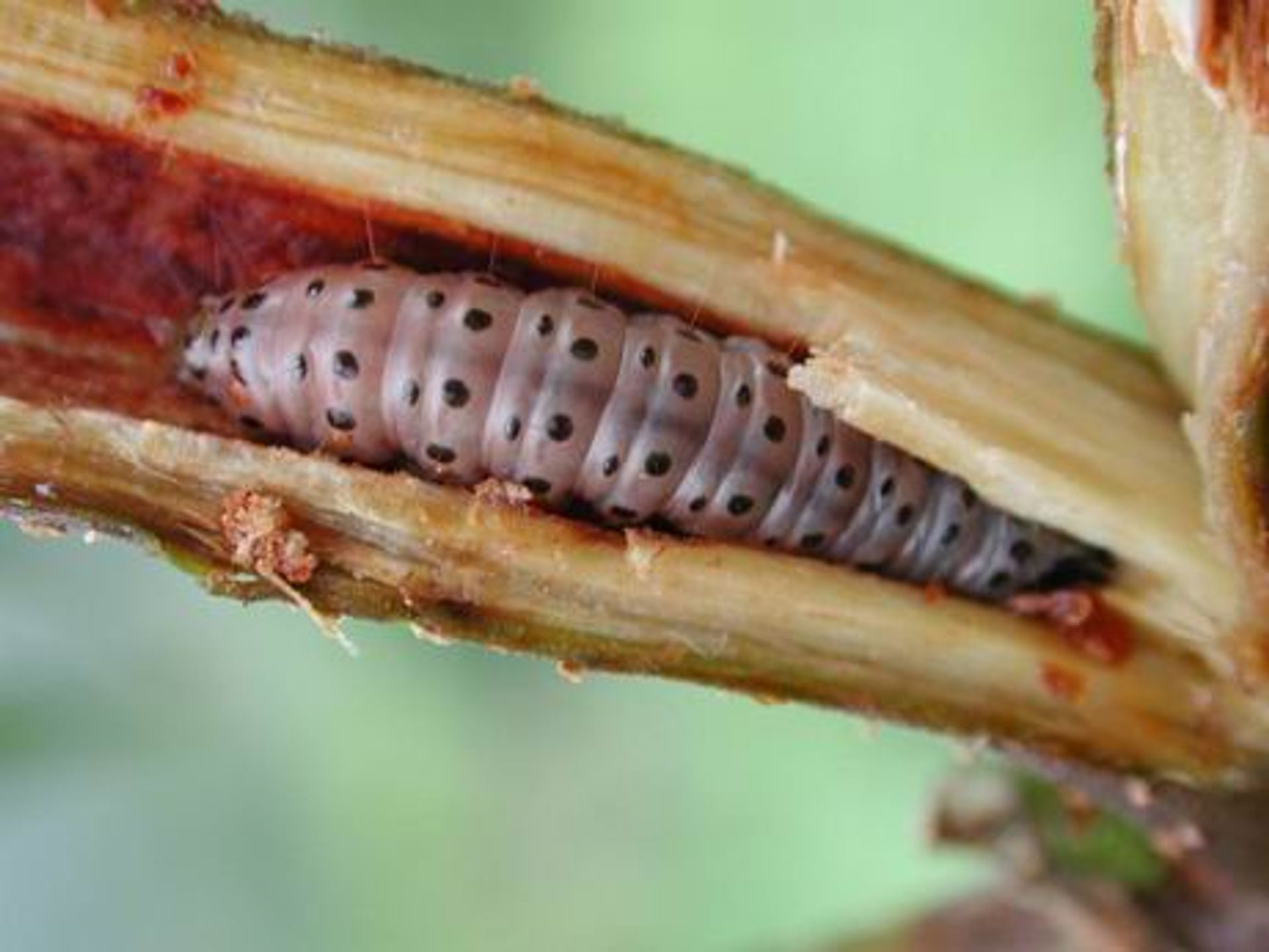
Distinguished from Hypsipyla ferrealis by silvery hyaline hindwings (versus gray hindwings in H. ferrealis). Larvae are recognized by their presence in terminal shoots and seeds of Swietenia and Cedrela, forming internal galleries.
Images
Appearance
have silvery hyaline (transparent) hindwings. Larvae are shoot borers that create galleries within plant tissues.
Habitat
Open, sunlit environments; larvae prefer trees receiving full sunlight without shade. Associated with plantations and natural stands of mahogany and Spanish-cedar.
Distribution
Native to southern Florida (USA), most of the West Indies, Sinaloa and southward through Mexico, Central America, and South America (except Chile). Introduced to Mauritius. Specific records include Belize, Rica, Cuba, Dominica, El Salvador, Grenada, Guadeloupe, Guatemala, Haiti, Honduras, Jamaica, Martinique, Panama, Puerto Rico, Saint Lucia, Saint Vincent and the Grenadines, Trinidad and Tobago, Argentina, Bolivia, Brazil (Acre, Amapá, Amazonas, Distrito Federal, Mato Grosso, Minas Gerais, Pará, Rio Grande do Sul, Rondônia, Roraima, Santa Catarina), Colombia, Ecuador, French Guiana, Guyana, Paraguay, Peru, Suriname, Uruguay, Venezuela, and Galápagos Islands.
Diet
Larvae feed on new shoots of Swietenia spp. (mahogany) and Cedrela spp. (Spanish-cedar/tropical-cedar). Particularly abundant in seeds of Carapa guianensis and Carapa procera (Meliaceae).
Host Associations
- Swietenia macrophylla - West Indies mahogany; larvae feed on new shoots
- Swietenia mahagoni - American mahogany
- Cedrela odorata - Spanish cedar
- Carapa guianensis - larvae particularly abundant in seeds
- Carapa procera - larvae particularly abundant in seeds
- Khaya senegalensis - African mahogany
Behavior
Mating occurs primarily during scotophase (dark period). Females produce and release to attract males. Males demonstrate oriented toward sources and engage in courtship prior to copulation. Larvae bore into terminal shoots, forming internal galleries.
Ecological Role
Major pest limiting and establishment of mahogany . Serves as for including Trichospilus diatraeae (Eulophidae). Susceptible to fungi including bassiana, with one isolate from Brasília causing 70% mortality of and newly hatched larvae.
Human Relevance
Significant economic pest of mahogany and Spanish-cedar plantations throughout the Neotropics. Larval feeding on terminal shoots restricts of mahogany and damages timber quality. Subject of research using fungi.
Similar Taxa
- Hypsipyla ferrealis distinguished by gray hindwings versus silvery hyaline hindwings in H. grandella
More Details
Biological Control Research
A bassiana isolate from Brasília, Brazil was the first fungus reported from H. grandella in the Federal District, showing 70% mortality against and larvae.
Parasitoid Record
Trichospilus diatraeae (Hymenoptera: Eulophidae) has been recorded as a of H. grandella.
Sources and further reading
- BugGuide
- Wikipedia
- GBIF taxonomy match
- iNaturalist taxon
- NCBI Taxonomy
- Catalogue of Life
- Hypsipyla grandella . [Distribution map].
- Hypsipyla grandella . [Distribution map].
- Mating Behavior ofHypsipyla grandella(Lepidoptera: Pyralidae) Under Laboratory Conditions
- Attraction and Ovipositional Response of Hypsipyla grandella (Lepidoptera: Pyralidae) to Host and Non-Host Materials1
- OCORRÊNCIA E PATOGENICIDADE DE Beauveria bassiana À Hypsipyla grandella COLETADA EM BRASÍLIA
- TRICHOSPILUS DIATRAEAE CHERIAN & MARGABANDHU, 1942 (HYMENOPTERA: EULOPHIDAE), UN NUEVO PARASITOIDE DE HYPSIPYLA GRANDELLA (ZELLER, 1848) (LEPIDOPTERA: PYRALIDAE)
- Volatiles as Attractants of Mahogany Shoot Borer, Hypsipyla grandella Zeller (Lepidoptera: Pyralidae).