
Stictia
Illiger, 1807
horse guards, cowfly tigers, insecto policia
Species Guides
1- Stictia carolina(Horse Guard Wasp)
Stictia is a of large, often brightly colored predatory sand wasps comprising approximately 30 , primarily distributed in the Neotropics. The genus is best known for Stictia carolina, commonly called the "Horse Guard," which specializes in hunting horse flies around livestock. Females construct solitary nests in sandy soil, provisioning them with paralyzed flies to feed their larvae. These are valued for their of pest flies, though they are not commercially available. Males engage in aerial patrols and "sun dances" to locate females.
Pronunciation
How to pronounce Stictia: /ˈstɪktiə/
These audio files are automatically generated. While they are not always 100% accurate, they are a good starting point.
Identification
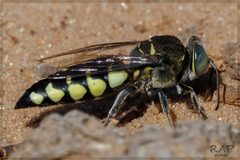
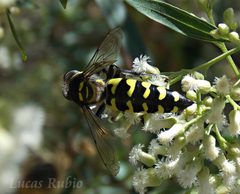
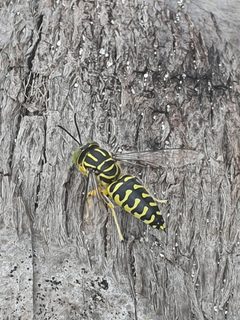
Large-bodied sand wasps with bold black-and-white or black-and-yellow coloration. Stictia carolina has extensive white markings across the entire in females, while males confine white markings to the front half of the abdomen only. Distinguished from similar sand wasps by size (among the largest in North America), distinctive color pattern, and association with horse fly hunting around livestock. Separated from bald-faced (Dolichovespula maculata) by more extensive abdominal white markings and solitary rather than colonial nesting.
Images
Habitat
Sandy soils in open areas, including beaches, dunes, and sandy fields. Nesting requires loose, well-drained sand, ideally with gentle slopes. Often found in agricultural settings near livestock, particularly horses, where hunting opportunities are abundant.
Distribution
Primarily Neotropical, with northern range extension into the United States. Stictia carolina occurs from New Jersey and Pennsylvania south to Florida, west to Illinois, Kansas, and New Mexico; most abundant in the southern Great Plains. Other occur throughout Central and South America, with some Caribbean species such as Stictia signata found in Cuba.
Diet
of flies (Diptera), particularly horse flies (Tabanidae) and deer flies. Females hunt by hovering around livestock, especially horses, and can fly backwards in front of moving animals to intercept flies. Prey is paralyzed with a sting and transported to nest as larval food.
Life Cycle
Solitary nesting with . Females excavate diagonal burrows 35-51 cm long and 18-24 cm deep, terminating in a single . Each burrow receives one . Larvae are fed 15-35 paralyzed flies during development. Nest construction averages 22-30 hours with frequent breaks during midday heat; burrows are closed with inner and outer seals between provisioning trips.
Behavior
Females hunt flies around livestock, hovering persistently near horses and cattle— often mistaken for aggression. Males engage in "sun dances": level in circles, figure eights, or sinuous patterns near nesting areas, typically in morning hours. Males perch on low vegetation, , stones, or ground and actively chase competitors or intercept other insects entering their territories. Nesting is aggregated with multiple females in small areas of suitable sand.
Ecological Role
agent of horse flies and deer flies, reducing nuisance and potential transmission to livestock. Prey for velvet ants (Dasymutilla occidentalis has been recorded emerging from Stictia pupae). to cleptoparasitic satellite flies (Sarcophagidae: Miltogramminae) whose larvae consume prey remains; also host to such as Hexacola sp. that attack these .
Human Relevance
Valued by horse owners and ranchers for reducing horse fly without chemical intervention. Frequently misidentified as aggressive due to hovering around horses, leading to unnecessary fear and occasional destruction of nesting areas. No commercial sources exist despite interest in .
Similar Taxa
- BicyrtesSimilar sand wasp with black-and-yellow coloration and nesting in sand, but smaller in size and specializing in stink bugs (Hemiptera) rather than flies; occurs further north including New England.
- SpheciusLarge sand wasps including cicada killers; similar size and sand-nesting , but hunt cicadas rather than flies and have different color patterns (often reddish rather than black-and-white).
Sources and further reading
- BugGuide
- Wikipedia
- GBIF taxonomy match
- iNaturalist taxon
- NCBI Taxonomy
- Catalogue of Life
- Bembicid Holdings | Entomology Research Museum
- Bug Eric: Wasp Wednesday: The "Horse Guard"
- Bug Eric: Services
- Destinations: Piedras Blancas National Park, Costa Rica and a backyard in Columbia, Maryland: Sand wasps – Crabronidae — Bug of the Week
- Observations on the Mating Behavior of Male Stictia heros (Hymenoptera: Sphecidae)
- Parasitismo entre especies (Diptera, Hymenoptera) en los nidos de Stictia signata (Hymenoptera: Sphecidae)
- Body size and nesting behaviour of the sand waspStictia heros(Hymenoptera: Sphecidae) in Costa Rica