
Leucophora obtusa
(Zetterstedt, 1837)
satellite fly
Leucophora obtusa is a satellite fly in the Anthomyiidae that parasitizes the larvae of Andrena bees. The is found across Japan, Europe, and North America. It is notoriously difficult to distinguish from other Leucophora species and is characterized by being particularly hairy. The "satellite fly" refers to the female's of hovering or "orbiting" around nests.
Identification
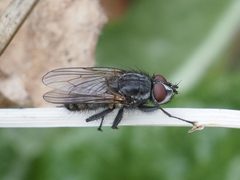
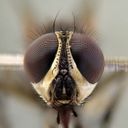
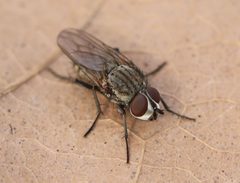
Characterized by exceptionally hairy body compared to , with long erect hairs on abdominal sternites and lateral scutellar margins. Distinguished from other Leucophora primarily by this pilosity pattern, though precise identification requires expert examination.
Images
Appearance
Particularly hairy body with dense hair covering the , , and legs. Long erect hairs present on abdominal sternites and lateral margins of the scutellum. Notoriously difficult to distinguish from other Leucophora .
Habitat
Distribution
Japan, Europe, and North America. Distribution records from Denmark, Norway, and Sweden.
Host Associations
- Andrena bees - larvae parasitizedlarvae are parasitic on 's
- Andrena bee nests - oviposition sitefemales oviposit in the tumulus of the nest entrance
Life Cycle
Larvae are parasitic on the 's . Development occurs within the host 's nest.
Behavior
Females hover or "orbit" around nests. Females shadow the bee back to its burrow to locate oviposition sites.
Ecological Role
of Andrena larvae. Acts as a natural control agent for bee .
Similar Taxa
- Other Leucophora speciesNotoriously difficult to distinguish; requires examination of hair and pattern, particularly erect hairs on abdominal sternites and scutellar margins
More Details
Genome sequencing
assembly completed: 1,289.8 Mb nuclear genome, 6 chromosomal pseudomolecules, 18.72 kb mitochondrial genome.
Etymology of common name
The term "satellite fly" derives from the female's distinctive hovering around nests, resembling a satellite orbiting a planet.
Sources and further reading
- BugGuide
- Wikipedia
- GBIF taxonomy match
- iNaturalist taxon
- NCBI Taxonomy
- Catalogue of Life
- Botanizing at Elephant Rocks State Park | Beetles In The Bush
- endoparasitoid | Blog
- Marine invertebrates with Cornwall Wildlife Trust - Buglife Blog - Buglife
- December | 2021 | Beetles In The Bush
- The genome sequence of a satellite fly, Leucophora obtusa (Zetterstedt, 1837).