
Leucophora
Robineau-Desvoidy, 1830
satellite flies, root-maggot flies
Species Guides
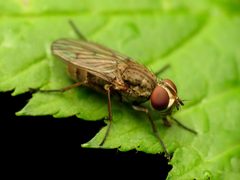
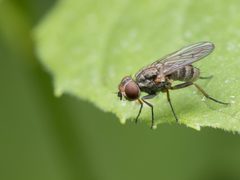
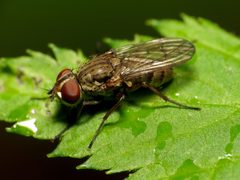
5Leucophora is a of kleptoparasitic flies in the Anthomyiidae, comprising approximately 60 described with worldwide distribution except Oceania. Species are commonly known as 'satellite flies' due to their habit of hovering near nests. The genus is associated with bees and solitary , with females shadowing hosts to locate nest entrances for oviposition. Larvae are parasitic on host . Several species are notoriously difficult to distinguish based on external alone.
Pronunciation
How to pronounce Leucophora: //luːˈkɒfərə//
These audio files are automatically generated. While they are not always 100% accurate, they are a good starting point.
Identification
External is highly conserved across , making visual identification difficult; male and female genital structures provide crucial diagnostic characters for species-level determination. Some species, such as Leucophora obtusa, are distinguished by unusually dense long erect hairs on abdominal sternites and scutellum margins compared to .
Images
Habitat
Found in proximity to nests of bees and ; collected from deciduous woodland environments where solitary bees nest.
Distribution
Worldwide distribution except Oceania; recorded from Japan, Europe, North America, and South America (16 recognized from Argentina alone).
Host Associations
Life Cycle
Larvae develop as within . Females oviposit in the tumulus at nest entrances of host bees.
Behavior
females exhibit 'satellite' : hovering or 'orbiting' around nests, and actively shadowing host bees back to their burrows to locate nest entrances for -laying.
Ecological Role
of solitary and larvae; regulator of .
Similar Taxa
- other AnthomyiidaeLeucophora are distinguished by kleptoparasitic and association with hymenopteran nests; most anthomyiids are not parasitic and lack the 'satellite fly' behavioral
More Details
Taxonomic difficulty
The exhibits remarkable external morphological uniformity, leading to frequent misidentification. Reliable determination requires examination of male and female genital structures. The distiphallus and ovipositor terminal segments show species-specific modifications.
Genomic resources
Chromosomally complete assembly available for Leucophora obtusa (1,289.8 Mb, 6 chromosomal pseudomolecules, 18.72 kb mitochondrial genome) as part of the Darwin Tree of Life Project.