
Ammophila procera
Dahlbom, 1843
Common Thread-waisted Wasp
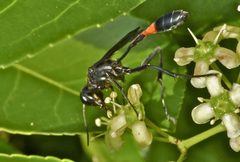
Ammophila procera is a large, solitary thread-waisted in the Sphecidae, among the most conspicuous members of its in North America. Females construct burrows in sandy or compact soils, provision them with paralyzed caterpillar prey, and seal the nest after laying a single . The is notable for its elaborate nest-closing and landmark-based navigation. feed on flower nectar and are frequently observed visiting blossoms, particularly goldenrod.
Pronunciation
How to pronounce Ammophila procera: /ˌæməˈfaɪlə proʊˈsɪrə/
These audio files are automatically generated. While they are not always 100% accurate, they are a good starting point.
Identification
Distinguished from other Ammophila by its large size combined with silver thoracic stripes—A. nigricans is similarly large but lacks silver stripes and has black wings with red . A. pictipennis has orange or yellow wings and no silver thoracic stripes. A. aberti is silvery overall but lacks the bold thoracic striping pattern. A. wrightii and A. formicoides are much smaller (<20 mm) and -mimics with reddish-brown coloration.
Images
Appearance
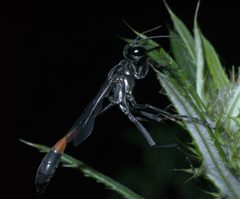
Large thread-waisted , females 25–38 mm in length. Body black with distinctive silver stripes on the sides of the , a hallmark of most Ammophila . with red coloration. Wings dark. The constricted waist (petiole) between thorax and abdomen is pronounced. Males are smaller and more slender than females, with longer .
Habitat
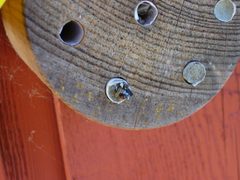
Open areas with sandy or compact soils suitable for burrowing. Frequently found in coastal dunes, beaches, prairies, and other open with exposed ground. Nests in hard-packed or compact sand rather than loose, shifting dunes.
Distribution
Transcontinental in North America: southern Canada through the United States to Mexico and Central America (south to Guatemala).
Seasonality
active primarily during warmer months; observations span spring through autumn depending on latitude. Nesting activity peaks in summer.
Diet
feed on flower nectar. Larvae are fed paralyzed caterpillars by the provisioning female.
Host Associations
- Nadata gibbosa - preyWhite-dotted Prominent caterpillar
- Heterocampa manteo - preyVariable Oakleaf Caterpillar
- Heterocampa astarte - prey
- Schizura ipomoeae - preyMorning-glory Prominent
- Datana spp. - prey
- Symmerista spp. - prey
- Smerinthus cerisyi - preyOne-eyed Sphinx, at least one record
Life Cycle
Female excavates burrow (slanted to vertical, ending in single ), then seals entrance and performs orientation to memorize landmarks. She hunts caterpillars, paralyzing them with sting, and transports them to the nest—running with prey held in and middle legs, or flying with prey beneath body. Single laid on first caterpillar in cell; cell typically receives one caterpillar. Larva hatches in approximately two days, feeds for about five days, then pupates within nest. emerges with fully formed wings. Some females may initiate multiple nests simultaneously; nest usurpation (removing another female's egg and replacing with own) has been observed.
Behavior
Females exhibit elaborate nest-closing , using small stones or clods as tools to tamp down soil and obscure the entrance. Performs memorized orientation using visual landmarks to relocate sealed burrows, sometimes days later. When alarmed during nest excavation, females typically return to complete the burrow. Prey transport involves gripping caterpillar to render it rigid, enabling agile running. roost at night by gripping vegetation with , body propped at 45-degree angle.
Ecological Role
/ of caterpillars, particularly prominent larvae (Notodontidae). control agent for herbivorous lepidopteran larvae. serve as when foraging for nectar. Serves as for satellite flies (Sarcophagidae: Senotainia vigilans, Metopia laterallis) that parasitize nests.
Human Relevance
Generally beneficial due to caterpillar , including some agricultural pest (e.g., corn earworm relatives). Not aggressive toward humans; stings occur only if is physically grabbed. Nesting activities are brief and localized, causing no persistent nuisance. Occasionally observed in gardens and parks where sandy soils and flowering plants coincide.
Similar Taxa
- Ammophila nigricansSimilarly large but lacks silver thoracic stripes; has black wings and red
- Ammophila pictipennisHas orange or yellow wings and lacks silver thoracic stripes
- Ammophila abertiSilvery overall but lacks bold thoracic striping; slightly smaller
- Ammophila wrightiiMuch smaller (<20 mm), -mimic, reddish-brown, lacks silver stripes
More Details
Nest Parasites
Satellite flies in Sarcophagidae (Senotainia vigilans, Metopia laterallis) follow prey-laden females and deposit live larvae at nest entrances to parasitize the provisioned caterpillars.
Tool Use
The use of stones to close nests, once interpreted as intelligent tool use, is now understood as fixed action patterns, though it remains among the most complex nest-closing known in solitary .
Sources and further reading
- BugGuide
- Wikipedia
- GBIF taxonomy match
- iNaturalist taxon
- NCBI Taxonomy
- Catalogue of Life
- Bug Eric: Wasp Wednesday: Ammophila procera
- Bug Eric: Ammophila in Action
- Bug Eric: December 2010
- Bug Eric: White Prairie Clover: An Awesome Blossom
- Bug Eric: Wasp Wednesday: Ammophila aberti
- Bug Eric: Wasp Wednesday: Ammophila pictipennis