
Ammophila nigricans
Dahlbom, 1843
thread-waisted wasp
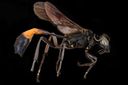
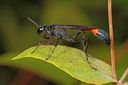
Ammophila nigricans is a large, striking thread-waisted in the Sphecidae, recognized by its deep blue-black body with red abdominal banding and black wings. It is one of the largest eastern in its , comparable in size to A. procera but readily distinguished by its coloration. Females are solitary nesters that excavate burrows in clayey or sandy soil and provision them with paralyzed caterpillars as food for their larvae. The species ranges across the eastern United States from Kansas and Texas to New England and south to Georgia, Florida, and Louisiana. It appears less common than most other Ammophila species.
Pronunciation
How to pronounce Ammophila nigricans: //ˌæ.moʊˈfaɪ.lə ˈnaɪ.ɡrɪ.kænz//
These audio files are automatically generated. While they are not always 100% accurate, they are a good starting point.
Identification
Easily distinguished from all other Ammophila by the combination of: (1) lack of silver stripes on the (present in most including A. procera); (2) deep blue-black body with red abdominal band; (3) entirely black wings. The similar-sized A. procera has prominent silver thoracic stripes and clear or smoky wings rather than black. A. wrightii and A. formicoides are much smaller, -mimetic, and uniformly reddish-brown.
Images
Habitat
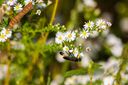
Open areas with clayey or sandy soil suitable for nest excavation. have been observed nectaring on flowers including mint blossoms and Swamp Milkweed. The is associated with supporting its caterpillar .
Distribution
Eastern United States: from Kansas and Texas eastward to New England, and south to Georgia, Florida, and Louisiana. Records include Massachusetts, Ohio, Illinois, Kansas, and throughout the southeastern states.
Seasonality
Active during warm months; observed in July and August. Females may be found at dusk adopting a characteristic sleeping posture, gripping grass stems or twigs with their at approximately a 45-degree angle.
Diet
feed on nectar from various flowers including mint and milkweed. Larvae are provisioned with paralyzed caterpillars by the female parent.
Host Associations
- Catocala spp. (underwing moths) - prey/larvae provisioned as food for larvae
- Euparthenos nubilis (locust underwing) - prey/larvae provisioned as food for larvae
- Zale spp. (zale moths) - prey/larvae provisioned as food for larvae
Life Cycle
Solitary nesting . Females excavate vertical or angled burrows in soil, terminating in a horizontal chamber. The nest is provisioned with one or more large paralyzed caterpillars, upon which a single is laid. The larva feeds externally on the caterpillar. Detailed developmental timing and number of per year are not well documented.
Behavior
Females are solitary and non-aggressive. They exhibit a distinctive sleeping at dusk, gripping vegetation with their while holding the body at an angle. When hunting, females locate caterpillars by touch rather than visual cues, as the cryptic prey typically remain motionless during the day. Females have been observed to provision nests with multiple large caterpillars. The is less frequently encountered than , suggesting either lower abundance or more secretive habits.
Ecological Role
of caterpillars, particularly large noctuid larvae. As a solitary , it contributes to regulation of . The serves as a for Strepsiptera , which have been documented in related Ammophila species.
Human Relevance
Not aggressive toward humans; stings only if handled. Of potential interest for biological study of parental care strategies and - relationships. The has been subject of research into how maternal provisioning influences risk of parasite transmission to offspring.
Similar Taxa
- Ammophila proceraSimilar large size, but distinguished by silver thoracic stripes, lack of red abdominal band, and non-black wings
- Ammophila wrightiiMuch smaller, -mimetic, uniformly reddish-brown, with different nesting (burrow excavated after prey capture)
- Ammophila formicoidesMuch smaller, -mimetic, uniformly reddish-brown, closely related to A. wrightii
More Details
Research significance
Ammophila nigricans has been used in studies of parental care evolution, specifically demonstrating that provisioning nests with multiple small caterpillars (rather than one large caterpillar) greater risk of transmitting Strepsiptera to offspring. This work by RJ Millena and Jay Rosenheim showed that this single behavioral trait explains approximately 90% of variation in risk across Ammophila species.
Taxonomic notes
The was originally described by Dahlbom in 1843. Western and eastern of some related Ammophila species show variation in wing venation (number of submarginal ), but this has not been specifically documented for A. nigricans.
Sources and further reading
- BugGuide
- Wikipedia
- GBIF taxonomy match
- iNaturalist taxon
- NCBI Taxonomy
- Catalogue of Life
- 'When I Grow Up, I Want to Be an Entomologist' | Bug Squad
- Humbled and Honored to Receive ACE Awards | Bug Squad
- Bug Eric: December 2010
- Bug Eric: September 2017
- Bug Eric: Wasp Wednesday: Ammophila procera
- Bug Eric: Ammophila in Action