
Symmerista
Hübner, 1821
Species Guides
7- Symmerista albifrons(White-headed Prominent)
- Symmerista canicosta(Red-humped Oakworm Moth)
- Symmerista leucitys(orange-humped mapleworm moth)
- Symmerista schmidti
- Symmerista solistella
- Symmerista suavis
- Symmerista zacualpana
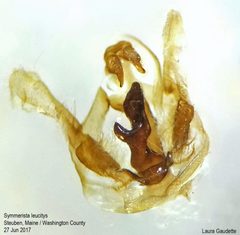
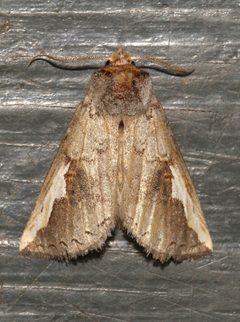
Symmerista is a of prominent moths ( Notodontidae) erected by Jacob Hübner in 1821. The genus contains at least nine described distributed primarily in North America, with several species described from Central America. Larvae are notable for a distinctive leaf-clipping where they sever petioles after feeding and apply red saliva to the cut surface, a trait that has been experimentally demonstrated to introduce salivary constituents into the plant's to suppress defense responses in nearby leaves.
Pronunciation
How to pronounce Symmerista: /sɪməˈrɪstə/
These audio files are automatically generated. While they are not always 100% accurate, they are a good starting point.
Images
Habitat
Deciduous forests in eastern North America; larvae feed on foliage of broadleaf trees including oaks (Quercus spp.) and sugar maple (Acer saccharum). Specific associations vary by : S. albifrons and S. canicosta are oak feeders, while S. leucitys is associated with sugar maple forests.
Distribution
Eastern United States, with records from New York, Vermont, and the Great Lakes/Midwest regions; some extend into southeastern Canada. Three species (S. albifrons, S. canicosta, S. leucitys) are broadly sympatric in the Great Lakes and Midwest regions. Additional species described from Central America (S. aura, S. inbioi, S. luisdiegogomezi, S. minaei, S. zacualpana).
Diet
Larval stages feed on leaves of trees; documented hosts include white oak (Quercus alba), willow oak (Quercus phellos), other oak , and sugar maple (Acer saccharum). Specific host associations vary by species.
Host Associations
- Quercus alba - plantwhite oak; for S. albifrons
- Quercus phellos - plantwillow oak; for S. albifrons
- Quercus spp. - plantoaks; for S. albifrons and S. canicosta
- Acer saccharum - plantsugar maple; for S. leucitys
Life Cycle
S. leucitys is (one per year). Final instar larvae clip leaves after partially consuming them, requiring several hours to a day to finish consuming a single leaf before severing the petiole.
Behavior
Larvae exhibit distinctive leaf-clipping : after feeding on a leaf, they sever the petiole or midrib and allow the remaining leaf fragment to fall. They then rub their over the cut surface, applying red saliva containing pigment from the portion of the labial glands. This red pigment travels several millimeters within the petiole xylem within five minutes. The behavior has been demonstrated experimentally to function primarily in introducing salivary constituents that suppress plant defense responses in nearby leaves where the caterpillar will feed next, rather than primarily to eliminate visual cues for .
Ecological Role
Larvae contribute to greenfall (premature leaf drop) in deciduous forests. During conditions, they can cause extensive defoliation of economically and ecologically important trees including oaks and sugar maple. The serves as documented prey for the thread-waisted wasp Ammophila procera. Larval saliva appears to manipulate plant physiology by suppressing defense mobilization in adjacent foliage.
Human Relevance
Occasional forest pest; S. leucitys (orangehumped mapleworm) is a documented defoliator of sugar maple with potential economic impact on maple syrup production and forest health. The has been subject to studies.
Similar Taxa
- HeterocampaBoth belong to Notodontidae and contain prominent with larvae that feed on oak foliage; however, Heterocampa larvae do not exhibit the distinctive red saliva application documented in Symmerista
- DatanaAnother Notodontidae with larvae that feed on oak and other broadleaf trees; Symmerista can be distinguished by the unique leaf-clipping and saliva-application not reported in Datana
More Details
Leaf-clipping research
A 2022 PLOS ONE study experimentally demonstrated that the leaf-clipping in Symmerista albifrons and S. leucitys functions to introduce salivary constituents into the plant's . Cauterizing the eliminated fluid application, and dissections confirmed red pigment is produced in the labial glands. This overturned earlier hypotheses that leaf-clipping primarily served to reduce visual cues for bird .
Taxonomic history
The was erected by Jacob Hübner in 1821. One former , Symmerista tlotzin, has been transferred to the genus Elymiotis. Four Central American species were described by Chacón in 2014: S. aura, S. inbioi, S. luisdiegogomezi, and S. minaei.
Sources and further reading
- BugGuide
- Wikipedia
- GBIF taxonomy match
- iNaturalist taxon
- NCBI Taxonomy
- Catalogue of Life
- Bug Eric: Wasp Wednesday: Ammophila procera
- Bug Eric: More moth fashions
- Bug Eric: November 2010
- Bug Eric: 2010
- Field and Laboratory Biology of Symmerista canicosta1
- Salivary surprise: Symmerista caterpillars anoint petioles with red saliva after clipping leaves
- OBSERVATIONS ON BIOLOGY AND NATURAL CONTROL OF THE ORANGEHUMPED MAPLEWORM, SYMMERISTA LEUCITYS (LEPIDOPTERA: NOTODONTIDAE), IN NEW YORK
- The Distribution of Three Broadly Sympatric Species of <i>Symmerista</i> Moths (Lepidoptera: Notodontidae) in the Great Lakes and Midwest Regions of the United States.