
Symmerista leucitys
Franclemont, 1946
orange-humped mapleworm moth, orange-humped mapleworm
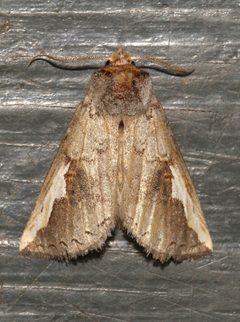
Symmerista leucitys is a notodontid commonly known as the orange-humped mapleworm moth. The is a defoliator of sugar maple, with a single per year. Larvae exhibit distinctive leaf-clipping , severing petioles after feeding and applying red saliva containing pigments from the labial glands to the petiole stub. This saliva travels rapidly into the petiole xylem and is hypothesized to suppress plant defense responses in nearby leaves. During years, clipped leaves can comprise over 80% of greenfall losses in early October.
Pronunciation
How to pronounce Symmerista leucitys: /sɪməˈrɪstə ljuːˈsɪtɪs/
These audio files are automatically generated. While they are not always 100% accurate, they are a good starting point.
Identification
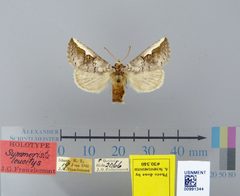
are small notodontid with approximately 35 mm wingspan. Larvae can be distinguished from other maple-feeding caterpillars by the distinctive leaf-clipping and application of red saliva to petiole stubs. Within the Symmerista, S. leucitys can be separated from S. albifrons by geographic range and subtle morphological differences, though specific diagnostic characters require examination of adult specimens.
Images
Habitat
Deciduous forests dominated by sugar maple (Acer saccharum). Larvae are found on foliage; are associated with maple woodland .
Distribution
Eastern North America from southern Canada through the northern half of the United States east of the Great Plains. Documented from New York, Vermont, New Hampshire, and surrounding regions.
Seasonality
with one per year. Larval activity occurs during summer months; active in appropriate season for single generation. Specific adult period not documented in available sources.
Diet
Larvae feed exclusively on sugar maple (Acer saccharum) foliage. do not feed (typical for many , though not explicitly documented).
Host Associations
- Acer saccharum - larval food plantsugar maple; exclusive documented in laboratory and field studies
Life Cycle
(one per year). Final instar larvae require several hours to a day to consume a single leaf before severing the petiole and moving to another leaf. and details not documented in available sources.
Behavior
Larvae exhibit distinctive leaf-clipping : after feeding, they sever the petiole with , causing the remaining leaf fragment to fall, then rub their over the petiole stub to apply red saliva. The red pigment travels several millimeters into the petiole xylem within five minutes. This behavior is hypothesized to introduce salivary constituents that suppress plant defense mobilization in nearby leaves where the caterpillar will feed next. Larvae resume feeding immediately when exposed to slight air movement simulating wind.
Ecological Role
herbivore and periodic forest defoliator of sugar maple. Contributes significantly to greenfall (premature leaf drop); during , clipped leaves can comprise over 80% of greenfall losses in early October. Extensive defoliation occurs during periodic outbreaks. Subject to natural control by and (specific agents not detailed in available sources).
Human Relevance
Economic significance as a forest pest during years, causing defoliation of sugar maple. The has been studied for its unique leaf-clipping and salivary manipulation of plant defenses, contributing to understanding of plant-insect chemical interactions.
Similar Taxa
- Symmerista albifronsCongeneric also exhibits red saliva application to petiole stubs; distinguished by geographic distribution and subtle morphological differences in specimens
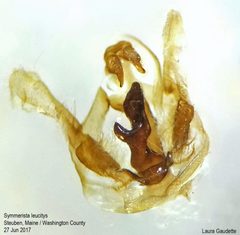
- Other Symmerista speciesShare maple-feeding habits and notodontid ; specific identification requires examination of genitalia and wing patterns
More Details
Salivary biochemistry
The red pigment in S. leucitys saliva is produced in the portion of the labial glands. Cauterizing the eliminates fluid application, confirming the source. This represents one of the few documented cases of caterpillar saliva containing visible pigments with demonstrated vascular mobility in plants.
Research significance
This has become a model for studying the 'visual cue hypothesis' of leaf-clipping , which proposed that petiole clipping reduces bird by eliminating visual evidence of feeding. Research on S. leucitys helped refute this hypothesis, demonstrating instead that saliva application to introduce defense-suppressing compounds is the primary function.
Sources and further reading
- BugGuide
- Wikipedia
- GBIF taxonomy match
- iNaturalist taxon
- NCBI Taxonomy
- Catalogue of Life
- Bug Eric: Wasp Wednesday: Ammophila procera
- Bug Eric: More moth fashions
- Bug Eric: November 2010
- Bug Eric: 2010
- OBSERVATIONS ON BIOLOGY AND NATURAL CONTROL OF THE ORANGEHUMPED MAPLEWORM, SYMMERISTA LEUCITYS (LEPIDOPTERA: NOTODONTIDAE), IN NEW YORK
- Salivary surprise: Symmerista caterpillars anoint petioles with red saliva after clipping leaves