
Notodontidae
Stephens, 1829
Prominent Moths
Subfamily Guides
10- Cerurinae
- Dicranurinae
- Dioptinae
- Dudusinae
- Heterocampinae(prominent moths)
- Notodontinae(Prominent moths)
- Nystaleinae
- Periergosinae
- Phalerinae
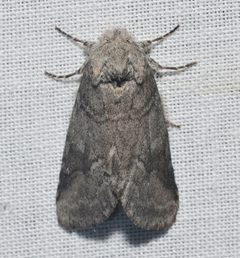
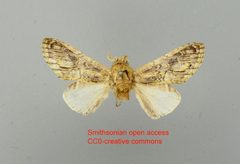
is a of comprising approximately 3,800 described , first established by James Francis Stephens in 1829. The family is distributed globally but reaches its greatest diversity in tropical regions, particularly the New World. are characterized by heavy bodies, long wings held folded across the back at rest, and predominantly dull coloration in grey or brown tones. The family name derives from Greek roots meaning 'back tooth,' referring to the tuft of hair often present on the trailing edge of the forewing. Larvae exhibit remarkable morphological diversity and possess chemical defenses uncommon in other Lepidoptera.
Pronunciation
How to pronounce Notodontidae: /ˌnoʊtoʊˈdɒntɪˌdiː/
These audio files are automatically generated. While they are not always 100% accurate, they are a good starting point.
Identification
can be distinguished from superficially similar Noctuidae by their resting posture: hold wings folded across the back or tented over the body, rather than flat. The presence of a tuft of hair on the trailing edge of the forewing is a key diagnostic feature, though not universal. Most lack bright coloration, appearing in shades of grey and brown, with the exception of the Dioptinae. Adults possess tympanal organs on the opening dorsally, and tibial spurs with serrated edges. Larvae often display bizarre shapes, humps, or projections, and may rest with both ends raised.
Images
Habitat
Found in diverse environments worldwide, with greatest abundance in tropical forests. occur in woodlands, gardens, and various natural and semi-natural . Larval are predominantly woody plants, especially trees and shrubs, though the Dioptinae feeds on herbaceous vegetation.
Distribution
Global distribution with highest concentration in tropical regions, particularly the New World. Present on all continents except Antarctica. In Europe and North America, occur across temperate zones with decreasing frequency at higher elevations and northern latitudes.
Diet
Larvae feed primarily on trees and shrubs, with most restricted to single plant . Documented associations include Salicaceae (willows, poplars), Fagaceae (oaks), Juglandaceae (walnuts), Hamamelidaceae, Ericaceae, and Anacardiaceae. The Dioptinae feeds on herbaceous plants. do not feed; mouthparts range from well-developed to absent.
Life Cycle
are hemispherical to spherical and lack ribs. Larvae typically undergo four to five instars, with some exhibiting dramatic shape and color changes between instars. Many species possess or modified last ; some have eversible glands. occurs in soil or within silk cocoons attached to plants. emerge with non-functional mouthparts in many species.
Behavior
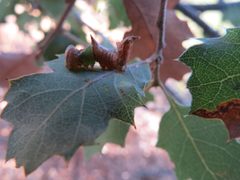
Larvae display diverse defensive : many rest with both ends raised, some exhibit (death-feigning), and several spray formic acid or other defensive compounds accurately at attackers. The puss moth larva (Cerura vinula) rears both ends in a threatening display when disturbed, showing modified resembling whips. Some larvae are gregarious, particularly in the processionary (Thaumetopoeinae). are primarily , except Dioptinae which are .
Ecological Role
Herbivores whose larvae function as significant defoliators of trees and shrubs. Some cause economically important damage to forest and ornamental trees. Serve as prey for various including and birds. Contribute to nutrient cycling through herbivory and serve as food source for higher .
Human Relevance
Several are notable forest and shade tree pests causing defoliation, including the saddled prominent (Heterocampa guttivita), yellownecked caterpillar (Datana ministra), walnut caterpillar (Datana integerrima), California oakworm (Phryganidia californica), and poplar defoliator (Clostera cupreata). The puss moth and lobster are familiar to naturalists for their remarkable larval .
Similar Taxa
- NoctuidaeSuperficially similar in size and dull coloration, but distinguished by flat wing posture at rest, lack of forewing tuft, and different tympanal organ orientation.
- ThaumetopoeidaeFormerly treated as separate or ; processionary share gregarious larval but differ in and are now generally included within .
Sources and further reading
- BugGuide
- Wikipedia
- GBIF taxonomy match
- iNaturalist taxon
- NCBI Taxonomy
- Catalogue of Life
- Meet Emily Meineke, New UC Davis Urban Landscape Entomologist | Bug Squad
- Jeff Smith: Busy as a Bee? No, As Industrious as a Lepidopterist | Bug Squad
- Sphingidae | Beetles In The Bush | Page 2
- Bug Eric: Wasp Wednesday: Polistes exclamans
- The Moth and Me | Beetles In The Bush
- Noctuidae | Beetles In The Bush | Page 3
- The genome sequence of the Puss Moth, Cerura vinula (Linnaeus, 1758) (Lepidoptera: Notodontidae).