
Symmerista albifrons
(Smith, 1797)
White-headed Prominent, Orange-humped Oakworm
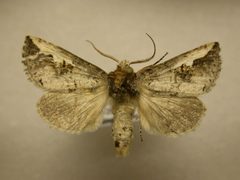
Symmerista albifrons, known as the white-headed prominent or orange-humped , is a in the Notodontidae. First described by J.E. Smith in 1797, it occurs throughout North America. The species is recognized by its distinctive white and orange thoracic hump, with larvae that feed on oak foliage. It belongs to a of prominents whose caterpillars are important prey items for solitary such as Ammophila procera.

Pronunciation
How to pronounce Symmerista albifrons: /sɪˈmɛrɪstə ˈælbɪfrɒnz/
These audio files are automatically generated. While they are not always 100% accurate, they are a good starting point.
Identification
The white with dark body provides immediate separation from most other prominents. The orange-humped larva is distinguished from other oak-feeding caterpillars by its namesake orange thoracic swelling. may be confused with other Symmerista but the white head pattern is distinctive within the . Similar bark-mimicking in like Geometridae lack the prominent white head patch.
Images
Habitat
Deciduous forests and woodlands, particularly areas with oak trees. are attracted to lights and can be found near buildings adjacent to wooded .
Distribution
North America, with records from the United States including Vermont and across the continent.
Diet
Larvae feed on oak foliage (Quercus ).
Host Associations
- Quercus - larval plantoak foliage
Life Cycle
Complete with , larva, pupa, and stages. Larvae are the orange-humped form that feeds on oak leaves.
Behavior
are and attracted to artificial light sources. Larvae are solitary feeders on oak foliage.
Ecological Role
Larvae serve as prey for predatory including Ammophila procera and other solitary wasps. The contributes to nutrient cycling in oak woodland through herbivory and as a food source for higher .
Human Relevance
Larvae may cause minor defoliation of ornamental oaks but are not considered a significant pest. The is of interest to lepidopterists and naturalists for its distinctive appearance and ecological interactions.
Similar Taxa
- Other Symmerista speciesSimilar bark-mimicking pattern but distinguished by white marking
- Nadata gibbosa (White-dotted Prominent)Shared Notodontidae and similar but lacks white and has different wing pattern
- Heterocampa speciesOak-feeding prominents with different larval and pattern
More Details
Predator interactions
Documented as prey for the thread-waisted wasp Ammophila procera, which paralyzes caterpillars to provision nest .
Taxonomic history
Originally described by J.E. Smith in 1797 with basionym Symmerista albicosta.
Observation data
Over 7,000 observations recorded on iNaturalist, indicating it is a frequently encountered .
Sources and further reading
- BugGuide
- Wikipedia
- GBIF taxonomy match
- iNaturalist taxon
- NCBI Taxonomy
- Catalogue of Life
- A Summit to Save the Butterflies | Bug Squad
- Encyrtid Holdings | Entomology Research Museum
- Bug Eric: Wasp Wednesday: Ammophila procera
- The Brilliance of Brownfields - Buglife Blog - Buglife
- Bug Eric: More moth fashions
- Bug Eric: November 2010