
Datana
Walker, 1855
Species Guides
16- Datana angusii(Angus' Datana Moth)
- Datana californica(California Datana)
- Datana cochise
- Datana contracta(Contracted Datana Moth)
- Datana diffidens
- Datana drexelii(Drexel's Datana Moth)
- Datana drexelii-major
- Datana integerrima(Walnut Caterpillar Moth)
- Datana major(azalea caterpillar)
Datana is a of prominent moths in the Notodontidae, erected by Francis Walker in 1855. The genus comprises approximately 13 described distributed across North America. Larvae of Datana species are known defoliators of hardwood trees and are among the common late-season defoliators of southern U.S. forests. Several species are notable agricultural and ornamental pests, particularly on pecan and walnut trees.
Pronunciation
How to pronounce Datana: /dɑːˈteɪnə/
These audio files are automatically generated. While they are not always 100% accurate, they are a good starting point.
Identification
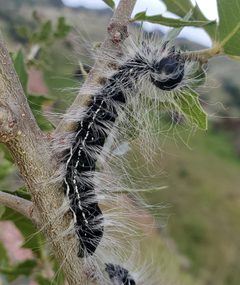
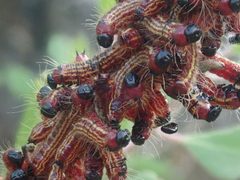
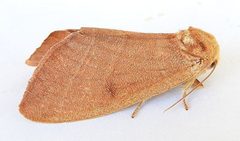
distinguished from similar Notodontidae by wing pattern and genitalia; specific identification often requires dissection. Larvae recognizable by gregarious feeding habit, long soft body hairs, and characteristic damage pattern of skeletonizing leaves or consuming entire leaf blades. Distinguished from fall webworm (Hyphantria cunea) by absence of silken webbing; from walnut caterpillar (Datana integerrima specifically) by timing and association. -level identification of larvae challenging without rearing to adult.
Images
Habitat
Deciduous hardwood forests, riparian woodlands, orchards, and urban landscapes with trees present. Associated with oak, hickory, pecan, walnut, and other hardwood . often found near larval host plants; attracted to light.
Distribution
North America, primarily United States and southern Canada. distributed across eastern, central, and southwestern regions. Records from Vermont westward across the continent, with concentration in eastern and central deciduous forest regions. One species (Datana chiriquensis) extends to Central America (Panama).
Seasonality
active primarily in late spring through summer, with periods varying by and latitude. Larvae present from mid-summer through early fall, with late-season defoliation characteristic. Single or multiple per year depending on species and climate; most appear to be or .
Diet
Larvae feed on leaves of hardwood trees, particularly Fagaceae (oaks, Quercus spp.; beeches, Fagus spp.), Juglandaceae (walnuts, Juglans spp.; hickories, Carya spp.; pecans, Carya illinoinensis), and occasionally other woody plants. Specific associations vary by . do not feed.
Host Associations
- Quercus - larval food plantoaks
- Carya - larval food planthickories and pecans
- Juglans - larval food plantwalnuts
- Fagus - larval food plantbeeches
Life Cycle
laid in masses on undersides of leaves. Larvae hatch and feed gregariously, consuming leaf tissue. Full-grown larvae descend to ground and pupate in soil or leaf litter, often in silken cocoons incorporating debris. emerge following pupal . stage typically pupa or egg, varying by .
Behavior
Larvae exhibit gregarious feeding , often consuming leaves in groups and producing conspicuous accumulation. When disturbed, larvae may drop from foliage on silken threads. Late-instar larvae may disperse individually. , attracted to artificial light sources. Females release for mate location.
Ecological Role
Primary consumer and defoliator in deciduous forest . can cause localized defoliation, though typically with minimal long-term tree health impact. Serve as prey for and including birds, predatory insects, and parasitic . Documented as prey for thread-waisted wasps (Ammophila spp.). Contribute to nutrient cycling through deposition and leaf litter processing.
Human Relevance
Several are occasional pests of pecan orchards and ornamental hardwoods. Datana integerrima (walnut caterpillar) and D. ministra (yellow-necked caterpillar) are the most economically significant. Defoliation can reduce nut fill in pecans and aesthetic value in landscape trees. Management rarely required; mechanical removal or targeted application used when necessary. Larvae and may cause nuisance in residential areas during .
Similar Taxa
- AnisotaBoth contain late-season defoliators with gregarious larvae; Anisota larvae have prominent thoracic horns and different color patterns (often orange stripes), and produce less conspicuous .
- LochmaeusSimilar late-season defoliator in Notodontidae; Lochmaeus larvae have different body shape and prominent humps, with more irregular feeding pattern.
- DryocampaAnother Notodontid defoliator; Dryocampa larvae are solitary or in small groups, with distinct coloration (often green with red horns), and feed earlier in season.
- Hyphantria cuneaFall webworm builds extensive silken webs enclosing foliage; Datana larvae do not construct webs, producing only silken escape threads when disturbed.
- MalacosomaTent caterpillars construct dense silken tents in branch crotches; Datana larvae lack this and have different body hair characteristics.
More Details
Taxonomic History
erected by Francis Walker in 1855. Type Datana contracta Walker, 1855. Species boundaries historically problematic, with some described multiple times or synonymized. Molecular phylogenetic studies may clarify relationships within the genus and with related Phalerinae.
Pest Management Notes
Late-season defoliation by Datana typically causes minimal long-term tree damage due to timing late in growing season. Management recommendations emphasize monitoring and rather than prophylactic treatment. When intervention necessary, Bacillus thuringiensis or reduced-risk applied to young larvae most effective.
Defensive Behavior
Larvae possess that may cause skin irritation in sensitive individuals, though generally less severe than reactions to some or Erebidae .
Sources and further reading
- BugGuide
- Wikipedia
- GBIF taxonomy match
- iNaturalist taxon
- NCBI Taxonomy
- Catalogue of Life
- Insects and mites that feed on leaves - AgriLife Extension Entomology
- Bug Eric: Wasp Wednesday: Ammophila procera
- Much Ado About Nothing? End-of-Summer Defoliation Heats Up
- Bug Eric: November 2010
- 2018 Arizona Insect Collecting Trip “iReport” | Beetles In The Bush