
Datana diffidens
Dyar, 1917
Datana diffidens is a of prominent in the Notodontidae, first described by Harrison Gray Dyar Jr. in 1917. It is native to North America and is one of approximately ten species in the Datana found on the continent. Like other members of its genus, the larvae are likely folivorous, though specific plant associations for this species remain poorly documented. The species has been recorded in iNaturalist with over 340 observations, suggesting it is encountered with some regularity by naturalists.
Pronunciation
How to pronounce Datana diffidens: //dəˈtɑːnə ˈdɪfɪˌdɛnz//
These audio files are automatically generated. While they are not always 100% accurate, they are a good starting point.
Identification
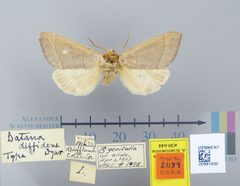
Datana diffidens is distinguished from by subtle differences in wing pattern and genitalia that require expert examination. The Datana is recognized by the combination of broad wings, relatively stout body, and larvae with a characteristic looping defensive posture. -level identification typically requires dissection and comparison of genitalic structures or detailed examination of wing venation and scaling patterns. The MONA ( Photographers Group) or Hodges number 7912 is assigned to this species.
Images
Habitat
Specific preferences for Datana diffidens are not documented. Members of the Datana generally occur in deciduous and mixed woodlands where larval plants are present. Based on collection records from Arizona and broader North American distribution, the likely occupies riparian areas, oak woodlands, and other forested habitats in the southwestern United States and adjacent regions.
Distribution
North America. The has been recorded in the southwestern United States, including Arizona (Chiricahua Mountains, Santa Rita Mountains, Huachuca Mountains), with broader distribution across the continent based on iNaturalist observations and museum records.
Seasonality
period is not precisely documented for this . In the Datana, adults typically fly during late spring through summer, with larvae present in summer and early fall. The 2018 Arizona collecting trip recorded Datana sp. caterpillars in July/August, suggesting larval activity in mid to late summer in that region.
Life Cycle
Complete with , larva, pupa, and stages. Specific details of the for Datana diffidens are not documented. In the Datana, larvae are typically gregarious in early instars and become solitary later. occurs in soil or leaf litter. The likely has one per year () or possibly two in southern portions of its range, though this is speculative.
Behavior
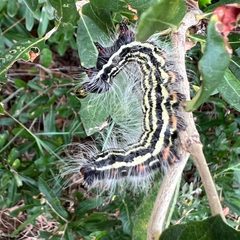
Larvae of Datana , including presumably D. diffidens, exhibit a characteristic defensive of arching the and ends when disturbed, forming a loop. This posture is shared across the and may serve to startle or present a less vulnerable profile.
Ecological Role
As a folivorous , larvae likely function as primary consumers in forest , converting plant to animal biomass available to and . The serves as prey for various natural enemies including predatory , birds, and parasitic insects.
Human Relevance
Not documented as a significant pest . Some Datana species occasionally cause localized defoliation of ornamental or crop trees, but D. diffidens is not specifically noted in agricultural or forestry literature. The species may be encountered by naturalists and enthusiasts, contributing to biodiversity documentation through platforms like iNaturalist.
Similar Taxa
- Datana integerrimaWalnut caterpillar, a common with similar larval and ; distinguished by plant association (Juglans, Carya) and wing pattern
- Datana perspicuaAnother North American Datana with overlapping distribution; requires genitalic examination for reliable separation
- Datana ministraYellow-necked caterpillar, a widespread with similar larval appearance; distinguished by specific color pattern and preferences
More Details
Taxonomic history
Described by Harrison Gray Dyar Jr. in 1917, a prolific American entomologist who described thousands of Lepidoptera . The specific epithet 'diffidens' is Latin, meaning 'distrustful' or 'hesitant', though the etymological reference is not documented.
Research needs
Basic of Datana diffidens remains poorly known. Priority research needs include documentation of larval plants, precise geographic range, , and distinguishing characters from .
iNaturalist documentation
With 346 observations as of the data retrieval, this has moderate citizen science documentation, though many observations may be identified only to level due to identification challenges.
Sources and further reading
- BugGuide
- Wikipedia
- GBIF taxonomy match
- iNaturalist taxon
- NCBI Taxonomy
- Catalogue of Life
- Insects and mites that feed on leaves - AgriLife Extension Entomology
- Bug Eric: Wasp Wednesday: Ammophila procera
- Much Ado About Nothing? End-of-Summer Defoliation Heats Up
- Bug Eric: November 2010
- 2018 Arizona Insect Collecting Trip “iReport” | Beetles In The Bush