
Datana integerrima
Grote & Robinson, 1866
Walnut Caterpillar Moth
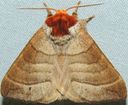
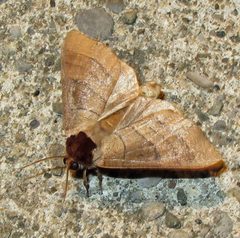
Datana integerrima, commonly known as the walnut caterpillar , is a North American in the Notodontidae. The moths have a wingspan of 35–50 mm and are active from May to August. The larvae are notable defoliators of walnut, hickory, and other hardwood trees, feeding gregariously in large groups. While capable of causing significant defoliation, single-season rarely cause lasting damage to healthy trees.
Pronunciation
How to pronounce Datana integerrima: //dæˈtænə ɪnˌtɛɡəˈraɪmə//
These audio files are automatically generated. While they are not always 100% accurate, they are a good starting point.
Identification
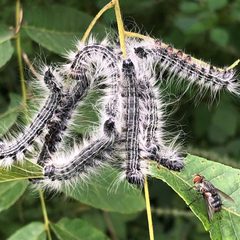
are distinguished from other Datana by genitalia examination; external features are subtle. Larvae can be identified by their distinctive color progression (reddish-brown young to black adults with gray hairs), lack of web-building, and gregarious feeding . The combination of plant (walnut, hickory, oak) and the characteristic massing behavior on trunks and branches to helps separate them from similar defoliators like fall webworm (Hyphantria cunea), which builds conspicuous silken webs.
Images
Habitat
Deciduous forests and woodlands, particularly those containing walnut (Juglans), hickory (Carya), and oak (Quercus) . Also found in urban and suburban settings where trees are planted, including parks and residential areas. Larvae require access to host foliage and will move to lower trunk and scaffold branches to congregate and .
Distribution
Eastern North America, ranging from Ontario south through most of the eastern United States, west to Minnesota, and south to northern Mexico.
Seasonality
are on wing from May to August. Larvae are present during summer months, with timing varying by latitude. In southern portions of the range, multiple may occur; northern typically have one generation annually.
Diet
Larvae feed on leaves of Carya (hickory), Juglans (walnut), Quercus (oak), Salix (willow), and Gleditsia triacanthos (honey locust), as well as some shrubs. do not feed.
Host Associations
- Carya - larval food plantHickory
- Juglans - larval food plantWalnut ; primary reference
- Quercus - larval food plantOak
- Salix - larval food plantWillow
- Gleditsia triacanthos - larval food plantHoney locust
Life Cycle
Females deposit masses of 500 or more eggs on undersides of leaves. Eggs hatch in approximately 10 days. Larvae feed for about 25 days, progressing through five instars. Young larvae feed gregariously on foliage. Full-grown larvae crawl to the soil to pupate, where they overwinter. emerge the following spring.
Behavior
Larvae exhibit strong gregarious , feeding in groups and congregating in large masses on tree trunks and scaffold branches to shed their skins () synchronously. This congregation behavior is highly visible and often the first sign of noticed by observers. Final instar larvae consume the majority of foliage and can defoliate branches rapidly. Larvae do not construct protective webs or tents.
Ecological Role
As a native defoliator, D. integerrima contributes to nutrient cycling in deciduous forests. Severe defoliation can temporarily reduce photosynthetic capacity of trees, but healthy trees typically recover without long-term consequences. The serves as prey for various natural enemies including , birds, and other . Pupae in soil may be consumed by ground-foraging .
Human Relevance
Considered a minor pest of walnut and pecan orchards, where larval feeding can reduce nut fill and the following year's production if defoliation is severe. In residential settings, the conspicuous larval masses and associated accumulation create aesthetic concerns. Control is rarely necessary in natural forests; in managed settings, or mechanical removal may be employed when threaten economic damage. The has been documented as prey for the thread-waisted wasp Ammophila procera, which provisions nests with paralyzed caterpillars.
Similar Taxa
- Fall webworm (Hyphantria cunea)Both are late-season defoliators with hairy larvae, but fall webworm constructs conspicuous silken webs enclosing foliage, while D. integerrima larvae do not build webs and instead congregate on trunks to .
- Other Datana speciesSeveral Datana overlap in range and use; accurate identification of larvae to species often requires rearing to or examination of subtle morphological characters.
- Anisota senatoria (orangestriped oakworm)Another gregarious late-season defoliator, but Anisota larvae have prominent orange stripes and horns, differing from the black-and-gray coloration of mature D. integerrima.
Misconceptions
Despite the and reputation as a pest, single-season defoliation by walnut caterpillar rarely causes lasting harm to healthy trees. The conspicuous larval masses often trigger unnecessary applications. Additionally, the is sometimes confused with fall webworm due to similar plants and timing, but the absence of web-building in D. integerrima is a key distinguishing feature.
More Details
Pest management considerations
In pecan and walnut orchards, monitoring for masses with flashlight inspection of leaf undersides at night can facilitate early detection. Control is most effective when targeted at young larvae; larger larvae are more difficult to kill with and have already completed most of their feeding damage.
Sources and further reading
- BugGuide
- Wikipedia
- GBIF taxonomy match
- iNaturalist taxon
- NCBI Taxonomy
- Catalogue of Life
- Insects and mites that feed on leaves - AgriLife Extension Entomology
- Bug Eric: Wasp Wednesday: Ammophila procera
- Much Ado About Nothing? End-of-Summer Defoliation Heats Up
- Bug Eric: November 2010
- 2018 Arizona Insect Collecting Trip “iReport” | Beetles In The Bush