
Anisota senatoria
Smith, J.E., 1797
orangestriped oakworm, orange-tipped oakworm
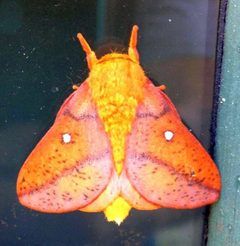
Anisota senatoria is a Nearctic silk in the Saturniidae, commonly known as the orangestriped . It is one of the more common Saturniids in eastern North America, occasionally reaching pest status in the northern parts of its range. The is notable for being a late-season feeder on oak foliage, which limits its long-term impact on tree health. are sexually dimorphic: females are larger, yellow-orange with silver-white spots and faint black lines across the wings, while males are smaller and reddish-brown. The species is very similar to A. finlaysoni in southern Ontario and A. peigleri in the southern United States.
Pronunciation
How to pronounce Anisota senatoria: /ænɪˈsoʊtə sɛnəˈtɔriə/
These audio files are automatically generated. While they are not always 100% accurate, they are a good starting point.
Identification
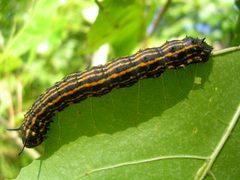
distinguished from similar Anisota by wing pattern and geographic location. A. finlaysoni occurs in eastern Lake Ontario region and has distinct adult ; A. peigleri occurs in the southern US. Larvae identified by black ground color with yellow-orange lateral stripes, prominent thoracic horns, and gregarious feeding on oaks in late summer. Distinguished from greenstriped mapleworm (Dryocampa rubicunda) by plant and stripe color (orange vs. green).
Images
Habitat
Deciduous forests and urban landscapes dominated by oak trees. Found in both natural forest settings and highly visible urban areas such as parks, yards, and street tree plantings where oaks are present. Larvae require access to soil for , making paved surfaces a significant barrier to successful completion.
Distribution
Eastern North America, from the edge of the Great Plains to the Atlantic coast, and from southern Ontario south to central Georgia, Alabama, and eastern Texas. More common in northern portions of its range; present but less abundant in northern Florida.
Seasonality
emerge once annually from mid-June to mid-July. Larvae feed in August and September. One per year throughout most of range.
Diet
Larvae feed primarily on oaks (Quercus spp.), especially red oaks. Also reported from chestnut, birch, hazel, hickory, and maple. do not feed.
Host Associations
- Quercus - primary larval especially red oaks
- Castanea - larval chestnut
- Betula - larval birch
- Corylus - larval hazel
- Carya - larval hickory
- Acer - larval maple
Life Cycle
One per year. emerge mid-June to mid-July, mate during midday, and females lay on undersides of leaves in late afternoon. Eggs hatch in 1–2 weeks. Larvae feed gregariously in early instars, often remaining clustered in late instars. Fifth instar larvae descend from trees, burrow underground to pupate, and overwinter as pupae. Nutritional studies indicate late-season feeding strategy favors over rapid growth rate, with consumption rate increasing in response to decreased nitrogen levels in mature foliage.
Behavior
Larvae exhibit gregarious feeding, particularly in early instars. When tree defoliation is complete, larvae wander to locate new host trees, often descending to ground and climbing adjacent trees. Mass larval exodus from trees creates significant mortality risk from ground-dwelling and human-created obstacles such as paved trails. accumulation beneath infested trees can be substantial, producing audible sounds like raindrops in forest settings.
Ecological Role
Late-season defoliator of oaks. As late-season feeders, they do little lasting damage to because most energy has been stored by trees already. Serves as host for (particularly ichneumonids) that help regulate . Contributes to nutrient cycling through deposition. Provides food source for various including birds, spiders, and predatory beetles.
Human Relevance
Occasionally reaches pest status in urban landscapes, particularly in northern range. Defoliation can be unsightly and accumulation on sidewalks, patios, and driveways creates nuisance. programs have been developed in such as Norfolk, VA and Montgomery Village, MD. Mechanical control (hand-picking larvae or pruning infested branches) often sufficient; rarely needed. Paved trails and roads create artificial mortality sources for wandering larvae, though public awareness can mitigate impacts.
Similar Taxa
- Anisota finlaysoniVery similar in appearance; occurs in southern Ontario. Distinguished by and restricted range in eastern Lake Ontario region, separated by ~200 km gap from A. senatoria .
- Anisota peigleriVery similar; occurs in southern United States. Geographic separation and subtle morphological differences distinguish the .
- Dryocampa rubicundaGreenstriped mapleworm has similar and habit of gregarious late-season feeding, but distinguished by green lateral stripes (vs. orange), different plants (maples vs. oaks), and appearance.
More Details
Taxonomic Complexity
boundaries within the Anisota senatoria species-group have been historically problematic. Recent research indicates A. finlaysoni has a much smaller range than previously believed, with Lake Erie re-assigned to A. senatoria. barcodes do not reliably discriminate species in the senatoria-group.
Nutritional Ecology
Compared to spring-feeding oak defoliators like Alsophila pometaria, A. senatoria exhibits a feeding strategy favoring over rapid growth rate. Unlike A. pometaria, whose growth rate is directly related to leaf nitrogen content, A. senatoria growth rate is independent of leaf nitrogen, with consumption rate increasing to compensate for lower nitrogen in mature foliage.
Sources and further reading
- BugGuide
- Wikipedia
- GBIF taxonomy match
- iNaturalist taxon
- NCBI Taxonomy
- Catalogue of Life
- Much Ado About Nothing? End-of-Summer Defoliation Heats Up
- Archive — Bug of the Week
- Outrage for oaks – Orangestriped Oakworm, Anisota senatoria — Bug of the Week
- Trails of despair for wild silk moth caterpillars: Orangestriped Oakworm, Anisota senatoria, and Greenstriped mapleworm, Dryocampa rubicunda — Bug of the Week
- Megalopygidae | Beetles In The Bush
- ID Challenge #11 | Beetles In The Bush
- The nutritional ecology of larvae of Alsophila pometaria and Anisota senatoria feeding on early‐ and late‐season oak foliage
- Ecology, morphology and distribution of Anisota finlaysoni Riotte (Lepidoptera, Saturniidae)