
Anisota peigleri
Riotte, 1975
yellowstriped oakworm, yellow-striped oakworm moth
Anisota peigleri is a saturniid native to the southeastern United States, described by Jules C. E. Riotte in 1975. Previously misidentified as Anisota senatoria, this is distinguished by its activity and specific geographic range. The larvae are specialized oak feeders that develop in gregarious clusters, causing noticeable but generally non-lethal defoliation of trees. The species completes one annually, with adults active from mid-July through late August.

Pronunciation
How to pronounce Anisota peigleri: /ˌænɪˈsoʊtə ˈpeɪɡləri/
These audio files are automatically generated. While they are not always 100% accurate, they are a good starting point.
Identification
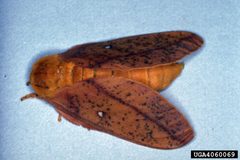
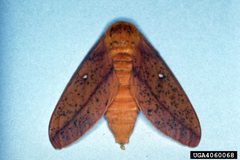
Distinguished from the closely related Anisota senatoria (orangestriped ) by geographic distribution—A. peigleri occurs in the southeastern U.S. while A. senatoria ranges more broadly across eastern North America. are strictly , flying during daylight hours from mid-July to late August, whereas A. senatoria adults are reportedly more or . The was formally described in 1975 based on these and other subtle morphological differences. Larvae cannot be reliably separated from A. senatoria without rearing to adults or molecular analysis.
Images
Habitat
Associated with oak-dominated forests and woodlands, particularly in upland and piedmont regions. Larvae feed on oak foliage in the ; are encountered in wooded areas and along forest edges where trees occur. The thrives in both natural forest settings and urban landscapes where oaks are planted.
Distribution
to the southeastern United States: from south-eastern Kentucky, south-western Virginia, eastern Tennessee, and western North Carolina, south through western South Carolina and central Georgia into north-central Florida. The range is more restricted than that of the similar A. senatoria.
Seasonality
(one per year). emerge from pupae in mid-July and remain active through late August. Mating occurs from mid-morning to mid-afternoon. Larvae develop through late summer and early autumn, then descend to the ground to pupate and overwinter.
Diet
Larvae are specialized folivores feeding primarily on various oak (Quercus spp.), including pin oak (Quercus palustris). They feed in tight throughout larval development. do not feed; they rely on energy reserves accumulated during the larval stage.
Host Associations
- Quercus palustris - primary explicitly documented as a larval food plant
- Quercus spp. - various oak utilized
- Carya spp. - occasional hickory reported for related , not explicitly confirmed for A. peigleri
- Betula spp. - occasional birch reported for related , not explicitly confirmed for A. peigleri
Life Cycle
Complete with four stages: , larva, pupa, . Females deposit eggs on undersides of oak leaves. Larvae hatch and feed gregariously, progressing through multiple instars. Fully grown larvae exit trees and burrow into soil to form shallow pupal chambers. Pupae overwinter, with adults emerging the following summer. No adult feeding occurs.
Behavior
Larvae exhibit strong gregarious , feeding in dense clusters throughout development. This clustering makes them highly visible and produces concentrated defoliation patterns. are unusual among saturniids in being strictly , with mating activity concentrated in midday hours. When larval food is depleted, caterpillars may descend trees and wander in search of new plants, making them vulnerable to ground-dwelling and human foot traffic on trails and sidewalks.
Ecological Role
Larvars function as primary consumers in oak woodland , converting leaf into insect biomass available to and . Periodic can temporarily reduce foliage, though late-season timing limits impact on tree health. The serves as for parasitoid and flies that help regulate . production contributes to nutrient cycling beneath host trees.
Human Relevance
Considered a minor defoliator of landscape and street oaks. can cause aesthetic damage and accumulate on sidewalks, patios, and driveways in urban settings. Rarely requires intervention; natural enemies typically collapse . Where management is deemed necessary, mechanical removal of larval clusters or targeted applications are effective. The presents opportunities for public engagement with insects, as gregarious larvae and wandering caterpillars often attract attention and can serve as educational subjects.
Similar Taxa
- Anisota senatoriaExtremely similar in larval appearance and ; historically confused with A. peigleri before 1975 description. Distinguished by broader geographic range, different period, and subtle morphological differences. Adults of A. senatoria are more /.
- Anisota stigmaRelated oak-feeding saturniid with similar larval and gregarious feeding habits. Geographic range and differ.
- Anisota virginiensisPink-striped oakworm with comparable ; distinguished by larval coloration (pink stripes rather than yellow) and different geographic distribution.
More Details
Taxonomic history
This was described as new by Jules C. E. Riotte in 1975, separating it from the long-recognized Anisota senatoria based on morphological and biological differences. The description resolved decades of confusion regarding distinct southeastern .
Diurnal activity
Day-flying in is notable within Saturniidae, a whose members are predominantly . This trait likely represents an to specific environmental conditions in its southeastern range.
Sources and further reading
- BugGuide
- Wikipedia
- GBIF taxonomy match
- iNaturalist taxon
- NCBI Taxonomy
- Catalogue of Life
- Outrage for oaks – Orangestriped Oakworm, Anisota senatoria — Bug of the Week
- Trails of despair for wild silk moth caterpillars: Orangestriped Oakworm, Anisota senatoria, and Greenstriped mapleworm, Dryocampa rubicunda — Bug of the Week
- Much Ado About Nothing? End-of-Summer Defoliation Heats Up
- Megalopygidae | Beetles In The Bush
- ID Challenge #11 | Beetles In The Bush
- Archive — Bug of the Week