
Saturniidae
Emperor and Giant Silk Moths, saturniids, giant silkworm moths, royal moths
Subfamily Guides
3- Ceratocampinae(Royal Moths)
- Hemileucinae(Buck and Io Moths)
- Saturniinae(Emperor Moths)
is a of Lepidoptera containing approximately 2,300 described , including some of the largest in the world. are characterized by large lobed wings, heavy bodies covered in hair-like , reduced or mouthparts, and the absence of a . The family exhibits notable diversity in the Neotropics, with highest in tropical and subtropical wooded regions. Many species produce silk cocoons, and several have significant economic or cultural importance.
Pronunciation
How to pronounce Saturniidae: //səˌtɜːrˈnɪɪˌdiː//
These audio files are automatically generated. While they are not always 100% accurate, they are a good starting point.
Identification
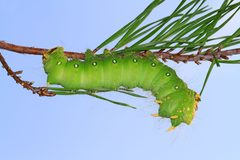
Distinguished from other Lepidoptera by large size, lobed wings, reduced mouthparts, and absence of a . Overlapping hindwings create continuous wing surface. Males with large, bipectinate (feather-like) . Larvae are large (50–100 mm in final instar), stout, cylindrical, with that are often spiny or hairy; many possess . Distinguished from Sphingidae caterpillars, which are typically smooth with diagonal stripes and a single horn.
Images
Appearance
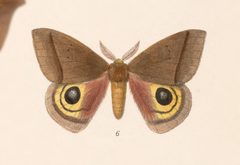
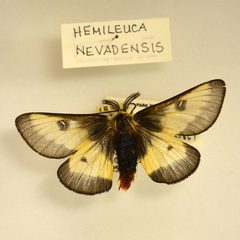
possess large, lobed wings with wingspans typically ranging from 2.5–15.2 cm, though some tropical such as the Atlas (Attacus atlas) reach up to 30 cm. Bodies are heavy and covered in hair-like . Wings often display bright coloration with translucent eyespots or 'windows' where scales are absent. is present in many species, with males distinguished by larger, broader, feather-like . Adults lack functional mouthparts; the digestive tract is absent or . The hindwings overlap the forewings, producing an unbroken wing surface in the absence of a .
Habitat
Predominantly associated with wooded tropical and subtropical regions. Greatest diversity occurs in Neotropical forests, particularly in Mexico and Central and South America. occupy forest and surrounding woodlands. Some (Ceratocampinae, Hemileucinae) include species that pupate underground in soil chambers rather than spinning aerial cocoons.
Distribution
Worldwide distribution with highest diversity in the New World tropics. Approximately 12 described occur in Europe, one of which (the emperor ) reaches the British Isles. North America 68 described species, with 42 species occurring north of Mexico and Southern California. Colombia alone contains 602 documented species, with 310 species and one to that country. The originated in the Neotropical region based on phylogenetic evidence showing most ancient restricted to the Americas.
Seasonality
Varies by and latitude. Some species are (single annually), others multivoltine (multiple ). Spring and summer broods typically eclose within weeks; autumn broods enter and emerge the following spring. during the fifth larval instar and cooling temperatures influence diapause induction. In some species, spring and summer broods exhibit different phenotypes.
Diet
do not feed; they subsist entirely on lipid reserves accumulated during larval development. Larvae feed primarily on foliage of trees and shrubs. Most are folivores of woody plants; exceptions include some Hemileucinae (e.g., Automeris louisiana, A. patagonensis, Hemileuca oliviae) that feed on grasses. Specific associations vary considerably by species and .
Life Cycle
Females lay up to 200 , deposited singly or in small groups on plants. Eggs are round, slightly flattened, smooth, and translucent to whitish. Larvae undergo 4–6 , reaching 50–100 mm in final instar. Most larvae spin silken cocoons in leaves, leaf litter, or rock crevices; some (Ceratocampinae, Hemileucinae) burrow underground to pupate in earthen chambers with minimal silk use. Pupal duration approximately 14 days for non-diapausing individuals; diapausing pupae overwinter. live one week or less post-.
Behavior
is devoted almost entirely to . Females emit -specific to attract males; males detect these chemical signals with sensitive receptors on tips and may fly several miles to locate females. Females rarely fly prior to mating. Some larvae produce clicking sounds with when disturbed, possibly serving as aposematic warnings. Gregarious feeding occurs in some species (e.g., Arsenura armida, Hemileucinae), while most are solitary.
Ecological Role
Larvae function as herbivores in forest and woodland , consuming significant quantities of foliage. Some act as defoliator pests in agricultural or silvicultural contexts. serve as prey for bats and other . The contributes to nutrient cycling through herbivory and serves as a food source for various and predators.
Human Relevance
Several are important defoliator pests, including Anisota senatoria on oaks, Coloradia pandora on pines, and Hemileuca oliviae on range grasses. Multiple species have commercial value in wild silk production, notably Antheraea pernyi (Chinese tussah ), Antheraea × proylei, and Samia cynthia (ailanthus silkmoth). Some species are consumed as food, including Gonimbrasia belina (mopane worm) and related African species. Several species are raised as educational pets due to their spectacular appearance and harmless nature as . Some (Automeris, Lonomia) possess venomous larvae that pose health risks to humans; Lonomia caterpillars can be lethal.
Similar Taxa
- SphingidaeSimilar large size and robust bodies; distinguished by streamlined, bullet-shaped bodies, narrow pointed wings, and long for nectar feeding in . Sphingidae caterpillars typically smooth with diagonal lateral stripes and a single curved horn, unlike hairy or spiny saturniid larvae.
- Bombycidae including domesticated Bombyx mori; distinguished by smaller size, more compact bodies, and different wing venation. larvae spin denser, more uniform cocoons of commercial silk quality.
More Details
Silk Production
While only moderately close relatives to the domestic (Bombyx mori), cocoons of larger saturniids can be gathered for wild silk fabric production. The silk is coarser and less uniform than silk.
Conservation Concerns
of several North American have declined, notably in New England where the Imperial moth (Eacles imperialis) is considered extirpated from some states. Threats include destruction, use, introduction of flies (Compsilura concinnata), and light pollution disrupting mating .
Subfamily Diversity
The comprises 9–11 recognized depending on classification system, including Oxyteninae, Cercophaninae, Arsenurinae, Ceratocampinae, Hemileucinae, Agliinae, Ludiinae, Salassinae, and Saturniinae. Oxyteninae and Cercophaninae are sometimes treated as separate families.
Sources and further reading
- BugGuide
- Wikipedia
- iNaturalist taxon
- NCBI Taxonomy
- Catalogue of Life
- Silkworm Moths, Blacklighting, Hot Chocolate, Cookies and More | Bug Squad
- Saturniidae | Beetles In The Bush | Page 2
- Bug of the Week
- Bug Eric: Giant Silkmoths
- Sphingidae | Beetles In The Bush | Page 2
- The Moth and Me | Beetles In The Bush
- An updated checklist of the wild silkmoths (Lepidoptera: Saturniidae) of Colombia
- Larvas urticantes Automeris (Lepidoptera: Saturniidae) en Cajanus cajan: riesgo para la salud de productores panameños Automeris (Lepidoptera: Saturniidae) stinging larvae in Cajanus cajan: a health risk for Panamanian farmers Larvas de picada de Automeris Hübner, 1819 (Lepidoptera: Saturniidae) em Cajanus cajan (L.): um risco sanitário para os produtores do Panamá