
Anisota virginiensis
Drury, 1773
pink-striped oakworm moth
Species Guides
3- Anisota virginiensis discolor(pink-striped oakworm)
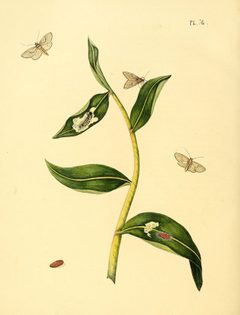
- Anisota virginiensis pellucida
- Anisota virginiensis virginiensis(Pink-striped Oakworm)
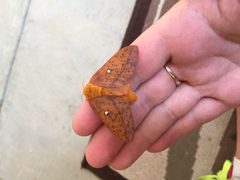
Anisota virginiensis, the pink-striped , is a North American silk moth in the Saturniidae. display strong in wing coloration, with females showing purplish-red and ochre-yellow wings and males showing purplish-brown wings with a large transparent central area. The is known for gregarious larval and late-season defoliation of oak and other hardwood trees. It is widely distributed across eastern North America and is occasionally considered a minor forest pest, though late-season defoliation rarely causes significant tree mortality.
Pronunciation
How to pronounce Anisota virginiensis: //ˌænɪˈsoʊtə vɜrˌdʒɪˈniːənsɪs//
These audio files are automatically generated. While they are not always 100% accurate, they are a good starting point.
Identification
distinguished from other Anisota by female wing coloration (purplish-red with ochre-yellow, not orange-brown as in A. senatoria) and male transparent wing patch. Larvae identified by rosy or brownish-yellow stripes on gray-green body, two prominent mesothoracic spines, and gregarious feeding on oak. Similar to A. stigma but with different stripe coloration and distribution.
Images
Habitat
Deciduous woodlands, oak-hickory forests, and suburban areas with oak trees. Found in both mature forests and restored prairie-forest . Larvae require oak foliage; attracted to areas with high plant .
Distribution
Eastern North America: Canada (Nova Scotia to southeastern Manitoba, with records from Saskatchewan); United States (widespread in eastern and central regions, north to Vermont).
Seasonality
active in summer. Mating occurs in morning hours. Larvae feed late summer through early fall, with new appearing in late season. Overwinters as pupa in soil.
Diet
Larvae feed on foliage of Quercus (oak) , also reported on Acer (maple), Betula (birch), and Corylus (hazel). do not feed.
Host Associations
- Quercus - primary larval main food source; laid under oak leaves
- Acer - larval secondary
- Betula - larval secondary
- Corylus - larval secondary
Life Cycle
laid under oak leaves. Larvae hatch and feed gregariously when young, becoming solitary when mature. Caterpillars feed for several weeks in late summer, then pupate in soil. Single per year with pupal stage. emerge following year.
Behavior
Males swarm around females in response to release, described as -like . Mating is rapid and occurs in morning; pairs remain together through the day. Females oviposit under leaves after mating. Larvae exhibit -dependent behavioral shift: young and mid-instar caterpillars feed in groups, mature caterpillars feed alone. Mating swarms have been observed at carrion, where nutrient-enriched plants may occur.
Ecological Role
Late-season defoliator of hardwood forests. Contributes to nutrient cycling through deposition. Serves as prey for birds, , and other natural enemies. Gregarious larval may facilitate satiation. Not considered a .
Human Relevance
Occasional pest of ornamental and forest oaks; can cause aesthetic damage and accumulate on surfaces below trees. Rarely requires management; control typically unnecessary except for consecutive years of defoliation on high-value trees. Historical use of arsenical sprays noted; modern management favors mechanical removal or targeted biological .
Similar Taxa
- Anisota senatoriaOrangestriped ; larvae have orange-brown stripes rather than rosy or brownish-yellow; lack transparent wing patch in males and have different female coloration
- Anisota stigmaSpiny ; larvae with different spine arrangement and stripe pattern; distribution overlaps but coloration differs
More Details
Mating biology
Mating swarms at carrion represent an unusual behavioral observation, possibly related to enhanced plant quality near decomposing organic matter.
Defoliation impact
Despite conspicuous damage, late-season feeding means trees have largely completed storage for the year; thus, single-year defoliation rarely impacts tree health significantly.