
Anisota stigma
Fabricius, 1775
Spiny Oakworm Moth
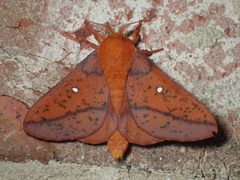
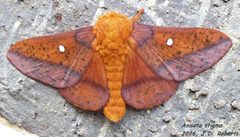
Anisota stigma is a Saturniidae commonly known as the spiny moth. The occurs across eastern and central North America, with males uniquely attracted to light among Anisota species. Its larvae feed primarily on oak foliage. The moth was first described by Johan Christian Fabricius in 1775.
Pronunciation
How to pronounce Anisota stigma: /ˌænɪˈsoʊtə ˈstɪɡmə/
These audio files are automatically generated. While they are not always 100% accurate, they are a good starting point.
Identification
Distinguished from by its relatively small size (wingspan ~45 mm versus larger in A. senatoria and A. virginiensis). Males are the only Anisota known to be attracted to light. Larvae have spiny projections not present in all related species.
Images
Appearance
have a wingspan of approximately 45 mm. The is smaller than related Anisota species. Larvae possess spiny projections, characteristic of the .
Distribution
North America from Massachusetts and southern Ontario south to Florida, west to Minnesota, Kansas, and Texas.
Diet
Larvae feed primarily on oak (Quercus). Has been reported on hazel (Corylus) and basswood (Tilia).
Behavior
Males are attracted to light, a trait unique within the Anisota.
Ecological Role
Larval herbivore on oak trees. Specific ecological interactions beyond herbivory have not been documented.
Human Relevance
Occasional defoliator of oak trees. May contribute to localized oak defoliation events, though typically not a significant pest.
Similar Taxa
- Anisota senatoriaLarger wingspan, orangestriped pattern on larvae, males not attracted to light
- Anisota virginiensisLarger size, different larval coloration, males not attracted to light
Sources and further reading
- BugGuide
- Wikipedia
- GBIF taxonomy match
- iNaturalist taxon
- NCBI Taxonomy
- Catalogue of Life
- ID Challenge #11 | Beetles In The Bush
- Outrage for oaks – Orangestriped Oakworm, Anisota senatoria — Bug of the Week
- Trails of despair for wild silk moth caterpillars: Orangestriped Oakworm, Anisota senatoria, and Greenstriped mapleworm, Dryocampa rubicunda — Bug of the Week
- Much Ado About Nothing? End-of-Summer Defoliation Heats Up
- No Buzz, No Problem: Study Shows How Honey Bees Pollinate Blueberries
- Unique Relationship Between Joshua Tree and Moth Documented for First Time