
Datana major
Grote & Robinson, 1866
azalea caterpillar, major datana
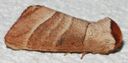
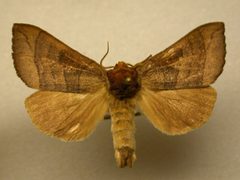
Datana major is a in the Notodontidae, commonly known as the azalea caterpillar or major datana. The ranges across the eastern and central United States, from Maryland south to Florida and west to Kansas and Arkansas. are active from June to August, with one per year in most of the range and a partial second generation in southern areas. The larvae are notable pests of azaleas and related ornamental plants.
Pronunciation
How to pronounce Datana major: /dəˈteɪnə ˈmeɪdʒər/
These audio files are automatically generated. While they are not always 100% accurate, they are a good starting point.
Identification
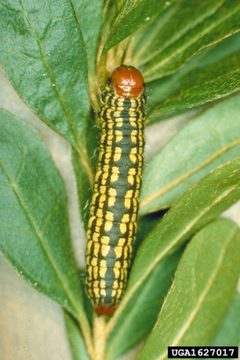
can be distinguished from other Datana by wing pattern and genitalia. The combination of geographic range and period helps separate D. major from similar species. Larvae are recognized by their distinctive black, yellow, and red striped pattern and association with Rhododendron and Andromeda. They can be distinguished from the walnut caterpillar (Datana integerrima) by plant and larval coloration pattern.
Images
Habitat
Found in deciduous and mixed forests, suburban landscapes, and commercial nurseries. Associated with containing plants in the Ericaceae, particularly cultivated azaleas and rhododendrons.
Distribution
Eastern and central United States: Maryland to Florida, west to Kansas and Arkansas. The is most common in the southeastern United States.
Seasonality
are on wing from June to August. Normally one per year; a partial second generation may occur in the southern part of the range.
Diet
Larvae feed primarily on Rhododendron and Andromeda polifolia (bog rosemary). They are feeders on Ericaceae. do not feed.
Host Associations
- Rhododendron - larval food plantprimary , including cultivated azaleas
- Andromeda polifolia - larval food plantbog rosemary, native
Life Cycle
are laid in masses on the undersides of leaves. Larvae feed gregariously when young, dispersing as they mature. They undergo five instars before dropping to the ground to pupate in a cocoon in soil or leaf litter. emerge the following summer. In the southern range, some individuals may complete a partial second .
Behavior
Larvae exhibit gregarious feeding when young, with groups of larvae consuming leaves from the edges inward. When disturbed, larvae raise their and tail in a characteristic U-shaped defensive posture. This behavior, combined with bright warning coloration, advertises their unpalatability to .
Ecological Role
As a herbivore on Ericaceae, D. major contributes to nutrient cycling in forest . The serves as prey for various and . Larval defoliation is typically localized and does not cause significant tree mortality in natural settings.
Human Relevance
Considered a significant pest of ornamental azaleas and rhododendrons in nurseries and landscapes. can cause substantial aesthetic damage to valued plantings. Larvae are often noticed by homeowners due to their conspicuous coloration and gregarious feeding. Control is rarely necessary in natural forests but may be warranted in commercial and ornamental settings.
Similar Taxa
- Datana integerrimawalnut caterpillar; similar larval appearance but feeds on Juglandaceae (walnut, hickory) rather than Ericaceae
- Datana ministrayellow-necked caterpillar; similar striped larval pattern but has yellow band behind and feeds on diverse hardwoods
- Datana perspicuaspotted datana; similar appearance but differs in wing pattern and larval plants
More Details
Taxonomic history
First described by Grote & Robinson in 1866. The has been variously treated in literature, with some sources referring to it as Drexel's datana.
Pest management
In ornamental settings, larvae can be removed by hand or with targeted applications. Bacillus thuringiensis is effective against young larvae. Natural enemies including and birds often provide adequate .
Sources and further reading
- BugGuide
- Wikipedia
- GBIF taxonomy match
- iNaturalist taxon
- NCBI Taxonomy
- Catalogue of Life
- Insects and mites that feed on leaves - AgriLife Extension Entomology
- 2018 Arizona Insect Collecting Trip “iReport” | Beetles In The Bush
- Bug Eric: November 2010
- Much Ado About Nothing? End-of-Summer Defoliation Heats Up
- Bug Eric: Wasp Wednesday: Ammophila procera
- Platystomatidae | Beetles In The Bush