
Schizura ipomaeae
Doubleday, 1841
Morning-glory Prominent, morning-glory prominent moth, false unicorn caterpillar
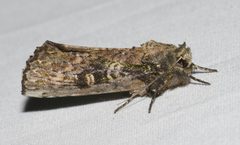
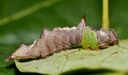
Schizura ipomaeae, the morning-glory prominent , is a North American notodontid moth whose caterpillar is commonly known as the false unicorn caterpillar. The is found throughout the United States and southern Canada. The caterpillar feeds on morning glory (Ipomoea) and related plants in the Convolvulaceae . The moth is and attracted to light.
Pronunciation
How to pronounce Schizura ipomaeae: /skɪˈzjʊərə ɪpəˈmiːiː/
These audio files are automatically generated. While they are not always 100% accurate, they are a good starting point.
Identification
The caterpillar is distinguished from similar Schizura by the single horn-like projection on the (versus paired projections in some ) and association with morning glory . require genital dissection or molecular analysis for reliable separation from closely related Schizura species, as external is highly variable and overlapping. The similar Schizura unicornis (unicorn caterpillar) has a more eastern distribution and different host preferences.
Images
Habitat
Found in open including fields, roadsides, gardens, and agricultural areas where morning glory and bindweed occur. Also present in disturbed woodlands and forest edges. The thrives in both natural and anthropogenic environments due to the widespread distribution of its plants.
Distribution
United States and southern Canada. Records from Vermont and throughout eastern and central North America. Absent from western regions where related occur.
Seasonality
are active from late spring through summer, with peak typically in June-July depending on latitude. Multiple may occur in southern portions of the range. Caterpillars are present from summer through early fall.
Diet
Caterpillars feed on leaves of morning glory (Ipomoea ) and related plants in the Convolvulaceae , including bindweeds (Calystegia, Convolvulus). They are herbivores on this plant family.
Host Associations
- Ipomoea - primary Morning glory , primary larval food plant
- Calystegia - Bindweeds, secondary
- Convolvulus - Field bindweed and relatives
Life Cycle
Complete with four stages: , larva, pupa, and . Females deposit eggs on plant leaves. Larvae feed externally on foliage, progressing through five instars. Mature larvae descend to the ground to pupate in silken cocoons among debris or in shallow soil. Adults emerge the following season; some may have partial second in favorable climates.
Behavior
Caterpillars are solitary feeders that rest along leaf midribs or stems, relying on camouflage. When disturbed, they may thrash or drop from foliage on silk threads. are and come to light. The horn-like projection in larvae is a defensive structure, though the specific defensive compounds have not been characterized for this .
Ecological Role
As a herbivore, the caterpillar contributes to nutrient cycling in early successional and serves as prey for and . The may help regulate morning glory in natural settings.
Human Relevance
Occasional pest of cultivated morning glories and sweet potatoes (Ipomoea batatas), though rarely reaching economically damaging . The caterpillar's distinctive appearance makes it a subject of interest for naturalists and photographers. The has been used in studies of plant-insect due to its specialized relationships.
Similar Taxa
- Schizura unicornisSimilar caterpillar with projection, but typically has more eastern distribution and feeds on different plants including oaks and other woody plants
- Schizura concinnaRedhumped caterpillar with bright red and hump behind head, feeds on redbud, walnut, plum, and other trees; western and eastern North American distribution with different preferences
- Schizura leptinoidesOverlapping range and similar ; requires dissection for reliable identification
More Details
Etymology
The specific epithet ipomaeae refers to the Ipomoea, the morning glories that serve as primary larval .
Taxonomic History
Described by Doubleday in 1841, with some historical confusion in literature between this and S. unicornis due to similar larval .
Sources and further reading
- BugGuide
- GBIF taxonomy match
- iNaturalist taxon
- Catalogue of Life
- Learn About Plant-Insect Interactions at this UC Davis Seminar | Bug Squad
- Meet Emily Meineke, New UC Davis Urban Landscape Entomologist | Bug Squad
- Redhumped Caterpillar: Aptly Named | Bug Squad
- Some Very Hungry Caterpillars | Bug Squad
- This Red(bud's) for You | Bug Squad
- Bug Squad