
Smerinthus cerisyi
Kirby, 1837
One-eyed Sphinx, Cerisy's Sphinx
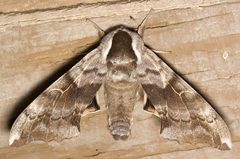
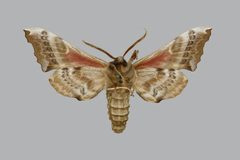
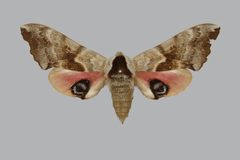
Smerinthus cerisyi is a sphinx moth in the Sphingidae, recognized by the single prominent eyespot on each hindwing. The is , with active throughout summer. Adults do not feed. Larvae feed on willow, poplar, pear, plum, and snowberry. The species was first described by William Kirby in 1837 and named in honor of Alexandre Louis Lefèbvre de Cérisy.
Pronunciation
How to pronounce Smerinthus cerisyi: /smɛˈrɪnθəs ˈsɛrɪsi/
These audio files are automatically generated. While they are not always 100% accurate, they are a good starting point.
Identification
The single blue eyespot with black center on each hindwing distinguishes Smerinthus cerisyi from similar . Smerinthus jamaicensis (Twin-spotted Sphinx) has two eyespots per hindwing. Smerinthus ophthalmica, formerly considered a synonym and now recognized as a valid , replaces S. cerisyi on the west coast of the United States. Smerinthus astarte, also formerly a synonym, was described as a separate species in 2018.
Images
Habitat
Associated with riparian and woodland where plants grow. Found in areas supporting willow, poplar, and other larval food plants.
Distribution
North America: south-eastern Alaska, southern Canada (all provinces), northern United States from border states south to northern Indiana, Pennsylvania, and Ohio; west coast to southern California; eastward to Rocky Mountains; western New Mexico north to western North Dakota. Also recorded from Illinois and Missouri. Replaced by Smerinthus ophthalmica on the west coast.
Seasonality
active through much of the summer. (single per year). Adults emerge in spring/early summer and are present until late summer.
Diet
Larvae feed on willow (Salix), poplar (Populus), pear (Pyrus communis), plum (Prunus), and snowberry (Symphoricarpos). do not feed.
Host Associations
- Salix - larval food plantwillow
- Populus - larval food plantpoplar
- Pyrus communis - larval food plantpear
- Prunus - larval food plantplum
- Symphoricarpos - larval food plantsnowberry
Life Cycle
Complete with four stages: , larva, pupa, . with one per year. Eggs laid on plants. Larvae feed and grow, then pupate in soil. Adults emerge the following spring/summer. Pupae overwinter in soil.
Behavior
are and attracted to light. Adults do not feed. Larvae are solitary feeders on plant foliage.
Ecological Role
Larval stage functions as herbivore on woody plants in Salicaceae, Rosaceae, and Caprifoliaceae. serve as potential prey for including bats and birds. Documented as for Ammophila procera.
Human Relevance
Occasional pest of ornamental trees including aspen and poplar, though damage is typically not significant. are encountered at lights and during surveys. Subject of interest for moth enthusiasts and citizen science projects such as National Moth Week.
Similar Taxa
- Smerinthus jamaicensisTwin-spotted Sphinx has two eyespots per hindwing versus one in S. cerisyi
- Smerinthus ophthalmicaFormerly synonymized with S. cerisyi, now recognized as valid replacing S. cerisyi on west coast
- Smerinthus astarteFormerly synonymized with S. cerisyi, described as separate in 2018
- Smerinthus salicetiSimilar sphinx moth in same with overlapping range
More Details
Taxonomic History
Smerinthus ophthalmica and Smerinthus astarte were formerly treated as synonyms of S. cerisyi. Taxonomic revision has recognized both as distinct , with S. ophthalmica occurring on the west coast and S. astarte as another separate entity.
Etymology
The specific epithet cerisyi honors Alexandre Louis Lefèbvre de Cérisy, a French entomologist.
Parasitoid Relationships
Documented as for the thread-waisted wasp Ammophila procera, which provisions its nests with paralyzed caterpillars of this .