
Smerinthus ophthalmica
Boisduval, 1855
Western Eyed Sphinx
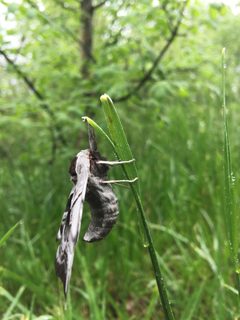
Smerinthus ophthalmica is a sphinx moth ( Sphingidae) found in western North America. Originally described by Boisduval in 1855, it was long treated as a synonym or of S. cerisyi until elevated to full status in 2010 based on morphological and genetic differences. It is distinguished from S. cerisyi by a pale brown phenotype, less scalloped forewing margins, smoother postmedian lines, sharper antemedian line angle, and narrower male antennal serrations. The species is known to lay readily on illuminated sheets during -attracting events.
Pronunciation
How to pronounce Smerinthus ophthalmica: //smɛˈrɪnθəs ɒfˈθæl.mɪ.kə//
These audio files are automatically generated. While they are not always 100% accurate, they are a good starting point.
Identification
Distinguished from the closely related Smerinthus cerisyi (One-eyed Sphinx) by: (1) pale brown coloration prevalent in prairie versus darker tones in S. cerisyi; (2) less scalloped margin on the forewing; (3) less scalloped and smoother postmedian lines on the forewing; (4) sharper angle of the antemedian line; (5) narrower serrations of the male ; and (6) substantial mitochondrial divergence. Previously considered , the two were separated in 2010 with S. ophthalmica occupying southern prairie-mountain regions and S. cerisyi occupying -mountain regions.
Images
Habitat
Prairie and mountain in western North America. Associated with grasslands, oak thickets, and mixed conifer forests. Found at elevations from lowlands to montane zones.
Distribution
Western North America from California north to Alberta, Canada. Range includes prairie-mountain regions from the Crowsnest Pass southward. Type locality: San Francisco, California.
Seasonality
active during summer months. One record from National Week event in mid-July documents -laying . Presumably single-brooded or with limited given northern latitude of much of its range.
Life Cycle
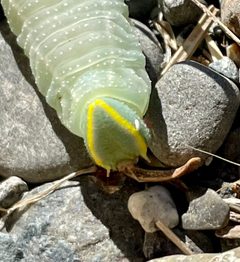
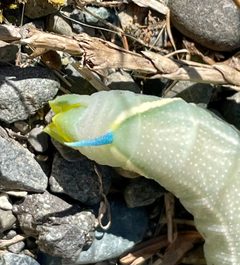
Complete with , larva, pupa, and stages. Females observed laying eggs on illuminated sheets, suggesting eggs are deposited on substrate near plants. Larval host plants inferred to include willows (Salix), cottonwoods (Populus), and possibly other woody plants based on related , but specific documentation for S. ophthalmica is lacking. occurs in the ground.
Behavior
. attracted to light. Females have been observed laying directly on illuminated sheets during -attracting events, suggesting opportunistic oviposition . Adults are known to nectar at flowers.
Ecological Role
serve as when nectaring. Larvae function as herbivores on woody plants. The is a documented for the Ammophila procera, which provisions its nests with paralyzed caterpillars.
Human Relevance
Subject of citizen science and -watching events such as National Moth Week. Of interest to lepidopterists due to its recent taxonomic elevation from synonymy. Larvae may occasionally be found on ornamental trees but are not considered significant pests.
Similar Taxa
- Smerinthus cerisyiLong treated as ; distinguished by darker coloration, more scalloped forewing margins, broader male antennal serrations, and -mountain distribution versus prairie-mountain distribution of S. ophthalmica
Misconceptions
Long misidentified as or subsumed under Smerinthus cerisyi due to historical taxonomic treatments by Rothschild & Jordan (1903) and Hodges (1971); only recognized as distinct in 2010 based on combined morphological and molecular evidence.
More Details
Taxonomic History
Described by Boisduval in 1855. Revisions by Rothschild & Jordan (1903) reduced it to of S. cerisyi. Hodges (1971) treated it as a synonym, which was generally followed until Eitschberger (2002) raised it from synonymy. Pohl, Anweiler, Schmidt & Kondla (2010) definitively established status based on morphological and mitochondrial differences.