
Smerinthus
Latreille, 1802
Eyed Hawkmoths
Species Guides
5- Smerinthus astarte(Drowsy-eyed Sphinx)
- Smerinthus cerisyi(One-eyed Sphinx)
- Smerinthus jamaicensis(Twin-spotted Sphinx)
- Smerinthus ophthalmica(Western Eyed Sphinx)
- Smerinthus saliceti(Salicet sphinx)
Smerinthus is a Holarctic of hawkmoths in the Sphingidae, containing approximately 12 recognized . are characterized by prominent eyespots on the hindwings and forewing patterns that resemble dried leaves. Adults possess reduced or absent mouthparts and do not feed. Larvae feed on a variety of plants in the families Salicaceae and possibly others.
Pronunciation
How to pronounce Smerinthus: /ˈsmɛrɪnθəs/
These audio files are automatically generated. While they are not always 100% accurate, they are a good starting point.
Identification
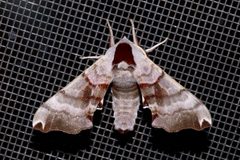
The combination of dried leaf-mimicking forewings and prominent eyespots on the hindwings distinguishes Smerinthus from similar sphinx moths. The eyespots are usually more vivid and circular than those in related like Paonias. The forewing pattern lacks the strong bark-like mottling seen in many other Sphingidae.
Images
Appearance
Medium to large hawkmoths with robust bodies. Forewings typically display patterns and coloration resembling dried leaves rather than tree bark. Hindwings bear conspicuous eyespots, often with blue or black centers surrounded by pink, red, or orange rings. are thickened toward the tip but not strongly hooked.
Habitat
Forest edge and areas with plants including Salix caprea (goat willow) and Populus tremula (aspen). have been observed in grassland with oak thickets and mixed conifers, as well as riparian areas with willow and poplar.
Distribution
Holarctic distribution encompassing North America, Europe, and Asia. Six recorded from China (S. caecus, S. kindermannii, S. minor, S. ocellatus, S. planus, S. szechuanus). S. cerisyi occurs in western North America from the Sierra Nevada and Siskiyou Mountains to upland areas of northern California. S. jamaicensis ranges across eastern North America. S. ocellatus is widespread in Europe.
Seasonality
typically active from spring through summer, with timing varying by latitude and . S. cerisyi pupates in soil and emerges the following April or May.
Host Associations
- Salix caprea - larval Goat willow; used by S. ocellatus
- Populus tremula - larval Aspen; used by S. ocellatus and S. cerisyi
- Populus - larval Cottonwoods; used by S. cerisyi
- Salix - larval Non-woolly willows; used by S. cerisyi
Life Cycle
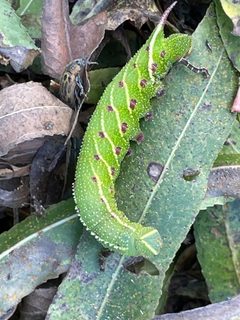
Holometabolous development with , larva, pupa, and stages. Larvae are green or bluish with diagonal stripes and a caudal horn typical of sphingid caterpillars. occurs in soil. In S. cerisyi, pupae overwinter and adults emerge the following spring.
Behavior
are . Females of S. tokyonis begin calling immediately after the photo-phase starts, releasing to attract males. Males exhibit orientation and contact behavior in response to female-emitted . Adults use olfactory cues to locate suitable and plants.
Ecological Role
Larvae function as herbivores on willow and poplar foliage. serve as prey for various including ; S. cerisyi has been recorded as a for the thread-waisted wasp Ammophila procera.
Human Relevance
Larvae occasionally cause minor defoliation of ornamental aspen and willow trees, though damage is typically insignificant. are attracted to lights and sugar . Some are reared by hobbyists.
Similar Taxa
- PaoniasAlso has eyespots on hindwings, but Smerinthus has more prominent, circular eyespots with brighter coloration and forewings that mimic dried leaves rather than bark
- PachysphinxSimilar large size and eyespots, but Smerinthus has more vivid eyespot coloration and different forewing pattern
More Details
Nomenclatural note
The name Smerinthus is derived from the Greek feminine noun 'Merinthos' but Latinized with the masculine -us ending, making it masculine according to ICZN Article 30.1.3. Consequently, the epithet ocellatus (masculine) is correct, while the commonly used ocellata is incorrect.
Pheromone chemistry
Smerinthus tokyonis produces a three-component blend: (10Z,12E)-, (10E,12Z)-, and (10Z,12Z)-hexadecadienyl acetates in a 6:7:87 ratio. This was the first identification in the Smerinthinae.
Sources and further reading
- BugGuide
- Wikipedia
- GBIF taxonomy match
- iNaturalist taxon
- NCBI Taxonomy
- Catalogue of Life
- What's That Caterpillar? | Bug Squad
- Bug Eric: Wasp Wednesday: Ammophila procera
- Bug Eric: National Moth Week Recap, 2015
- Bug Eric: November 2010
- Bug Eric: 2010
- The life history of Smerinthus minor Mell, 1937, with a review of the East Asian species of the genus Smerinthus Latreille, 1802 (Lepidoptera: Sphingidae)
- Olfaktorische Habitatfindung ausgewählter Macrolepidopteren (Abendpfauenauge Smerinthus ocellatus L. und Großer Gabelschwanz Cerura vinula L.) an Salweide (Salix caprea L.) und Zitterpappel (Populus tremula L.) in Waldmantelgesellschaften
- Identification and behavioral assays of sex pheromone components in Smerinthus tokyonis (Lepidoptera: Sphingidae)