
Smerinthus jamaicensis
Drury, 1773
Twin-spotted Sphinx
Smerinthus jamaicensis, commonly known as the Twin-spotted Sphinx, is a in the Sphingidae. It is widely distributed across North America, ranging from the Yukon southward throughout most of the continent, though absent from the southern half of western California. The belongs to a of sphinx moths characterized by their robust bodies and distinctive wing patterns.
Pronunciation
How to pronounce Smerinthus jamaicensis: //sməˈrɪnθəs ˌdʒæməˈsɛnsɪs//
These audio files are automatically generated. While they are not always 100% accurate, they are a good starting point.
Identification
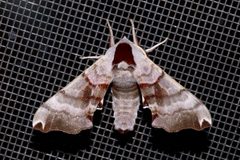
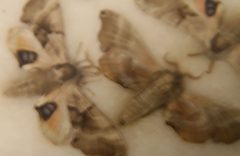
The Twin-spotted Sphinx can be distinguished from other Smerinthus by the two prominent eyespots on the hindwings (hence the ). The similar One-eyed Sphinx (Smerinthus cerisyi) has only one eyespot per hindwing. The eyespots are revealed when the is disturbed, serving as a startle display against . At rest, the forewings fold over the hindwings, concealing the eyespots and rendering the moth nearly invisible against tree bark.
Images
Appearance
A medium-sized sphinx moth with the robust, streamlined body typical of the . Forewings are cryptically patterned in shades of brown and gray, providing camouflage against bark. Hindwings display distinctive coloration with two prominent dark blue or black eyespots, each ringed with yellow or orange, which are revealed when the wings are spread. The tapers to a point. Wingspan ranges from approximately 50–70 mm.
Habitat
Occurs in diverse including deciduous and mixed woodlands, forest edges, suburban areas, and riparian corridors. Larval plants determine local distribution. are frequently attracted to artificial lights.
Distribution
Widely distributed across North America from the Yukon Territory south through Canada and the United States. Present throughout most of the continental United States except absent from the southern half of western California. Records from Alberta, Manitoba, and Saskatchewan in Canada, and from Vermont in the northeastern United States.
Seasonality
fly primarily from late spring through summer, with peak activity varying by latitude. In northern portions of the range, period is concentrated in June and July; more southerly may have extended flight periods or multiple .
Diet
Larvae feed on leaves of various woody plants including willow (Salix), poplar (Populus), and birch (Betula). do not feed; they rely on fat reserves accumulated during the larval stage.
Host Associations
- Salix - larval plant
- Populus - larval plant
- Betula - larval plant
Life Cycle
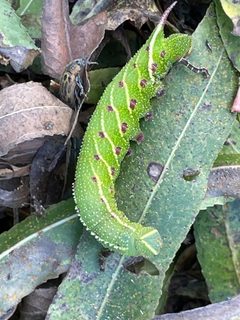
Complete with four stages: , larva, pupa, and . Females lay eggs on plant leaves. Larvae are green with diagonal white stripes and a horn at the end, typical of sphinx moth caterpillars. occurs in a subterranean . stage is the pupa. Adults emerge in spring to early summer.
Behavior
are and strongly attracted to artificial light sources. When disturbed, they display the hindwing eyespots by spreading their wings, a defensive thought to startle . Adults are capable of rapid, agile . Females have been observed laying on illuminated sheets near light traps.
Ecological Role
Larvae function as herbivores, consuming leaves of trees and contributing to nutrient cycling. serve as prey for including bats and birds. The eyespot display suggests significant pressure driving the evolution of this anti-predator .
Human Relevance
Occasionally encountered by the public at porch lights. Of minor economic importance; larvae may defoliate ornamental willows, poplars, or birches but rarely reach densities. Subject of interest among lepidopterists and enthusiasts, including during National Moth Week events.
Similar Taxa
- Smerinthus cerisyiSimilar size and coloration, but has one eyespot per hindwing rather than two; ranges overlap broadly
- Smerinthus ophthalmicaWestern with similar appearance; or parapatric distribution reduces confusion
More Details
Taxonomic history
The specific epithet jamaicensis refers to Jamaica, where the was described, though the is not restricted to that island. First described by Dru Drury in 1773.
Conservation status
Not evaluated by IUCN; appears secure throughout its broad North American range with no significant threats documented.