
Paonias
Hübner, 1819
blinded sphinx moths
Species Guides
3- Paonias astylus(Huckleberry Sphinx)
- Paonias excaecata(Blinded Sphinx)
- Paonias myops(Small-eyed Sphinx)
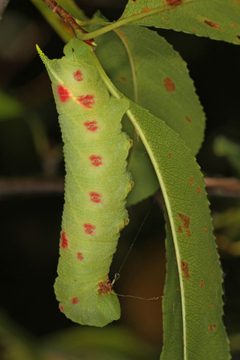
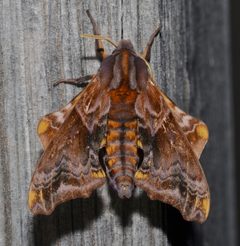
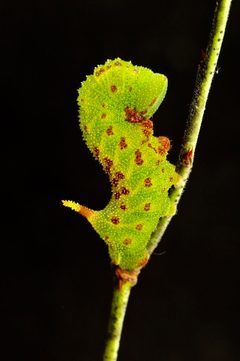
Paonias is a of sphinx moths in the Sphingidae, first described by Jacob Hübner in 1819. The genus contains five recognized distributed in North America, including the well-known blinded sphinx (Paonias excaecata) and small-eyed sphinx (Paonias myops). are medium-sized with distinctive wing patterns and reduced mouthparts; they do not feed as adults. Larvae feed on various woody plants.
Pronunciation
How to pronounce Paonias: /paʊˈnaɪəs/
These audio files are automatically generated. While they are not always 100% accurate, they are a good starting point.
Identification
of Paonias can be distinguished from other Smerinthinae by their characteristic wing patterns: the hindwings typically display prominent eyespots with blue or black centers, which are partially obscured or "blinded" by dark scaling across the eyespot, giving the its . The forewings are usually brown or gray with variable markings. The genus can be separated from the similar Smerinthus by differences in wing pattern details and genitalia structure; specific identification to level often requires examination of genitalia or careful attention to the extent of dark scaling on the hindwing eyespot and forewing pattern elements.
Images
Habitat
Deciduous and mixed woodlands, forest edges, and suburban areas with plants; larvae are associated with various woody shrubs and trees.
Distribution
North America, with records from Canada through the United States; individual have more restricted ranges within this broad area.
Seasonality
fly primarily in late spring through mid-summer, with peak activity typically in June and July depending on latitude and ; single or double-brooded depending on location.
Diet
Larvae feed on leaves of various woody plants including Prunus (cherries, plums), Salix (willows), Populus (poplars, aspens), and Betula (birches); have non-functional, reduced mouthparts and do not feed.
Behavior
are and strongly attracted to artificial light sources. When disturbed, adults may display their brightly patterned hindwings as a startle defense against . The reduced mouthparts of adults mean they rely entirely on larval-acquired energy reserves.
Ecological Role
Larvae function as herbivores on woody vegetation, contributing to nutrient cycling and serving as prey for various ; serve as prey for bats and other .
Human Relevance
frequently come to porch lights and are familiar to enthusiasts; the blinded sphinx (Paonias excaecata) is one of the more commonly encountered sphinx moths in eastern North America and is often photographed.
Similar Taxa
- SmerinthusSimilar size, wing shape, and presence of hindwing eyespots, but Smerinthus typically have more complete, unobscured eyespots and different forewing pattern elements; genitalia also differ.
- PachysphinxSimilar robust body form and Smerinthinae placement, but Pachysphinx are generally larger with different wing pattern details and lack the characteristic "blinded" eyespot.