
Paonias astylus
Drury, 1773
Huckleberry Sphinx
Paonias astylus is a sphinx moth native to eastern North America, commonly known as the huckleberry sphinx. The exhibits periods in the southern portion of its range and patterns in the north. have reduced mouthparts and do not feed; larvae specialize on woody plants in several including Ericaceae and Salicaceae.
Pronunciation
How to pronounce Paonias astylus: //paˈoʊ.niˌæs ˈæ.stɪ.ləs//
These audio files are automatically generated. While they are not always 100% accurate, they are a good starting point.
Identification
The combination of pink hindwing patches with dark margins distinguishes Paonias astylus from other eastern North American sphinx moths. Similar P. excaecatus (blinded sphinx) has more extensive pink on hindwings with blue-gray shading toward the base; P. myops (small-eyed sphinx) is larger with more rounded forewings. The gray-brown forewings with relatively indistinct patterning separate P. astylus from more boldly marked sphingids.
Images
Appearance
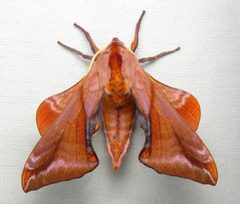
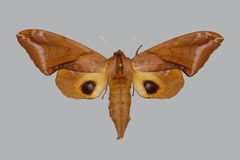
Wingspan 55–65 mm. Forewings are typically gray-brown with variable darker markings. Hindwings display a distinctive pink or rose-colored patch with dark borders, characteristic of the Paonias. Body is robust with a tapering typical of sphingid .
Habitat
Deciduous and mixed woodlands, forest edges, and shrubby areas where larval plants occur. Associated with blueberry barrens, wetland margins, and riparian corridors supporting Salix and Vaccinium.
Distribution
Eastern North America: Maine south to Florida, west to Missouri and Mississippi. Core range spans the Atlantic coastal plain and interior eastern deciduous forest.
Seasonality
active March–June and again in September in Florida (two ). Single generation with adults in July in northern portions of range. Larvae present during growing season corresponding with adult periods.
Diet
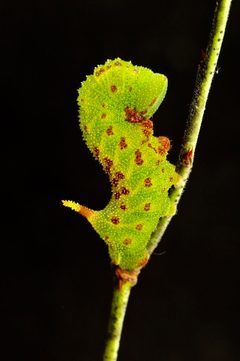
Larvae feed on Vaccinium (blueberry, including V. vacillans and V. corymbosum), Prunus, Andromeda, and Salix. do not feed.
Host Associations
- Vaccinium vacillans - larval food plantlowbush blueberry
- Vaccinium corymbosum - larval food planthighbush blueberry
- Prunus - larval food plant
- Andromeda - larval food plant
- Salix - larval food plantwillow
Life Cycle
Complete with , larva, pupa, and stages. stage not explicitly documented in available sources; likely pupal given northern .
Ecological Role
Larval herbivore on woody shrubs; contributes to nutrient cycling through leaf consumption. serve as potential prey for including bats and birds.
Human Relevance
Minor economic significance as a blueberry pest; occasional presence noted in cultivated Vaccinium plantings. occasionally attracted to artificial light sources.
Similar Taxa
- Paonias excaecatusSimilar size and pink hindwings, but has more extensive pink coloration with blue-gray basal shading on hindwings and more contrasting forewing pattern
- Paonias myopsLarger size (wingspan 70–85 mm), more rounded forewings, and different season in overlapping range