
Paonias myops
Smith, 1797
Small-eyed Sphinx, small-eyed sphinx moth
Paonias myops, commonly known as the small-eyed sphinx, is a in the Sphingidae. It was first described by James Edward Smith in 1797. The ranges across much of North America, from southeastern Canada to Florida and westward nearly to the Pacific Coast, with additional in Mexico. are notably more than most sphingid moths, with activity primarily from June through September depending on latitude.


Pronunciation
How to pronounce Paonias myops: /ˈpaʊniəs ˈmaɪɒps/
These audio files are automatically generated. While they are not always 100% accurate, they are a good starting point.
Identification
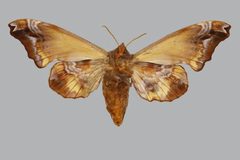
Distinguished from other Paonias by its smaller eyespots on the hindwings compared to the related blinded sphinx (Paonias excaecata). The species name 'myops' (Greek for 'near-sighted' or 'small-eyed') refers to these reduced eyespots. are more than most sphingids, which may aid in identification through behavioral observation.
Images
Appearance
have a wingspan of 52–69 mm. The exhibits the typical robust, streamlined body form characteristic of sphinx moths. Specific coloration and pattern details are not documented in available sources.
Habitat
Specific preferences are not documented in available sources. As a member of Sphingidae, it likely occurs in areas supporting larval plants, though these have not been identified in the provided material.
Distribution
Occurs from southeastern Canada (Quebec, Ontario, Manitoba, Saskatchewan, Alberta, Vermont) south to Florida, westward nearly to the Pacific Coast of the United States, and south into Mexico. Two are recognized: P. m. myops (nominate) and P. m. occidentalis (Mexico).
Seasonality
are active from June to September in eastern Canada. Multiple occur per year in southern portions of the range: two generations in New Jersey, four generations in Louisiana. Peak activity varies with latitude and local climate conditions.
Life Cycle
Complete with multiple per year in southern portions of the range. Specific details regarding , larval, and pupal stages are not documented in available sources.
Behavior
are more than most sphingid , a notable behavioral divergence within the . They are attracted to light. activity is primarily nocturnal rather than .
Human Relevance
are attracted to artificial light sources. No other documented human interactions are noted in available sources.
Similar Taxa
- Paonias excaecataSimilar in overall appearance and size, but distinguished by larger, more prominent eyespots on the hindwings; P. myops has notably smaller eyespots as referenced by its specific epithet.
More Details
Subspecies
Two recognized: Paonias myops myops (nominate, widespread) and Paonias myops occidentalis Clark, 1919 (Mexico).