
Paonias excaecata
Smith, 1797
Blinded Sphinx
Paonias excaecata, commonly known as the blinded sphinx, is a in the Sphingidae. It occurs across much of North America, from Canada to Florida and west to California and Texas. are attracted to ultraviolet lights, a trait frequently utilized by collectors and researchers for observation. The is one of several hawk moths found in the Paonias, which are characterized by their robust bodies and relatively broad wings.
Pronunciation
How to pronounce Paonias excaecata: /paˈoː.ni.as ɛk.sɛˈkaː.ta/
These audio files are automatically generated. While they are not always 100% accurate, they are a good starting point.
Identification
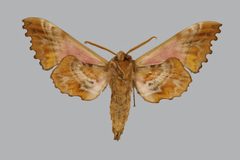
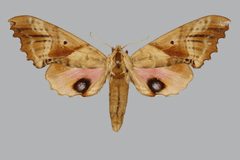
Distinguished from the similar small-eyed sphinx (Paonias myops) by the hindwing eyespot structure: P. excaecata has a more reduced, "blinded" eyespot without a complete dark pupil, whereas P. myops has a more defined, circular eyespot with a dark center. The pink coloration on the hindwing is generally more extensive in P. excaecata. Forewing pattern is variable and not reliably diagnostic between these .
Images
Appearance
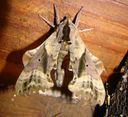
have a robust, streamlined body typical of sphinx moths. The forewings are generally brownish with variable patterning. The hindwings display distinctive coloration that aids in identification—typically featuring a blue or blue-gray eyespot with a dark center, bordered by a pink or reddish-pink patch. The "blinded sphinx" refers to the reduced or "blind" appearance of this eyespot, which lacks the complete concentric rings seen in related . Wingspan ranges from approximately 45–75 mm.
Habitat
Occurs in diverse including deciduous and mixed woodlands, forest edges, riparian corridors, and suburban areas with adequate tree cover. Larval plants are typically found in these wooded or semi-wooded settings.
Distribution
Transcontinental in North America. In Canada: Nova Scotia, New Brunswick, Prince Edward Island, Quebec, Ontario, Manitoba, Saskatchewan, Alberta, and British Columbia. In the United States: south to Florida in the east, westward through the Great Plains to eastern California, and south to central Texas.
Seasonality
have been observed from late spring through summer, with peak activity typically in June and July in the northern parts of the range. The single observation in the provided context occurred in mid-July in Illinois.
Diet
feed on nectar from various flowers. Larvae feed on leaves of plants in the Rosaceae, including cherry (Prunus), plum, and possibly other rosaceous trees and shrubs.
Host Associations
- Prunus - larval cherry and plum
Life Cycle
Complete with four stages: , larva, pupa, and . Larvae are green with diagonal white stripes and a horn at the end, typical of sphinx moth caterpillars. occurs in a subterranean . Adults are and attracted to light.
Behavior
are and strongly attracted to ultraviolet light sources, a well-documented in field observations. They are also known to visit flowers for nectar. Larvae are solitary feeders on plant foliage.
Ecological Role
function as when visiting flowers. Larvae serve as herbivores, consuming foliage of rosaceous trees and shrubs, and likely serve as prey for various including birds and .
Human Relevance
are frequently encountered by entomologists and naturalists at ultraviolet light setups, making them a familiar for collectors. The larvae are not considered significant economic pests. The species is sometimes featured in field guides to North American moths due to its distinctive hindwing pattern and wide distribution.
Similar Taxa
- Paonias myopsSimilar size, shape, and general coloration; distinguished by more complete, circular hindwing eyespot with dark pupil
- Paonias astylusAnother congeneric sphinx moth with overlapping range; differs in hindwing pattern details