
Ammophila aberti
Haldeman, 1852
Abert's Thread-waisted Wasp
Ammophila aberti is a solitary thread-waisted wasp in the Sphecidae, notable for its distinctive nesting and provisioning of caterpillars to its offspring. Females construct underground burrows in firm sand or soil, hunt and paralyze lepidopteran larvae, and provision nests with multiple prey items over extended periods. The exhibits complex nest closure behaviors using pebbles and soil, and has been documented engaging in nest and prey theft within nesting .
Pronunciation
How to pronounce Ammophila aberti: /æmˈɔfɪlə əˈbɜːrtaɪ/
These audio files are automatically generated. While they are not always 100% accurate, they are a good starting point.
Identification
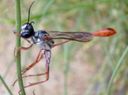
Distinguished from similar Ammophila by its sleek, silvery appearance and larger size relative to most . Less robust than A. procera. In the field, identification may require examination of nest architecture and geographic location. The species nests in harder substrates than some congeners, using pebbles extensively in nest closure.
Images
Appearance
Sleek, silvery with a thread-waisted body form typical of the . Larger than average for Ammophila, approaching the length of A. procera but less robust. Body has metallic silver coloration. prominent, used for prey capture and nest manipulation.
Habitat
Open, semi-arid locations with firm sand or muddy areas suitable for excavation. Nests constructed in hard, baked soil or compact sand. Documented in coastal and dune environments, flat areas with hard-packed substrate. Avoids loose, shifting sands.
Distribution
Western and central North America, from southern Canada to Mexico. Ranges throughout western North America, east as far as Iowa. Documented in Baja California Sur, Mexico; southern Arizona; Colorado; and other western states.
Seasonality
Active during warmer months. Nesting observed in May in southern Arizona. Autumn nesting documented in Baja California Sur, Mexico (2006-2007). Activity period extends through summer with provisioning potentially delayed by weather conditions.
Diet
of lepidopteran larvae (caterpillars). Recorded prey includes geometrid larvae and caterpillars from at least five : Geometridae, Noctuidae, Pyralidae, Hesperiidae, and Pieridae. Prey is paralyzed with venom and stored alive in nests.
Life Cycle
Solitary nesting with . Female constructs vertical or angled burrow several centimeters long in firm substrate, ending in a round 18-20 mm in diameter. Single laid on first caterpillar deposited. Larva feeds on provisioned prey, potentially reaching maturity by time last caterpillar is added. Development occurs entirely within sealed nest.
Behavior
Females dig nests by biting and removing soil, emitting audible buzz detectable from over four meters away. Excavated soil is flown away from burrow. Nests provisioned with 6-10 caterpillars on average, with gathering taking over two days. Temporary nest closure achieved by pulling pebble over entrance and covering with sand; reopened to deposit prey. Final closure involves jamming pebbles into burrow and kicking dirt or sand down, tamped with rock or hard object. Females may initiate multiple simultaneous nests (up to 8-12 documented), few of which are completed—possibly as decoys against . Prey-stealing observed: females attack returning to wrest caterpillars, and some dig open nests to pilfer cached prey. Mating involves male riding female's back, grasping her with ; female must elevate for successful copulation.
Ecological Role
of caterpillars, potentially regulating lepidopteran in sandy and semi-arid . Subject to by satellite flies (Sarcophagidae: Miltogramminae) and bee flies (Thyridanthrax sp.). Two documented as predators of larvae in Baja California Sur. Acts as inadvertent for Strepsiptera to offspring through extended maternal contact during provisioning.
Human Relevance
Not aggressive toward humans; stings only if physically grabbed or directly molested. Nesting activities brief and localized, not persistent over weeks. No threat to pets or children. Potential agent for caterpillar pests in appropriate .
Similar Taxa
- Ammophila proceraLarger and more robust; A. aberti is sleeker and less bulky despite similar length
- Ammophila pictipennisEast of Rockies primarily; has black body with red and orange wings versus silvery coloration of A. aberti
More Details
Nest Parasitism
nest documented: females may dig open nests of other A. aberti to steal cached prey. This , along with direct prey robbery from returning females, represents significant .
Tool Use Discussion
Historical accounts described nest closure as 'tool use' with pebbles as hammers; subsequent research interprets this as culmination of instinctive rather than true tool use, though the behavior may have originated through selection favoring more secure nest closure against velvet ant .
Strepsiptera Association
Research by Millena and Rosenheim demonstrated that A. aberti and related Ammophila with extended maternal provisioning (many small caterpillars versus one large prey item) show higher rates of Strepsiptera transmission to offspring, representing a trade-off between parental care and risk.
Sources and further reading
- BugGuide
- Wikipedia
- GBIF taxonomy match
- iNaturalist taxon
- NCBI Taxonomy
- Catalogue of Life
- 'When I Grow Up, I Want to Be an Entomologist' | Bug Squad
- Humbled and Honored to Receive ACE Awards | Bug Squad
- RJ Millena: from Entomology-Focused Kindergartener to Scoring Cover of Journal With Her Research | Bug Squad
- Bug Eric: Wasp Wednesday: Ammophila aberti
- Bug Eric: Wasp Wednesday: Ammophila pictipennis
- Bug Eric: Wasp Wednesday: Ammophila procera
- Observations on the Provisioning Behavior of Ammophila Aberti Haldeman (Hymenoptera: Sphecidae)
- Historia natural de la anidación de ammophila aberti haldeman (hymenoptera: sphecidae) en Baja California Sur. México
- Nest parasitism and nest defense in the solitary ground-nesting wasp Ammophila aberti Haldeman, 1852, with notes on the nesting behavior of Ammophila parkeri Menke, 1964 and Podalonia mexicana (de Saussure, 1867) (Hymenoptera: Sphecidae)