
Ammophila pictipennis
Walsh, 1869
thread-waisted wasp
Ammophila pictipennis is a thread-waisted wasp in the Sphecidae, widespread in eastern North America and south to Mexico City. It is one of the most common and distinctive members of its east of the Rocky Mountains. The is solitary and nests in sandy or hard-baked soil, provisioning each nest with a single paralyzed caterpillar for its larva. Females exhibit characteristic roosting , gripping vegetation with their during inclement weather or overnight.
Pronunciation
How to pronounce Ammophila pictipennis: //ˌæm.əˈfaɪ.lə ˌpɪk.təˈpɛn.ɪs//
These audio files are automatically generated. While they are not always 100% accurate, they are a good starting point.
Identification
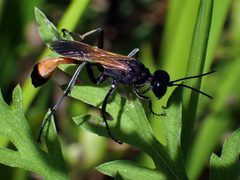
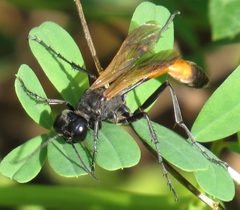
Distinguished from other Ammophila by the combination of orange or yellow wings and lack of silver bars on the lateral . Most similar species in the possess silver thoracic markings or differently colored wings. The metallic blue reflections on the black body can be visible in good light but may require appropriate viewing angle.
Images
Appearance
Black body with red abdominal segments. Black areas display metallic blue reflections under appropriate lighting. Wings are distinctly orange or yellow in color, a key diagnostic feature. Lacks the silver thoracic stripes present in many other Ammophila .
Habitat
Open areas with sandy soil; also excavates burrows in hard-baked soil. Frequently associated with prairie and grassland , including fields with flowering plants such as Dalea candida (White Prairie Clover).
Distribution
Eastern half of North America, from southern Canada through the eastern United States, extending south to Mexico City. Common east of the Rocky Mountains.
Seasonality
Active primarily during warmer months; observed from at least June through October. Specific varies with latitude.
Diet
feed on nectar from flowers. Larvae are fed paralyzed caterpillars by the provisioning female.
Host Associations
- Mythimna unipuncta - prey, paralyzed and provisioned in nest
- Xestia c-nigrum - preySpotted Cutworm
- Spodoptera ornithogalli - preyYellow-striped Armyworm
- Helicoverpa zea - preyCorn Earworm
- Pholisora catullus - preyCommon Sootywing skipper caterpillar; at least one record
Life Cycle
Solitary nesting . Female excavates shallow, vertical or nearly vertical burrow in sand or hard soil. Burrow shaft is slightly longer than the 's body and terminates in a nearly perpendicular . Female provisions the cell with a single paralyzed caterpillar, lays an on it, and permanently seals the nest. Nest closure involves manipulation of soil particles and small pebbles, with documented use of objects as tools to tamp down the seal.
Behavior
Exhibits distinctive roosting : grips plant stems with , props body at approximately 45-degree angle using middle and hind legs, often in loose clusters with conspecifics during night or inclement weather. Nesting females are persistent and typically return to burrows if disturbed. Transport prey by grasping with mandibles and middle legs, rendering caterpillar rigid for easier carriage; capable of running rapidly with prey and also flying while carrying caterpillars beneath the body. Performs orientation after nest completion to memorize location.
Ecological Role
of caterpillars, including several agricultural pest . Potential agent for cutworms and armyworms. Subject to by Strepsiptera ; research indicates that species with extended maternal contact (multiple small caterpillars vs. single large prey) show elevated risk of transmitting to offspring, though this specific pattern has been documented more broadly across the than specifically for A. pictipennis.
Human Relevance
Preys on caterpillar pests of crops, including corn earworm and armyworms. Not aggressive toward humans. Of interest in studies of insect tool use and parental care evolution.
Similar Taxa
- Ammophila proceraLarger size, possesses silver stripes on that A. pictipennis lacks; wings not orange-yellow
- Ammophila ferruginosaDifferent color pattern; lacks distinctive orange wings of A. pictipennis
More Details
Tool use documentation
Early observers (Rau & Rau, 1918) interpreted nest-closing as tool use, with females selecting and manipulating pebbles to tamp down soil. Subsequent research indicates this represents a fixed action pattern rather than cognitively flexible tool use, though the behavior remains notable among insects.
Research significance
Specimens of this have been included in broader studies of Ammophila-Strepsiptera - relationships, contributing to understanding of how parental care strategies influence risk across the .
Sources and further reading
- BugGuide
- Wikipedia
- GBIF taxonomy match
- iNaturalist taxon
- NCBI Taxonomy
- Catalogue of Life
- 'When I Grow Up, I Want to Be an Entomologist' | Bug Squad
- Humbled and Honored to Receive ACE Awards | Bug Squad
- Bug Eric: Wasp Wednesday: Ammophila pictipennis
- Bug Eric: White Prairie Clover: An Awesome Blossom
- Bug Eric: Wasp Wednesday: Ammophila procera
- Bug Eric: Ammophila in Action