
Mythimna unipuncta
(Haworth, 1809)
true armyworm moth, white-speck moth, common armyworm, rice armyworm
Mythimna unipuncta is a migratory noctuid found across North America, South America, Europe, Africa, and Asia. Larvae feed on grasses and cereal crops, causing significant agricultural damage during . are and nectivorous, feeding on flower nectar and ripe or decaying fruit. The exhibits seasonal , traveling north in spring and south in fall to optimize mating conditions. Larvae display characteristic , moving en masse between fields when food sources are depleted.
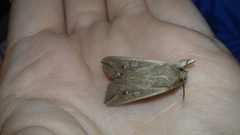
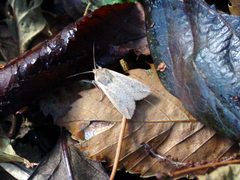
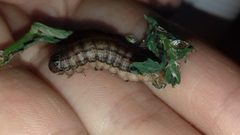
Pronunciation
How to pronounce Mythimna unipuncta: //mɪˈθɪmnə juːnɪˈpʌŋk.tə//
These audio files are automatically generated. While they are not always 100% accurate, they are a good starting point.
Identification
Distinguished from similar by the white speck pattern on forewings (the source of its "white-speck "). The combination of ochreous-grey forewings with suffusion, distinct white dots in the central darker area, and black dots along the wing edge separates it from Mythimna separata (northern armyworm) and Spodoptera species. Larvae are identified by the white lateral and spiracular lines against a grayish-green to brown background, with obscure line and plainer lines.
Images
Habitat
Found in agricultural landscapes, grasslands, and open with abundant grasses. Larvae develop on cereal crops, forage grasses, and weedy grasses. occur in diverse habitats including fields, meadows, and areas with flowering plants for nectar. In North America, inhabits areas east of the Rocky Mountains and northern Canada.
Distribution
Native to the Neotropical region but introduced and established across most of North America south of the Arctic, parts of South America, southern Europe, central and western Africa, western Asia, Iran, Israel, and Hawaii. In Europe recorded from Azores, Britain, Crete, France, Greece, Portugal, Sicily, and Spain. In North America, primarily east of the Rocky Mountains.
Seasonality
Multiple per year (2–3), each requiring 30–50 days to complete. are active from spring through fall, with timing: northward in spring, southward in fall. Mating occurs primarily in summer months. In the British Isles, season extends through summer months. Larval activity peaks in late spring and early summer; in the United States, crop monitoring is recommended especially in the first two weeks of June.
Diet
Larvae feed on Graminae (grasses), including cereal crops (wheat, barley, corn, rice) and weedy grasses. are nectivorous, feeding on nectar from various flowers and consuming ripe or decaying fruit.
Life Cycle
Complete with four stages: , larva, pupa, . Eggs laid in clusters of 80 on dry leaves and grass, especially between leaf and blade; incubation 3.5–6.5 days depending on temperature. Larval stage lasts 20–30 days across 6–9 instars, with growth from 4 mm to 35 mm. Later instars are , hiding in soil during daylight. occurs underground in a silken case; pupal stage 7–14 days in warm conditions, up to 40 days in cool conditions. Adult lifespan 9–10 days in warm conditions, 17–19 days in cool conditions. Total time 30–50 days.
Behavior
as . Larvae exhibit classic "" : mass movement in lines between fields when food depleted, releasing silk and dropping to soil when disturbed. Later instar larvae hide under soil during daylight, emerging to feed at night. Seasonal occurs with northward movement in spring and southward movement in fall to ensure favorable summer mating conditions. Females release for mate attraction; males use hair-pencils containing benzaldehyde and acetic acid in courtship. Hearing is important for both mating and evasion—tympanal organ detects bat echolocation, causing cessation of calling and . Diel hiding behavior in larvae is influenced by plant volatiles, light conditions, rearing history, larval , and developmental stage.
Ecological Role
Significant agricultural pest causing defoliation of cereal and forage crops. Serves as for numerous natural enemies including over 60 and fly (e.g., Winthemia rufopicta, Glyptapanteles militaris, Meteorus autographae, Cotesia marginiventris), predatory , ground beetles, ants, spiders, and birds (bobolink, crows, starlings). Subject to bacterial, fungal (Metarhizium anisopliae), and viral . contribute to pollination of flowering plants including apple.
Human Relevance
Major agricultural pest of cereals, corn, rice, and forage crops. Larval cause economically significant defoliation; monitoring recommended in early June in affected regions. traps used for monitoring. and baits employed for control. Rye cover crops can increase larval populations and damage in subsequent corn crops. MON810 Bt maize shows low efficacy, creating resistance management concerns. Also studied as model organism for physiology, pheromone , and insecticide resistance.
Similar Taxa
- Mythimna separataNorthern or rice ear-cutting caterpillar; similar larval and range but differs in distribution (primarily Asia) and wing pattern
- Spodoptera frugiperdaFall armyworm; similar and larval but belongs to different , has more distinct larval stripes and different forewing pattern
- Spodoptera exempta; similar mass- and larval appearance but restricted to Africa, distinct
- Spodoptera ornithogalliYellow-striped armyworm; similar larval and but with distinct yellow striping, different wing pattern
Sources and further reading
- BugGuide
- Wikipedia
- GBIF taxonomy match
- NCBI Taxonomy
- Rye Cover Crops Can Increase Armyworm Damage in Corn
- P.M. Pollinators: Study Shines Light on Nocturnal Insects' Role in Apple Production
- Bug Eric: National Moth Week 2021 Review
- A Missouri hotspot for Cylindera unipunctata | Beetles In The Bush
- How Artificial Intelligence Could Make It Easier to ID Common Corn Pests
- Bug Eric: Wasp Wednesday: Ammophila pictipennis
- Mythimna unipuncta . [Distribution map].
- Effect of rearing conditions on fatty acid allocation during flight in nectivorous lepidopteran Mythimna unipuncta
- Host location and suitability of the armyworm larvae of Mythimna unipuncta for the tachinid parasitoid Exorista larvarum
- Rearing History, Larval Density, and Larval Developmental Stage Affect Volatile- and Light-Mediated Diel Hiding Behavior in Mythimna unipuncta
- A battle of armies: massive attack of natural enemies to the true armyworm Mythimna unipuncta (Haworth, 1809) (Lepidoptera: Noctuidae) in forage crops
- The complete genome sequence of a second alphabaculovirus from the true armyworm, Mythimna unipuncta: implications for baculovirus phylogeny and host specificity
- Inheritance, fitness costs, incomplete resistance and feeding preferences in a laboratory‐selected MON810‐resistant strain of the true armyworm Mythimna unipuncta
- Influence of crop variety and fertilization on oviposition preference and larval performance of a generalist herbivore, the true armyworm, Mythimna unipuncta
- How do caterpillars cope with xenobiotics? The case of Mythimna unipuncta, a species with low susceptibility to Bt