
Glyptapanteles
Ashmead, 1904
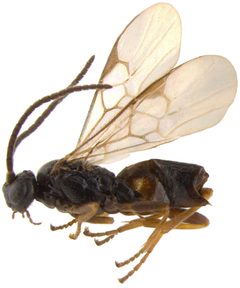
Glyptapanteles is a of koinobiont endoparasitoid in the Braconidae, distributed across all continents except Antarctica. in this genus are distinguished by their ability to manipulate : after larval from caterpillar hosts, the paralyzed host remains near the pupal cocoons and defends them against through violent thrashing movements. This behavioral manipulation is mediated by one or two larvae that remain within the host and sacrifice their own development to protect their siblings. Several species have been evaluated for of lepidopteran pests, particularly Lymantria dispar.
Pronunciation
How to pronounce Glyptapanteles: //ˌɡlɪptəˈpæntɪliːz//
These audio files are automatically generated. While they are not always 100% accurate, they are a good starting point.
Identification
Members of Glyptapanteles can be distinguished from other Microgastrinae by the combination of: tarsal claws with a distinct basal lobe or tooth; fore wing with areolet absent or reduced; and metasomal tergites with distinct sculpturing patterns. The genus is morphologically similar to Cotesia and Apanteles, but differs in tarsal claw structure and the degree of metasomal sculpturing. -level identification requires examination of male genitalia and molecular markers.
Images
Habitat
Associated with diverse terrestrial supporting lepidopteran , including temperate oak forests, agricultural fields, and natural vegetation. Field studies have documented occurrence in mixed oak forests with Quercus , as well as in winter cereal crops.
Distribution
Widely distributed across all continents except Antarctica. Documented from the Palearctic (Europe, including Austria, Denmark, Norway, Sweden; South Korea), Nearctic (North America), Neotropical (Brazil), Oriental (India), and Australasian (New Zealand) regions.
Seasonality
Activity patterns vary by and latitude. Glyptapanteles porthetriae exhibits multivoltine with successive in spring and early summer in temperate regions. occurs as first instar larvae within caterpillars.
Host Associations
- Lymantria dispar - primary early instar larvae, spring ; evaluated for biocontrol
- Mythimna (Pseudaletia) sequax - predominant in southern Brazil winter cereals
- Pseudaletia unipuncta - optimal for mass-rearing of G. militaris on ryegrass-fed
- Elymnias hypermnestra - type for G. hypermnestrae in India
- Chrysodeixis chalcites - documented
- Thyrinteina leucocerae - documented with behavioral manipulation observed
- Acronicta rumicis - G. liparidis prefers second-instar larvae
- Euproctis chrysorrhoea - potential alternative for G. porthetriae
- Phragmatobia fuliginosa - potential alternative for G. porthetriae
- Diacrisia virginica - potential alternative for G. porthetriae
- Orgyia leucostigma - potential alternative for G. porthetriae
- Hyphantria cunea - potential alternative for G. porthetriae
- Alcis repandata - potential alternative for G. porthetriae
- Peribatodes rhomboidaria - potential alternative for G. porthetriae
- Gelis sp. - hyperparasitoidhyperparasitoid of G. flavicoxis cocoons
- Supputius cincticeps - shield bug repelled by manipulated caterpillars
Life Cycle
Koinobiont endoparasitoid development: females oviposit into caterpillar , which continue feeding and growing until the 4th or 5th instar. Up to 80 larvae may emerge simultaneously from a single host to pupate externally. One or two larvae typically remain within the host to mediate behavioral manipulation. occurs in white silk cocoons clustered near the host. Development from to requires approximately 235 above 6.9°C for some . occurs as first instar larvae within alternative host species.
Behavior
Notable for behavioral manipulation: after larval , the caterpillar host positions itself near the pupal cocoons, arches its back, ceases feeding, and responds to disturbance with violent thrashing that repels . This benefits the pupae at the expense of the host, which eventually dies. Experimental studies demonstrate that manipulated hosts successfully ward off predators in approximately 60% of encounters, significantly improving pupal survival compared to unguarded cocoons.
Ecological Role
Acts as a natural enemy of lepidopteran herbivores, with potential to regulate pest . Most effective at low densities. Serves as prey for hyperparasitoids. The behavioral manipulation phenomenon represents a complex host- interaction with demonstrated impact on dynamics through altered -prey relationships.
Human Relevance
Evaluated for of pests: G. flavicoxis, G. porthetriae, and G. militaris assessed by USDA for control of Lymantria dispar in the United States. Mass-rearing protocols developed using optimal plant conditions (fresh ryegrass for G. militaris). observed under laboratory conditions may affect rearing .
Similar Taxa
- CotesiaSimilar koinobiont endoparasitoid lifestyle and range; distinguished by tarsal claw and metasomal sculpturing
- ApantelesClosely related within Microgastrinae with overlapping associations; requires morphological examination for separation
- Hymenoepimecis argyraphaga of behavioral manipulation; manipulates spider hosts rather than caterpillars
- Ampulex compressaSimilar manipulation strategy but in ; represents independent evolutionary origin of behavioral manipulation in Hymenoptera
More Details
Polydnavirus association
in this carry that are vertically transmitted and play a role in suppressing immune responses and facilitating successful . The polydnavirus associated with G. indiensis has been characterized morphologically and genomically.
Interspecific competition
G. porthetriae and G. liparidis compete within shared Lymantria dispar . Outcomes depend on oviposition timing: G. porthetriae typically wins when ovipositing first due to faster development, but G. liparidis dominates in simultaneous or delayed scenarios, particularly in older host larvae.
Heavy metal bioaccumulation
G. liparidis has been documented to accumulate heavy metals from contaminated Lymantria dispar , indicating potential sensitivity to environmental pollution.
Sources and further reading
- BugGuide
- Wikipedia
- GBIF taxonomy match
- iNaturalist taxon
- NCBI Taxonomy
- Interspecific competition between the braconid endoparasitoids Glyptapanteles porthetriae and Glyptapanteles liparidis in Lymantria dispar larvae
- New Insights into the Phenology and Overwintering Biology of Glyptapanteles porthetriae, a Parasitoid of Lymantria dispar
- POTENTIAL HOST RANGE EXPANSION BY THE HYPERPARASITOID GELIS SP.: UTILIZATION OF GLYPTAPANTELES FLAVICOXIS (HYMENOPTERA: BRACONIDAE) BY A PARASITOID OF COTESIA MELANOSCELA
- Host Age ofPseudaletia unipuncta(Lepidoptera: Noctuidae) and Parasitic Capacity ofGlyptapanteles militaris(Hymenoptera: Braconidae)
- Pathological response of the parasitoid, Glyptapanteles militaris, to nuclear polyhedrosis virus-infected armyworm hosts
- Physiological suppression of the larval parasitoid Glyptapanteles pallipes by the polyembryonic parasitoid Copidosoma floridanum
- A new species of Glyptapanteles (Hymenoptera: Braconidae: Microgastrinae), a larval parasitoid of Elymnias hypermnestra (Linnaeus) (Lepidoptera: Nymphalidae), along with some new host records of parasitoids from Peninsular India
- Morphological and genomic characterization of the polydnavirus associated with the parasitoid wasp Glyptapanteles indiensis (Hymenoptera: Braconidae)
- Larval stage Lymantria dispar microRNAs differentially expressed in response to parasitization by Glyptapanteles flavicoxis parasitoid
- Effects of parasitoid associated factors of the endoparasitoid Glyptapanteles liparidis (Hymenoptera: Braconidae)
- Effect of Honey and Sucrose on Longivity of Larval Endoparasitoids Viz., Glyptapanteles agamemnonis (Wilkinson) and Meteorus pulchricornis (Wesmael)
- Morphological and Molecular Characterization of Reared Parasitoid Wasps of the Genus Glyptapanteles Ashmead 1904 (Insecta: Hymenoptera: Braconidae: Microgastrinae) Associated with Lepidoptera in India
- Parasitóides larvais de Mythimna (Pseudaletia) sequax Franclemont e capacidade de parasitismo de Glyptapanteles muesebecki (Blanchard) em relação ao tempo de exposição, temperatura e densidade de hospedeiros
- Heavy metal concentrations of the endoparasitoid Glyptapanteles liparidis Bouche (Hymenoptera) in contaminated Lymantria dispar L. larvae (Lepidoptera)
- Development of the solitary larval endoparasitoid Glyptapanteles porthetriae (Hymenoptera: Braconidae) in its host Lymantria dispar (Lepidoptera: Lymantriidae)