
Phragmatobia fuliginosa
(Linnaeus, 1758)
Ruby Tiger, Ruby Tiger Moth
Phragmatobia fuliginosa, the Ruby Tiger, is a in the Arctiinae of Erebidae. It has a wingspan of 35–45 mm and is distinguished by dark reddish-brown forewings with a blackish comma-shaped spot and bright carmine to rose-red hindwings. The is widely distributed across the Palearctic and into northern North America, with multiple recognized including the North American P. f. rubricosa. It exhibits geographic variation in time: in northern regions with flying in June, and in southern Britain with adults appearing April–June and again August–September.


Pronunciation
How to pronounce Phragmatobia fuliginosa: //fræɡməˈtoʊbiə fjuːlɪdʒɪˈnoʊsə//
These audio files are automatically generated. While they are not always 100% accurate, they are a good starting point.
Identification
Distinguished from similar tiger moths by the combination of dark reddish-brown forewings with blackish comma-shaped spot and bright carmine to rose-red hindwings with black marginal spots. The Ruby Tiger's hindwing coloration is more uniformly red and less heavily spotted than many related . borealis (northern Scotland and Eurasia) has more extensive black markings with red restricted; North American subspecies rubricosa similar to nominate form. May be confused with Phragmatobia placida (sometimes treated as separate species), which has more triangular forewings uniformly dark brown and hindwings pure light pink with black spots.
Images
Appearance
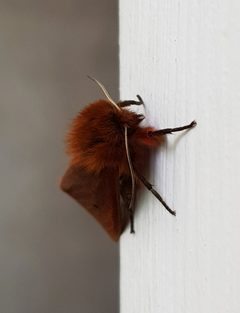
Forewings dark reddish-brown with dense scaling; a blackish comma-shaped spot at the apex of the , edged with carmine. Hindwings carmine to bright rose-red, more or less hyaline in the costal area, with more or less confluent black spots before the margin and at the apex of the cell. Underside strongly suffused with purple-pink. dark reddish-brown. Wingspan 35–45 mm. reddish-grey. Larva light or dark grey with black-brown ; entire body covered with foxy red hairs (more black-brown in some forms). Pupa black with marked with yellow in segmental incisions.
Habitat
Moist open forest and meadow areas, mixed hardwood forests at low elevations, open meadows or prairies, and agricultural areas at low elevations. Common on low-growing plants, high-roads, railway embankments, and waste fields. Larval hiding places include ground-level vegetation; larvae sometimes found on field paths and roads on warm winter days.
Distribution
: most of Europe (widespread in Great Britain and Ireland, absent only from Shetland), North Africa, Russia, Central Asia, Tibet. Northern North America (as rubricosa). Subspecies: borealis in Scotland and northern Eurasia; melitensis in Malta; paghmani in Transcaucasia through Central Asia and western China; pulverulenta in eastern China, Mongolia, and southeastern Kazakhstan; rubricosa in North America; taurica in Near East from southern Turkey to Palestine.
Seasonality
fly May to August depending on location. In southern England: , with April–June and August–September. In northern Britain and northern regions: , with single generation in June. stage: fully-grown larvae.
Diet
larvae feed on various plants including Rubus fruticosus (bramble), Prunus spinosa (blackthorn), Filipendula ulmaria (meadowsweet), Plantago lanceolata and P. major (plantains), Senecio jacobaea (ragwort) and other Senecio , Salix repens, S. starkeana, S. phylicifolia (willows), Polygonum spp., Rumex crispus (curled dock), Potentilla erecta (tormentil), Rubus idaeus (raspberry), Trifolium spp. (clovers), Chamaenerion angustifolium (fireweed), Calluna vulgaris (heather), Vaccinium myrtillus (bilberry), V. uliginosum (bog bilberry), Andromeda polifolia (bog rosemary), and Taraxacum species (dandelions). do not feed.
Life Cycle
Spherical reddish-grey deposited in batches. Hairy larvae feed through summer and autumn, overwinter fully-grown. in spring. In northern Britain typically single ; in southern Britain usually two generations. Larvae show extreme cold —one individual observed embedded in ice for at least 14 days without apparent harm.
Behavior
occasionally active during day but more commonly recorded at light; late summer more attracted to light traps. Larvae bask in sunshine to raise body temperature above ambient. Speedy larvae often observed running across roads and paths, particularly on warm winter days when they leave hiding places. Male courtship involves derived from obtained during larval feeding.
Ecological Role
Larval herbivore in open ; contributes to nutrient cycling through consumption of diverse herbaceous plants. serve as prey for birds, bats, and other . Male system based on sequestered plant alkaloids represents a tritrophic interaction.
Human Relevance
sequenced (629.4 Mb assembly, 28 chromosomal pseudomolecules, 13,338 protein-coding genes) as part of Darwin Tree of Life project. Occasionally encountered in gardens and agricultural areas. Not considered a pest . Subject of ecological and physiological research due to larval cold and chemical of production.
Similar Taxa
- Phragmatobia placidaOften treated as separate ; distinguished by more triangular, uniformly dark brown forewings and pure light pink hindwings with black spots
- Spilarctia luteumSimilar tiger moth with red hindwings, but forewing pattern differs and hindwing spotting more extensive
- Arctia cajaLarger garden tiger with more boldly patterned forewings and more heavily spotted hindwings
More Details
Genomic Resources
High-quality assembly available: 629.4 Mb, 28 chromosomal pseudomolecules (27 plus Z ), 15.4 kb mitochondrial genome, 13,338 protein-coding genes. Specimen from Wytham Woods, Oxfordshire, UK (June 2020).
Chemical Ecology
Male used in courtship are derived from (PAs) sequestered during larval feeding, primarily from Senecio (ragworts).
Subspecies Variation
Recognized show clinal variation in coloration and size: borealis (northern, more melanistic), fervida (Turkestan and northern China, largest and lightest), placida (southeast Europe and Asia Minor, large with triangular forewings).