
Arctia caja
(Linnaeus, 1758)
Garden Tiger, Great Tiger Moth
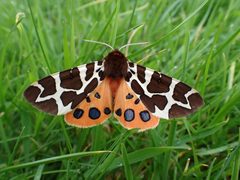
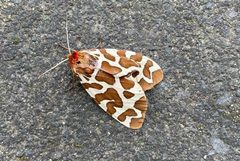
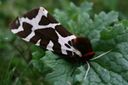
Large, conspicuously colored with a wingspan up to 65 mm. Forewings are cryptic brown with irregular cream-colored bands; hindwings are orange (rarely yellow) with large rounded bluish spots. This aposematic sequesters toxic alkaloids for defense. The species has undergone significant decline in the U.K. over the past 30 years, accompanied by phenotypic changes including longer, narrower wings and reduced genetic diversity.
Pronunciation
How to pronounce Arctia caja: //ˈɑrktiə ˈkaɪdʒə//
These audio files are automatically generated. While they are not always 100% accurate, they are a good starting point.
Identification
Distinguished from similar tiger moths by the combination of brown forewings with cream bands and bright orange hindwings with blue-black spots. Males have weakly pectinate (comb-like) , while females have thread-like antennae. The hindwing pattern of large rounded bluish spots on orange background is diagnostic. Similar include other Arctia, but A. caja is larger and has the distinctive blue-spotted orange hindwings.
Images
Habitat
Open forests, clearings, forest edges and hedgerows, roadsides, extensive dry or wet grasslands, and occasionally gardens. Found from lowland plains to over 2,300 m elevation. Prefers seasonal and temperate environments with sufficient ground vegetation for larval development.
Distribution
Holarctic distribution. In Europe: from Spain through western and central Europe to eastern Asia and Japan; north to Scandinavia, south to southern Italy, the Peloponnese, Asia Minor, and the Himalayas. In North America: belt and cordilleras of western North America.
Seasonality
. Most observed from mid-June to mid-August. Adults fly at night. Caterpillars hibernate through winter while still small (<10 mm), resuming feeding in spring.
Diet
Caterpillars are extremely , feeding on a wide range of low-growing plants and shrubs including Rumex, Rubus, Urtica, Lonicera, and Salix.
Life Cycle
laid in flat plates on undersides of plant leaves. Caterpillars hibernate in ground vegetation while small (<10 mm). occurs in a silk web woven on the ground. emerge in summer and are .
Behavior
activity. Aposematic coloration serves as warning to ; the sequesters toxic alkaloids from plants. do not feed.
Human Relevance
Subject of long-term studies in the U.K. documenting 85% decline over 30 years. sequenced as part of biodiversity research. Caterpillars occasionally encountered by gardeners but not considered a pest.
Similar Taxa
- Arctia virginalisSimilar (Ranchman's tiger moth) and larval form (woolly bear caterpillar), but restricted to western North America with different wing patterns and preferences.
- Other Arctia speciesGenerally smaller or with different hindwing coloration; A. caja is distinguished by its large size and distinctive orange hindwings with blue-black spots.
Sources and further reading
- BugGuide
- GBIF taxonomy match
- iNaturalist taxon
- NCBI Taxonomy
- Catalogue of Life
- Rick Karban and the Wooly Bear Caterpillars of Bodega Bay | Bug Squad
- UCF student names a new frog species after her professor | Blog
- Nota Lepidopterologica | Blog - Part 2
- endoparasitoid | Blog
- Long-term decline in abundance and distribution of the garden tiger moth ( Arctia caja ) in Great Britain
- Phenotypic changes and reduced genetic diversity have accompanied the rapid decline of the garden tiger moth ( Arctia caja ) in the U.K.
- The genome sequence of the Garden Tiger, Arctia caja (Linnaeus, 1758) (Lepidoptera: Erebidae).