
Arctia
Schrank, 1802
tiger moths
Species Guides
8- Arctia alpina(Arctic Tiger Moth)
- Arctia caja(Garden Tiger)
- Arctia lapponica(Lapland Tiger Moth)
- Arctia opulenta(Opulent Tiger Moth)
- Arctia parthenos(St. Lawrence tiger moth)
- Arctia plantaginis(wood tiger)
- Arctia virginalis(Ranchman's Tiger Moth)
- Arctia yarrowii(Yarrow's tiger moth)
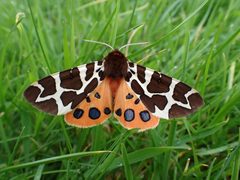
Arctia is a of tiger moths in the Erebidae, serving as the type genus for the subtribe Arctiina, tribe Arctiini, and Arctiinae. The genus was substantially expanded in 2016 following phylogenetic studies by Rönkä et al., which synonymized several previously separate genera. within Arctia exhibit aposematic warning coloration and have been subjects of long-term ecological research, including a 40-year study of Arctia virginalis in California.
Pronunciation
How to pronounce Arctia: /ˈɑrktiə/
These audio files are automatically generated. While they are not always 100% accurate, they are a good starting point.
Identification
Members of Arctia can be distinguished by palpi that are porrect (extending forward) and reach beyond the , with the first two joints being hairy. Males possess bipectinate with short branches swollen at the extremity and a terminal bristle, while females have serrate antennae. The legs are hairy, with the hind tibia bearing two pairs of spurs. The forewings are notably short and broad relative to body size.
Images
Distribution
are distributed throughout North America, the Palearctic region, India, and Sri Lanka. Specific documented occurrences include the Russian Far East (Khabarovsk Krai), Finland, Great Britain, and the western coast of North America from California through Oregon and Washington.
Life Cycle
Complete with documented developmental anomalies in some . Laboratory rearing of Arctia menetriesii demonstrated a development cycle from to lasting 72–83 days, with high mortality rates prior to observed under certain dietary conditions.
Behavior
of some , such as Arctia menetriesii, are not attracted to light and are not nocturnally active, flying reluctantly and making them difficult to detect. Larvae of Arctia plantaginis exhibit -induced plasticity in warning signal expression, developing more melanized (smaller orange patch) warning signals and molting more frequently when exposed to simulated risk.
Human Relevance
Some have experienced significant declines in parts of their range, such as Arctia caja in Great Britain, making them subjects of conservation concern. The has been extensively studied for aposematic coloration evolution and -prey interactions.
More Details
Taxonomic History
Following phylogenetic studies by Rönkä et al. in 2016, multiple were synonymized with Arctia, substantially expanding the genus's content and reclassifying many previously separate species.
Research Significance
Arctia virginalis has been the subject of continuous monitoring at Bodega Bay, California since 1982, representing one of the longest-running studies of insect . Precipitation has been identified as the primary driver of abundance, with wet winters associated with higher caterpillar densities.
Sources and further reading
- BugGuide
- Wikipedia
- GBIF taxonomy match
- iNaturalist taxon
- NCBI Taxonomy
- Catalogue of Life
- Rick Karban and the Wooly Bear Caterpillars of Bodega Bay | Bug Squad
- Nota Lepidopterologica | Blog - Part 2
- Nota Lepidopterologica welcomes new Editor-in-Chief Marcin Wiorek
- Academic journal | Blog
- open access | Blog
- Figure 3 from: Koshkin ES (2021) Life history of the rare boreal tiger moth Arctia menetriesii (Eversmann, 1846) (Lepidoptera, Erebidae, Arctiinae) in the Russian Far East. Nota Lepidopterologica 44: 141-151. https://doi.org/10.3897/nl.44.62801
- Life history of the rare boreal tiger moth Arctia menetriesii (Eversmann, 1846) (Lepidoptera, Erebidae, Arctiinae) in the Russian Far East
- Food-web modification in the eastern Gulf of Finland after invasion of Marenzelleria arctia (Spionidae, Polychaeta)
- Predator-Induced Plasticity on Warning Signal and Larval Life-History Traits of the Aposematic Wood Tiger Moth, Arctia plantaginis
- Long-term decline in abundance and distribution of the garden tiger moth ( Arctia caja ) in Great Britain
- Precipitation Drives the Abundance and Distribution of Arctia virginalis: A 40-Year Study.
- The genome sequence of the Garden Tiger, Arctia caja (Linnaeus, 1758) (Lepidoptera: Erebidae).