
Arctia virginalis
(Boisduval, 1852)
Ranchman's Tiger Moth, woolly bear caterpillar (larval form)
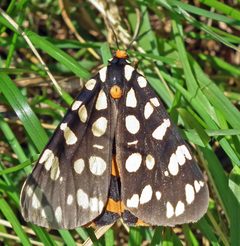
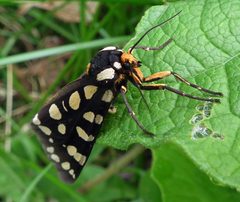
Arctia virginalis is a tiger moth in the Erebidae, found in western North America. The species was first described by Jean Baptiste Boisduval in 1852 and was formerly placed in the Platyprepia before being transferred to Arctia. are brightly colored with black forewings bearing light yellow spots and orange hindwings with black bands. The larvae, known as woolly bears, are densely hairy caterpillars with distinctive orange-black-orange coloration. A 40-year study at Bodega Bay, California, found that precipitation is the primary driver of abundance, with wet winters and wet sites supporting higher densities.
Pronunciation
How to pronounce Arctia virginalis: /ˈɑrk.ti.ə vɜrˈdʒɪ.næl.ɪs/
These audio files are automatically generated. While they are not always 100% accurate, they are a good starting point.
Identification
distinguished from similar tiger moths by combination of black forewings with light yellow spots and orange hindwings with broad irregular black bands. Larvae readily identified by dense long hairs with orange and tail and black central portion; this orange-black-orange pattern is distinctive among woolly bear caterpillars in western North America. Formerly known as Platyprepia virginalis.
Images
Habitat
Wet lowland prairies, wet meadows, wet forests, and riparian zones along creeks in dry desert regions. are patchy and strongly associated with moisture; dry upland sites are 7 times more likely to experience local extinctions. Caterpillars occur in litter and on low vegetation in these wet environments.
Distribution
Western North America from southern Monterey Bay, California across Nevada and southern Utah to Colorado, and north to southern British Columbia. are extremely patchy, with some separated by tens or hundreds of kilometers. Documented at coastal northern California, Sierra Nevada freshwater marsh at 1480m elevation, Trinity Alps, and coastal Washington.
Seasonality
on wing in summer. : females oviposit in late spring, hatch after 1–2 weeks, caterpillars feed through summer, autumn, and winter, pupate, and adults emerge the following late spring.
Diet
Larvae feed on a wide range of herbaceous plants. Observed feeding on Lupinus arboreus (yellow bush lupine) and Argentina anserina (silverweed cinquefoil). Early instars feed in litter on low vegetation; later instars climb vegetation to feed. Diet mixing enhances performance compared to single-plant diets. Partial to plants containing alkaloids but does not sequester alkaloids in tissues.
Host Associations
- Lupinus arboreus - larval foodplantYellow bush lupine, primary at Bodega Bay study site
- Argentina anserina - larval foodplantSilverweed cinquefoil, formerly Potentilla anserina
Life Cycle
. Females oviposit on vegetation or scatter on ground in late spring. Eggs hatch after 1–2 weeks. Caterpillars feed through summer, autumn, and winter. Early instars inconspicuous in litter, moving less than 1 meter. Later instars climb vegetation and are conspicuous with orange-black-orange coloration. Last instars wander many meters to find protected sites. spin silken cocoon. emerge in late spring; adults do not feed.
Behavior
attracted to mating on local hilltops; females leave these aggregations to oviposit. Early instar caterpillars spend most of time in litter and move only short distances. Later instars climb vegetation and become conspicuous. Last instar caterpillars typically wander many meters, likely searching for protected sites. Unlike many arctiids, does not sequester alkaloids from plants.
Ecological Role
Caterpillars serve as herbivores consuming vegetation and as prey for including ants. for and viral . synchronized across distant sites potentially through correlated precipitation patterns (Moran effect). varies up to 1000-fold annually, influencing local dynamics.
Human Relevance
Subject of 40-year ecological research on at Bodega Bay, California. Research has demonstrated strong precipitation-abundance relationships relevant to understanding climate change impacts on insect . Used in educational contexts to illustrate complex ecological interactions and long-term population studies. No known economic importance as pest or beneficial .
Similar Taxa
- Arctia caja (Garden Tiger Moth)Similar tiger moth appearance with spotted forewings and brightly colored hindwings, but A. caja has more regular wing patterns and is Palearctic, not found in western North America
- Other Arctia speciesShared characteristics of tiger moth coloration; distinguished by specific wing pattern details and geographic range
More Details
Taxonomic History
Formerly classified as Platyprepia virginalis; transferred to Arctia along with from genera Acerbia, Pararctia, Parasemia, and Platarctia based on phylogenetic studies. Basionym Chelonia virginalis Boisduval, 1852.
Long-term Research
40-year study (1980–2020) at Bodega Marine Reserve represents one of the longest continuous studies of any insect. Study revealed regime shift around 2002 coincident with changing precipitation patterns, and that precipitation interacts with multiple other factors (, , food quality) to determine abundance.
Population Dynamics
densities vary by up to 1000-fold. Wet winters associated with many caterpillars; more caterpillars found in wet sites than drier sites. has not shown decline over 40-year study period, unlike many other insect populations, though pattern of dynamics differed between 1985–2000 and post-2000 periods.
Sources and further reading
- BugGuide
- Wikipedia
- GBIF taxonomy match
- iNaturalist taxon
- NCBI Taxonomy
- Catalogue of Life
- Rick Karban and the Wooly Bear Caterpillars of Bodega Bay | Bug Squad
- Why a Population of 'Bears' May Predict White House Occupancy | Bug Squad
- Rick Karban, UC Davis Expert on Plant Communication, Named ESA Fellow | Bug Squad
- UC Davis Researchers: Wooly Bear Caterpillars Pick Winner of U.S. Presidential Campaign | Bug Squad
- Nota Lepidopterologica | Blog - Part 2
- Precipitation Drives the Abundance and Distribution of Arctia virginalis : A 40-Year Study