
Pyrrharctia isabella
J.E. Smith, 1797
Isabella tiger moth, banded woolly bear, woolly bear, woolly worm
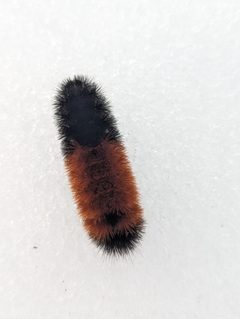
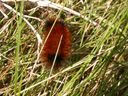
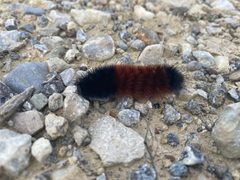
Pyrrharctia isabella is a tiger moth native to North America, best known for its larval form, the banded woolly bear caterpillar. The caterpillar is recognized by its alternating black and orange-brown bands and has become famous in North American folklore as a supposed predictor of winter weather severity. The species exhibits remarkable freeze , allowing larvae to survive winter temperatures by producing cryoprotectants that prevent lethal ice crystal formation. are dull yellowish to orangish with sparse black wing spotting and bright reddish-orange forelegs.
Pronunciation
How to pronounce Pyrrharctia isabella: //pɪˈrɑrk.ti.ə ˌaɪ.zəˈbɛl.ə//
These audio files are automatically generated. While they are not always 100% accurate, they are a good starting point.
Identification
Larvae are distinguished from other 'woolly bear' caterpillars by their uniform setae length and the specific pattern of two black bands (one , one ) flanking a single orange-brown band. This contrasts with the giant leopard moth caterpillar (Hypercompe scribonia), which is entirely black without orange bands, and the saltmarsh caterpillar (Estigmene acrea), which is often uniformly orange or yellowish without distinct black bands. are identified by the combination of dull yellowish-orangish coloration, bright reddish-orange forelegs, sparse black wing spotting, and three black dots per abdominal segment.
Images
Habitat
Occurs in cold and temperate regions. Larvae are found in meadows, fields, and areas with herbaceous vegetation. larvae seek protected locations under ground cover, fallen leaves, or beneath loose bark of fallen trees. The ' feeding habits allow it to inhabit virtually any area where plants grow.
Distribution
Present throughout the United States and Canada. Records confirm presence in Alberta, Manitoba, and Saskatchewan. A doubtful record exists for Belgium.
Seasonality
Larvae emerge from in fall and overwinter in caterpillar form. Activity resumes in spring with warming temperatures and fresh leaf availability. are present in summer. Multiple festivals celebrating the caterpillar occur in autumn across North America.
Diet
herbivore. Larvae consume a broad range of herbaceous plants and trees. Documented food plants include dandelion, aster, and plantain. Laboratory rearing has succeeded on bean, wheat germ, casein-wheat germ diets, and fresh plantain.
Life Cycle
are deposited on vegetation in late summer or fall. Larvae hatch in fall and feed before entering for winter. Unlike many , this overwinters as a partially grown larva rather than as egg or pupa. In spring, larvae resume feeding briefly, then spin a cocoon and pupate. The number of larval instars varies from 7 to 10. Temperature influences diapause development; larvae reared at 22-26°C survive chilling at 5°C, while those reared at 30°C do not.
Behavior
When threatened, larvae curl into a tight ball with stout, outward-facing spines as a defensive posture. Larvae are frequently observed in autumn moving across open ground seeking shelter. Overwintering larvae survive freezing through production of cryoprotectants (glycerol and sorbitol) that prevent ice crystal formation within , allowing supercooling and freeze .
Ecological Role
Herbivore that processes plant . Serves as prey item for various . The has been used as a model organism for studying freeze and cryoprotectant biochemistry in insects.
Human Relevance
Central figure in North American folklore as a supposed weather predictor; the relative width of larval color bands is traditionally believed to forecast winter severity, though this has no scientific basis. Subject of multiple festivals including the Woollybear Festival in Vermilion, Ohio (since 1973), Banner Elk, North Carolina (since 1977), and Beattyville, Kentucky (since 1988). Popular in children's nature education due to its conspicuous appearance and harmless nature. Larvae do not possess stinging or , though handling is discouraged as sharp hairs may cause dermatitis in sensitive individuals.
Similar Taxa
- Hypercompe scribonia (giant leopard moth)Larva is entirely black without orange bands, larger, and curls into ball showing crimson rings between segments when disturbed; is white with black spots and patterns.
- Estigmene acrea (saltmarsh caterpillar)Larva often uniformly orange or yellowish without distinct black bands; lacks the banded pattern diagnostic of Pyrrharctia isabella.
- Grammia incorruptaLarva also called 'woollybear' but known to self-medicate by consuming alkaloid-laden leaves to fight ; not distinguished by banding pattern in provided sources.
Misconceptions
Folklore claims that the width of the brown band on larvae predicts winter severity, with wide bands indicating mild winters and narrow bands severe winters. This has no scientific basis; band width varies with larval age (widening with ) and genetic variation within clutches, not weather. Claims of 70-80% forecasting are anecdotal and unsupported.
More Details
Freeze tolerance physiology
Larvars survive subfreezing temperatures by producing cryoprotectants including glycerol and sorbitol. These compounds act as antifreeze, preventing ice formation within while allowing freezing in extracellular spaces. The stops beating, followed by freezing of gut, blood, and body tissues. Recovery involves redistribution of ions across cell during thawing.
Laboratory rearing
Successfully reared from to at 26°C with 15:9 hour light:dark . Individual rearing is feasible; group rearing not documented in available sources.
Sources and further reading
- BugGuide
- Wikipedia
- GBIF taxonomy match
- iNaturalist taxon
- NCBI Taxonomy
- Catalogue of Life
- A Fuzzy-Wuzzy Good Time with Holiday Gifts | Bug Squad
- Dashing caterpillars predicting weather- Woolly bears, Pyrrharctia isabella, saltmarsh caterpillar, Estigmene acrea, and leopard moths, Hypercompe scribonia — Bug of the Week
- Winter mild or wild? Ask the banded woolly bear, Pyrrharctia isabella — Bug of the Week
- Dashing caterpillars predicting weather and preparing for winter: Banded woolly bear, Pyrrharctia Isabella, Giant woolly bear, Hypercompe scribonia, and Saltmarsh caterpillar, Estigmene acrea — Bug of the Week
- What do insects do in winter, Part 2? Tolerating the big chill: Banded woolly bears, Pyrrharctia isabella, field crickets, Gryllus spp., baldfaced hornets, Dolichovespula maculata, and others — Bug of the Week
- Catch a Glimpse of Caterpillars During National Moth Week
- Transmembrane ion distribution during recovery from freezing in the woolly bear caterpillar Pyrrharctia isabella (Lepidoptera: Arctiidae)
- LABORATORY REARING OF THE BANDED WOOLLYBEAR,PYRRHARCTIA (ISIA) ISABELLA(LEPIDOPTERA: ARCTIIDAE), ON DIFFERENT DIETS WITH NOTES ON THE BIOLOGY OF THE SPECIES
- FURTHER STUDIES ON THE BIOLOGY OFPYRRHARCTIA(ISIA)ISABELLA(LEPIDOPTERA: ARCTIIDAE): III. THE RELATION BETWEEN HEAD CAPSULE WIDTH AND NUMBER OF INSTARS
- Further studies on the biology of the banded woollybear, Pyrrharctia (Isia) isabella (J. E. Smith) (Lepidoptera: Arctiidae). IV. Diapause development as influenced by temperature