
Pyrrharctia
Packard, 1864
woolly bear moth
Species Guides
1- Pyrrharctia isabella(Isabella tiger moth)
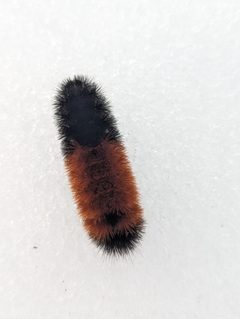
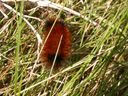
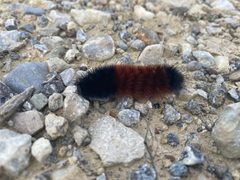
Pyrrharctia is a of tiger moths in the Erebidae, described by Packard in 1864. The genus contains two described found in North and Central America. The best-known species, Pyrrharctia isabella, produces the familiar banded woolly bear caterpillar, widely recognized for its black and orange banded appearance and cultural association with winter weather prediction. The genus is notable for the freeze- adaptations of its larvae, which overwinter as caterpillars using cryoprotectant compounds to survive subfreezing temperatures.
Pronunciation
How to pronounce Pyrrharctia: /pɪˈrɑːrktiə/
These audio files are automatically generated. While they are not always 100% accurate, they are a good starting point.
Images
Distribution
North and Central America.
Human Relevance
The larvae of Pyrrharctia isabella, known as banded woolly bears or woolly bear caterpillars, are culturally prominent in North American folklore as supposed predictors of winter weather severity. A popular tradition holds that the width of the orange band on the caterpillar forecasts winter conditions, with wider orange bands predicting milder winters. This folklore was popularized by entomologist C. H. Curran's studies from 1948-1956, though scientific evidence does not support predictive . The caterpillars are frequently featured in educational outreach and citizen science events such as National Week.
Similar Taxa
- Hypercompe scribonia (giant leopard moth)Larvae are large, black, and densely hairy, resembling all-black woolly bears, but lack orange bands entirely and curl into a tight ball when disturbed, unlike the banded woolly bear.
- Estigmene acrea (saltmarsh caterpillar)Larvae can be orange or yellow and lack the distinct black banding pattern of Pyrrharctia isabella; they are not freeze-tolerant in the same manner and do not overwinter as larvae.
Misconceptions
The belief that banded woolly bear caterpillars can predict winter weather severity based on orange band width is a persistent folklore with no scientific basis. Band width actually reflects larval age and developmental stage rather than future meteorological conditions.
Sources and further reading
- BugGuide
- Wikipedia
- GBIF taxonomy match
- iNaturalist taxon
- NCBI Taxonomy
- Catalogue of Life
- A Fuzzy-Wuzzy Good Time with Holiday Gifts | Bug Squad
- Dashing caterpillars predicting weather- Woolly bears, Pyrrharctia isabella, saltmarsh caterpillar, Estigmene acrea, and leopard moths, Hypercompe scribonia — Bug of the Week
- What do insects do in winter, Part 2? Tolerating the big chill: Banded woolly bears, Pyrrharctia isabella, field crickets, Gryllus spp., baldfaced hornets, Dolichovespula maculata, and others — Bug of the Week
- Winter mild or wild? Ask the banded woolly bear, Pyrrharctia isabella — Bug of the Week
- Dashing caterpillars predicting weather and preparing for winter: Banded woolly bear, Pyrrharctia Isabella, Giant woolly bear, Hypercompe scribonia, and Saltmarsh caterpillar, Estigmene acrea — Bug of the Week
- Catch a Glimpse of Caterpillars During National Moth Week
- Transmembrane ion distribution during recovery from freezing in the woolly bear caterpillar Pyrrharctia isabella (Lepidoptera: Arctiidae)
- LABORATORY REARING OF THE BANDED WOOLLYBEAR,PYRRHARCTIA (ISIA) ISABELLA(LEPIDOPTERA: ARCTIIDAE), ON DIFFERENT DIETS WITH NOTES ON THE BIOLOGY OF THE SPECIES
- FURTHER STUDIES ON THE BIOLOGY OFPYRRHARCTIA(ISIA)ISABELLA(LEPIDOPTERA: ARCTIIDAE): III. THE RELATION BETWEEN HEAD CAPSULE WIDTH AND NUMBER OF INSTARS
- Further studies on the biology of the banded woollybear, Pyrrharctia (Isia) isabella (J. E. Smith) (Lepidoptera: Arctiidae). IV. Diapause development as influenced by temperature