
Estigmene acrea
Drury, 1773
Salt Marsh Moth, Acrea Moth
Estigmene acrea, commonly known as the salt marsh or acrea moth, is a native North American moth in the Erebidae. The is notable for its highly variable caterpillar coloration, ranging from pale yellow to dark brown or black, and its unique relationship with —compounds it can detoxify and convert into . display striking : males have yellow-orange hindwings while females have white hindwings, with both sexes bearing black spots. The species exhibits unusual mating including male formation and female calling.
Pronunciation
How to pronounce Estigmene acrea: /ɛˈstɪɡmɪni ˈækrɪə/
These audio files are automatically generated. While they are not always 100% accurate, they are a good starting point.
Identification
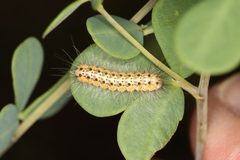
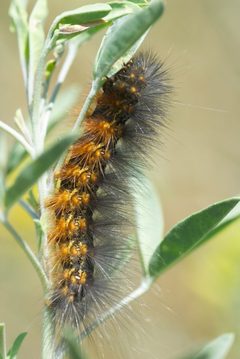
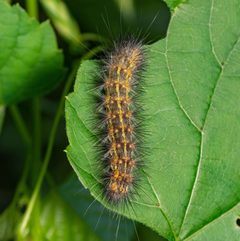
distinguished from similar white tiger moths by combination of white forewings with black spotting, yellow-orange (male) or white (female) hindwings with black spots, and yellow-orange with black spots. Caterpillars recognized by dense hair in tufts, variable coloration, segmental white dots, and rows of orange or black warts. Resembles banded woolly bear (Pyrrharctia isabella) but lacks black terminal bands; resembles giant woolly bear (Hypercompe scribonia) but is smaller and less uniformly black.
Images
Habitat
Occurs in diverse including salt marshes, meadows, fields, agricultural areas, and disturbed sites. attracted to flowers and honeydew. Larvae feed on broad range of herbaceous and woody plants.
Distribution
Native to North America from southern Canada (Ontario, Quebec, Alberta, Manitoba, Saskatchewan) throughout the United States, extending south through Mexico to Colombia. Also recorded from Democratic Republic of Congo and Kenya. Most abundant as a pest in the southwestern United States.
Seasonality
generally active May to August in northern portions of range; year-round in southern Florida and southern Texas. Multiple per year in southern range; single generation with larvae in northern range.
Diet
Caterpillars are , feeding on dandelion, cabbage, cotton, walnut, apple, tobacco, pea, potato, clover, maize, and numerous other herbaceous and woody plants. feed on nectar and honeydew.
Host Associations
- dandelion - larval food plant
- cabbage - larval food plant
- cotton - larval food plant
- walnut - larval food plant
- apple - larval food plant
- tobacco - larval food plant
- pea - larval food plant
- potato - larval food plant
- clover - larval food plant
- maize - larval food plant
Life Cycle
laid in clusters on plant leaves. Larvae hatch and feed through growing season; in northern range, partially grown larvae overwinter and resume feeding in spring before pupating. In southern range, multiple occur with continuous development. Larvae pupate in hair-and-leaf cocoons. emerge and mate; females call to males from within .
Behavior
Exhibits unique dual mating system: males form (aggregated display sites) where they inflate abdominal coremata and release derived from ingested ; females also actively call to males using (Z,Z)-3,6-cis-9,10-epoxyheneicosadiene. Calling peaks during second through fourth nights after , with bimodal calling pattern. Mated females produce significantly less pheromone than virgins. attracted to ultraviolet light.
Ecological Role
Caterpillars serve as herbivores and prey for including ichneumon Therion morio. may function as when nectaring. Unique alkaloid metabolism allows utilization of plants containing that are toxic to most other herbivores, potentially reducing competition for these resources.
Human Relevance
Occasional agricultural pest, particularly in southwestern United States, damaging corn, cotton, and other crops. Caterpillars known as "salt marsh caterpillars" or "woollybears"; sometimes confused with weather-predicting banded woolly bears (Pyrrharctia isabella) in folklore. Used in scientific research on insect-plant chemical interactions, , and lekking .
Similar Taxa
- Pyrrharctia isabella (Isabella Tiger Moth)Banded woolly bear caterpillar has distinct black-orange-black banding pattern; E. acrea lacks black terminal bands and has more variable coloration
- Hypercompe scribonia (Giant Leopard Moth)Giant woolly bear caterpillar is larger, uniformly black with crimson intersegmental rings when disturbed, and has more formidable spine defense; E. acrea smaller with variable coloration
- Spilosoma virginica (Virginia Tiger Moth)Yellow bear caterpillar more uniformly pale yellow; E. acrea more variable with distinct segmental markings
Misconceptions
Despite "salt marsh caterpillar" and superficial resemblance to banded woolly bear, this has no demonstrated ability to predict winter weather—a folklore attribute properly associated with Pyrrharctia isabella.
More Details
Alkaloid Metabolism
Unique among insects in ability to detoxify from plants and convert them into male courtship . This involves hydrolysis to retronecine and re-esterification to insect-specific alkaloids. The alkaloids also stimulate growth of male coremata (pheromone-disseminating organs).
Sexual Dimorphism
Hindwing coloration differs between sexes: males have yellow-orange hindwings, females have white hindwings. This is unusual among tiger moths and may play role in mate recognition.
Pest Status
Documented as pest of corn in Mexico and known to damage crops in Ontario and Quebec, Canada. Most significant economic impact in southwestern United States.
Sources and further reading
- BugGuide
- Wikipedia
- GBIF taxonomy match
- iNaturalist taxon
- NCBI Taxonomy
- Catalogue of Life
- Managing Insect Pests of Texas Sunflowers - AgriLife Extension Entomology
- Dashing caterpillars predicting weather and preparing for winter: Banded woolly bear, Pyrrharctia Isabella, Giant woolly bear, Hypercompe scribonia, and Saltmarsh caterpillar, Estigmene acrea — Bug of the Week
- Dashing caterpillars predicting weather- Woolly bears, Pyrrharctia isabella, saltmarsh caterpillar, Estigmene acrea, and leopard moths, Hypercompe scribonia — Bug of the Week
- Bug Eric: Blodgett Peak Bioblitz Report
- Archive — Bug of the Week
- Bug Eric: July 2011
- Saltmarsh Caterpillar, Estigmene acrea (Drury) (Insecta: Lepidoptera: Arctiidae)
- Male Lek Formation and Female Calling in a Population of the Arctiid Moth Estigmene acrea
- Behavioral Responses of Larvae and Adults ofEstigmene acrea(Lepidoptera: Arctiidae) to Light of Different Wavelengths
- Loss of gustatory responses to pyrrolizidine alkaloids after their extensive ingestion in the polyphagous caterpillar Estigmene acrea
- An Artificial Diet for Rearing the Salt Marsh Caterpillar, Estigmene acrea (Lepidoptera: Arctiidae), with Notes on the Biology of the Species12
- Diel periodicity and influence of age and mating on female sex pheromone titre in Estigmene acrea (Lep., Arctiidae)
- If you've got it, flaunt it: Ingested alkaloids affect corematal display behavior in the salt marsh moth, Estigmene acrea
- Influence of Chemical Cues from Host Plants on the Behavior of Neonate <I>Estigmene acrea</I> Larvae (Lepidoptera: Arctiidae)
- Morphogenetic effects of alkaloidal metabolites on the development of the coremata in the salt marsh moth, Estigmene acrea (Dru.) (Lepidoptera: Arctiidae)