
Therion morio
(Fabricius, 1781)
none
Therion morio is a parasitic ichneumon in the Ichneumonidae. Females possess a short, spine-like ovipositor used exclusively for laying inside caterpillar , not for defense. The is widespread across North America, ranging from Nova Scotia to Florida and west to Washington, Nevada, Kansas, and Mexico. It is considered a beneficial agent of pest caterpillars, particularly the Fall Webworm (Hyphantria cunea).
Pronunciation
How to pronounce Therion morio: /ˈθiːriən ˈmɔːri.oʊ/
These audio files are automatically generated. While they are not always 100% accurate, they are a good starting point.
Identification
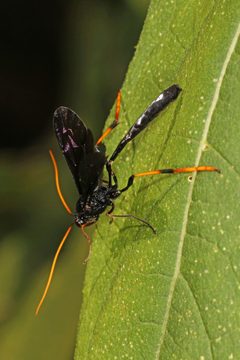
Therion morio is approximately the size of a black and yellow mud dauber (Sceliphron caementarium), and may be a visual mimic of that . The female has a short, spine-like ovipositor that is not used for defense. This distinguishes it from ichneumon wasps with long, thread-like ovipositors. The black and yellow coloration resembles that of stinging , though T. morio cannot sting.
Images
Habitat
Deciduous forest understories; observed in dim light conditions of forest understory.
Distribution
Widespread across North America: from Nova Scotia south to Florida, west to Washington, northwest Nevada, southeast Kansas, and Mexico. Specific records include Edmonton, Gull Lake, Wabamun, Aweme, and Fort Garry in Canada.
Seasonality
active in June; one specimen observed on June 25 in Wisconsin.
Host Associations
- Hyphantria cunea - Fall Webworm caterpillar - primary
- Cycnia inopinatus - Tiger moth caterpillar
- Spilosoma virginica - Virginia Tiger Moth caterpillar
- Estigmene acrea - Saltmarsh Caterpillar
- Lophocampa maculata - Spotted Tiger Moth caterpillar
Life Cycle
are laid inside caterpillar using the ovipositor. The egg has a distinctive shape consisting of an equatorial disc and caudal stalk, resembling an oil lamp, which is thought to attach the egg to the inside of the caterpillar's . The egg partially hatches into a "feeding embryo" stage where the first stage larva feeds through the inner of the egg. The second stage larva emerges from this inner membrane and continues feeding on the caterpillar. The third stage larva is described as a "dirty-looking, whitish " with . The emerges from the 's pupal stage.
Behavior
Females use their ovipositor to pierce caterpillars and inject . The is not defensive and does not use its ovipositor for self-defense. have been observed to pause long enough for photography, suggesting relatively calm .
Ecological Role
Internal of caterpillars, particularly tiger moths ( Erebidae: Arctiinae). Acts as a agent of pest caterpillars including the Fall Webworm.
Human Relevance
Beneficial insect for of pest caterpillars, particularly webworms that damage trees and shrubs.
Similar Taxa
- Sceliphron caementariumVisual mimic; similar size and black-and-yellow coloration, though S. caementarium is a mud dauber with different and nest-building
- other ichneumon wasps with long ovipositorsT. morio has a short spine-like ovipositor, unlike many ichneumonids with conspicuously long, thread-like ovipositors
Misconceptions
The short spine-like ovipositor may appear to be a stinger, but it is used only for laying , not defense. The cannot sting humans.
Sources and further reading
- BugGuide
- Wikipedia
- GBIF taxonomy match
- iNaturalist taxon
- Catalogue of Life
- Bug Eric: July 2011
- Superworms: The Bigger, Brawnier, Hungrier Cousins of Yellow Mealworms
- Study Examines Insects' Role in Plastic Pollution
- Celebrating 10 years of Open Access: Deutsche Entomologische Zeitschrift | Blog
- Two New Beetle Species Identified at NEON Field Site in Hawai'i
- Sitting on top of the world | Blog